
A long-standing code of silence inside the U.N. is coming to an end regarding what is probably the largest genocide ever since the U.N. founding: the genocide committed by the Rwandan Patriotic Front since 1990
 [2]
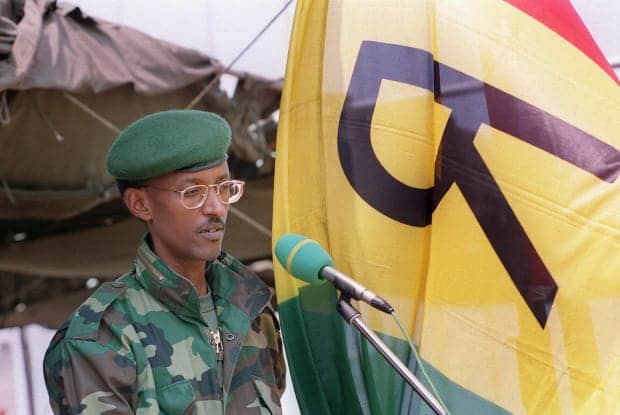
[2]Paul Kagame's RPF, in what James Traub describes in Foreign Policy as a "typical episode," "kidnapped refugees, many of them women and children, and brought them to a camp, allegedly under the pretext of returning them to Rwanda. The refugees were then brought out in small groups. From the report: 'They were bound and their throats were cut or they were killed by hammer blows to the head. Their bodies were then thrown into pits or doused with petrol and burned. The operation was carried out in a methodical manner and lasted at least one month.'"
On Aug. 27, the French daily Le Monde leaked the news that a long report by U.N. High Commissioner for Human Rights Navanethem Pillay [3] of South Africa calls the "systematic, methodical and pre-meditated crimes perpetrated against the Hutu" by the RPF (Rwandan Patriotic Front) in Zaire in 1996-1997 "crimes against humanity, war crimes, and even genocide crimes." The report has not yet been officially released but is already circulating freely.
The victims were "mostly children, women, the elderly and the sick." The investigation looks at the crimes perpetrated in Zaire/Congo throughout the decade 1993-2003. Rwanda is not the only country incriminated. But, according to Le Monde's Jean-Philippe Rémy, the RPF's systematic extermination of Rwandan Hutu refugees and other Congolese Hutu – either by violent force or by systematically blocking food supplies sent especially to them – could be considered "the crux of the report." At any rate, it is clear this extensive report is "devastating, especially for Rwanda," as Christophe Châtelot, in turn, points out in the excellent cover article [4].
Nevertheless, both articles end by reaching the same major erroneous conclusion stated by most of the press articles that have appeared since the report was leaked: the need, they say, to establish a tribunal with jurisdictional authority over these crimes. Not only does such a court already exist but, on Feb. 6, 2008, it already issued arrest warrants against 40 RPF top officials who are allegedly responsible for the crimes in Congo referred to in the new U.N. report.
 [5]
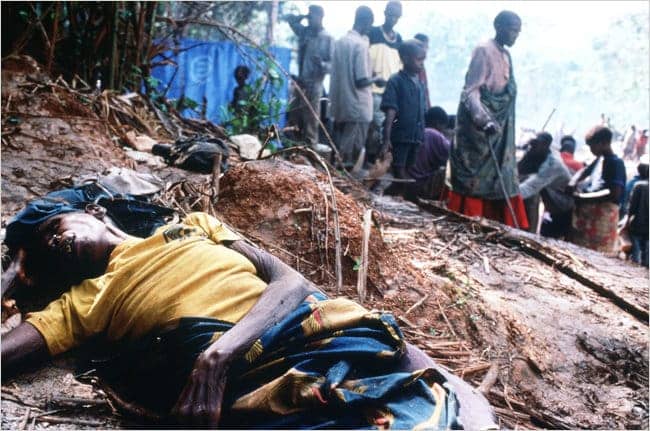
[5]An elderly Rwandan woman in a refugee camp in Congo in 1997 was one of countless victims of Rwandan forces making repeated forays into United Nations-administered camps that, according to the New York Times, housed roughly a million Hutu who had fled the genocide in Rwanda. – Photo: Roger Lemoyne via Getty Images
This court is Spain's Audiencia Nacional (National Court) which, pursuant to the principle of universal justice, possesses full jurisdiction to prosecute this kind of crime. It is by virtue of this principle, for example, that the arrest of Augusto Pinochet was possible in London and that today the Interpol and the SIRENE network are acting on the 40 arrest warrants cited above. Let us also remember that the four Spanish Marist clergymen who were accompanying the Hutu refugees and who had previously condemned internationally this huge slaughter were murdered by the RPF in the Nyamirangwe refugee camp in eastern Congo on Oct. 31, 1996.
In my opinion, there are various other errors in Jean-Philippe Rémy's article. Rémy is much too quick to endorse some interpretations of the motives behind the crimes that hardly match the facts and are at this point almost untenable today. The most outrageous interpretation states that "the Rwandan intervention sought to prevent the refugees from coming together and, led by the 'genocidaires,' rising in revolt to attack Rwanda from their refugee camps at the other side of the border, in the former Zaire. The approach was to empty the entire region. Part of the refugees will return to Rwanda, another will be killed at the camps, others will flee across Zaire where they will be hunted down."
Could a huge mass of human beings consisting mostly of malnourished women, elderly people and children come together and rise in revolt? Besides, shouldn't there be a mention of the other goals the RPF pursued with that slaughter – those that many honest analysts actually rank as the main goals? That is,
• controlling the mineral fields in eastern Zaire, exactly where the "annoying" refugee camps were located; putting an end to the presence and diverting the attention of the international community related to those fields, which could derail the plans these criminals and their powerful allies had in Zaire;
• "correcting" as far as possible the demographic imbalance between Hutu and Tutsi which the RPF viewed as excessive, while at the same time averting a big international scandal under the guise of "hunting down the genocidaires";
• having a submissive and controlled Hutu population, devoid of intellectuals or leaders, repopulate some of the regions in Rwanda that the RPF "operations" had left so deserted that they could potentially become a permanent black mark for the RPF that the international community would readily decry.
Unfortunately, the U.N.'s 14-year silence has had tragic consequences. Thousands of conniving silences have allowed those criminals basking in the bogus moral halo of having allegedly halted the genocide by Hutu extremists in the spring of 1994 to continue causing, with utter impunity, tremendous suffering in Rwanda and Congo!
But the report, whose recent leak has spurred widespread international coverage, could be the beginning of the end for Paul Kagame, who at the time was already head of the RPF and is now also president of Rwanda. True, up to now, it has only been a leak.
But the facts of the report are now in the public domain, above and beyond the sequel of pressures, blackmails and deals about to take place from now on, hushed and behind the scenes of the high political and economic circles of our times, primarily with the purpose of eliminating the word "genocide" from the text. Indeed, at long last more and more analyses are appearing about this situation which some of us had already been analyzing 14 years ago as the incidents themselves were occurring.
Already as early as October 1996 and more pointedly from February 1997 onwards, we condemned the massive massacres of Rwandan and Congolese Hutu being carried out in true genocidal manner, the cremation of tens of thousands of bodies, the extermination through starvation etc. Our documents were signed by some 20 Nobel laureates, as well as by heads of the political groups of the European Parliament.
How could our world leaders not possibly have known of crimes on such scale? How could Spain's Ministry of Foreign Affairs not have known either?
 [6]
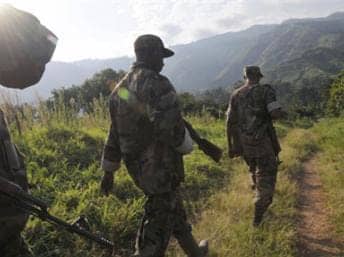
[6]As soon as the U.N. report was leaked, Rwanda described the allegations against its soldiers, such as these shown in the Democratic Republic of Congo, as "outrageous." – Photo: AFP
We ourselves had those documents handed to Bill Clinton and others truly and ultimately responsible for this genocide. In addition to the diplomatic channels, Elie Wiesel, survivor of the Nazi extermination camps and Nobel Peace laureate, promised our colleague Adolfo Pérez Esquivel, a Nobel Peace laureate as well, to personally hand them to Bill Clinton in the meeting he was to have with the president shortly thereafter.
On the other hand, on Feb. 24, 1997, after my 42-day fast at the European Parliament in Brussels, I personally handed these documents to Abel Matutes1 [7], native of Ibiza, who was Spain's minister of foreign affairs at the time. Inocencio Arias, spokesman for the Ministry of Foreign Affairs, was with him at that meeting. I, in turn, was accompanied by Mercé Amer, Socialist regional/autonomic secretary of Mallorca.
Spanish state television TVE vetoed the news of this meeting, where documents of such serious nature and signed by such prominent people were being presented to the minister. The Brussels correspondent of TVE came over to me and told me how badly she personally felt: She had been following our fast and admired what we were doing together with Commissioner Emma Bonino, but she added that the news had unfortunately been vetoed and that, much to her regret, she wouldn't be able to film.2 [8]
As it was, heightened tension reigned at the meeting due to the assassination of three Spanish volunteers of Médicos del Mundo merely a few days before. We now know that the RPF perpetrated this crime, even though the strong propaganda machine of the international godfathers of this criminal organization had managed within hours to get the world media to attribute this triple murder to extremist Hutu once again.
Indeed, it's so true that the U.N. report doesn't make any major revelations that even now, after its leak, I will hardly be making any changes in the second edition of my book, "África, la madre ultrajada" ("Africa, The Violated Mother"). The news is not the fact that the RPF perpetrated a genocide on such a large scale.3 [9]
In this genocide, the count of ethnic Hutu, both Rwandan and Congolese, violently eliminated by the RPF since 1990 should be estimated at hundreds of thousands at least. The scale of this genocide is even much larger if we consider the millions of victims, not only Hutu but also from other Bantu ethnic groups in Congo – or simply "not Hima-Tutsi," as the racist RPF elite calls them.
They died not only through violent force but primarily due to starvation and other reasons related to the aggressions inflicted on Zaire/Congo by Rwanda, Uganda and Burundi in their genocidal attempt to establish in that region an empire controlled by Hima-Tutsi clans.
The High Commissioner for Human Rights has merely investigated the tip of the iceberg of this genocide, since it has looked at merely 600 violent incidents only in Congo and only from 1993 to 2003. It is a genocide in which already as early as 1997 – that is, one year before the second and deadliest invasion – the report of the U.N. team headed by the Chilean Roberto Garretón [10] documented the investigation of around 40 locations in Congo and put the death count at up to 100,000.
A hint of the scale of this genocide can be found in a report by the International Rescue Committee which estimates 5.4 million victims in Congo until 1997 – in excess of the normal mortality figures – due to causes related to the aggressions staged there.
That's not the news. The real news is something else: namely, that in a move that breaks the code of silence that has reigned within the U.N. for too many years, the High Commissioner for Human Rights reveals that the U.N. Security Council and U.N. Secretary-General Ban Ki-moon and Kofi Annan before him – the same parties who less than a year ago accused some of us of financing the genocidaires – have actually spent more than a decade covering up the continuous genocide carried out by the RPF from Oct. 1, 1990, until today, which probably constitutes the largest one since the U.N. was founded!
Jean-Philippe Rémy's article cited above is entitled, precisely, "A Long Set of Obstacles to Justice and Truth." As Glen Ford well said in the analysis he wrote shortly after the leak of the report, "Rwandan Crisis Could Expose U.S. Role in Congo Genocide [11],"4 [12] we are facing "a political crisis that threatens to disrupt Washington's plans to dominate the continent.
"At stake is not only the reputation of Rwandan President Paul Kagame, an alumnus of the U.S. Army Command and General Staff College in Fort Leavenworth, Kansas, but the larger American strategy for militarization of Africa and exploitation of her riches. …
 [13]
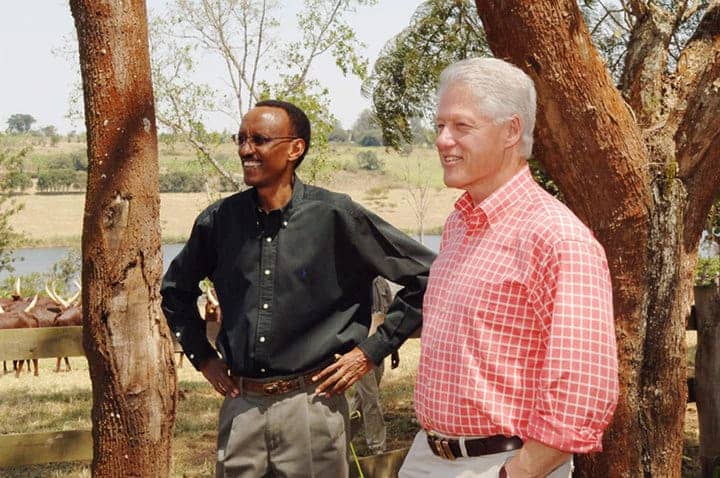
[13]Former U.S. President Bill Clinton visits Rwandan President Paul Kagame on Kagame's farm in Muhazi."Carnage on such a scale could not have occurred were it not for the connivance of the United States, which has nurtured Kagame at every juncture. …
"The leaked U.N. report cannot be put back in the bottle. Kagame, who labels all critics 'genocidaires' or apologists for genocide, is exposed as 'the greatest mass killer on the face of the earth, today,' as described by Edward S. Herman, co-author of 'The Politics of Genocide.' Kagame's mentors and funders in the U.S. government, who aided and abetted his genocide in Congo, must be held equally accountable – if not more so, since United States corporations derive the greatest benefit from Congo's blood minerals, and the U.S. military gains the most advantage from Rwandan and Ugandan services as mercenaries at America's beck and call in Africa."
The Rwandan government has reacted by making virulent threats, and the High Commissioner has postponed the report's release until Oct. 1. The following weeks will be marked by a fierce struggle to delete the word "genocide" from the report, since this classification would require the immediate intervention of the international community.
Nevertheless, something new is happening in this great conflict as a significant movement of pieces appears to be taking place on the board. Another fact also evidences this: The important Gersony report[14]5 [15], up until recently eerily unavailable, suddenly surfaced this past Sept. 7. It is another honest report, done as early as 1994, but in this case by the U.N. High Commissioner for Refugees.
The report has remained suppressed since then and high-ranked U.N. officials even denied it had ever existed. It documents the systematic ethnic cleansing of Hutu, genocidal in nature, carried out by the RPF in the Rwandan interior6 [16] during 1994.
The investigative team led by Gersony examined the assassination of some 30,000 Hutu by the RPF, but only looked at crimes perpetrated during a two-month period and in merely three prefectures. However, similar to the recent report by the U.N. High Commissioner for Human Rights, "[T]he massacres condemned in the Gersony report represented only the visible tip of a monumental iceberg consisting of hundreds of thousands of victims butchered by RPF troops since October 1, 1990 in the areas occupied by the military."
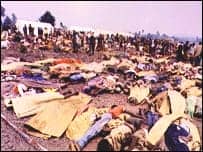 [17]
[17]Rwandan refugees massacred in a camp in DR Congo. – Photo: survivorsnetoworks.blogspot.com
Former Rwandan Foreign Minister Jean-Marie Vianney Ndagijimana makes this statement in his excellent book recently published, "Paul Kagame a sacrifié les tutsi"7 [18] ("Paul Kagame has sacrificed the Tutsi"). Upon receiving a photocopy of the Gersony report, I asked him to confirm its authenticity, which he did, although he added that an annex is missing.
Jean-Marie Vianney Ndagijimana, of mixed Hutu-Tutsi descent, had testified in the lawsuit we filed at the Spanish National Court and is now the person responsible in France for the Intra-Rwandan Dialogue we have been sponsoring since 2004. This extraordinary Rwandan witnessed first hand the wheeling and dealing behind the suppression of the compromising report.
The entire horse-trading took place in the U.S. Department of State in early October 1994 between Hutu Rwandan President Pasteur Bizimungu from the RPF – albeit always under the watchful eye of "consultant" Charles Muligande – and Assistant Secretary of State for African Affairs George Moose. Pasteur Bizimungu had actually gone to argue that "a 'post- genocide' was going on, while at the same time, the RPF military was getting away with massacring entire groups of people without the international community expressing any disapproval."
Seeing George Moose's excessively understanding reaction to the Rwandan president's case, Jean-Marie Vianney Ndagijimana inferred what was going to happen with the Gersony report, as it indeed turned out: That meeting "sealed the fate of the Gersony report once and for all."
Vianney Ndagijimana resigned from his post as minister a few weeks later "in order not to be an accomplice of the ethnic cleansing practises" and went into exile "to bear witness of this silent genocide, as disgraceful and reprehensible as the Tutsi genocide, and to publicly condemn it worldwide."
Others didn't act with such ethics and integrity: Kofi Annan, U.N. Under-Secretary-General for Peacekeeping at the time; Shahryar Khan, U.N. Secretary-General's Special Representative to Rwanda; Timothy Wirth, Undersecretary for Global Affairs, including matters of human rights; Brian Atwood, director for Africa of USAID, which had financed the investigation aimed at determining whether the interior of Rwanda was equipped for the return of Hutu refugees.
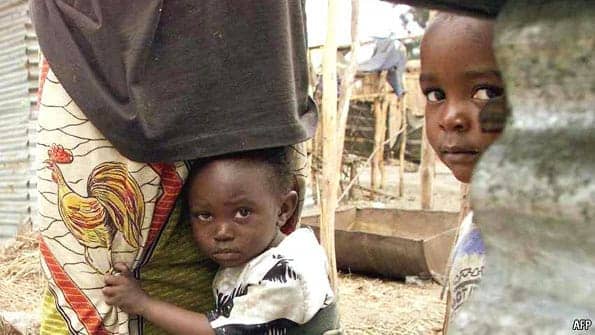 [19]
[19]"Kagame's army and allied militias knowingly committed wholesale killings of Hutus, often 'mostly children, women, old and ill people.' Indeed, the (leaked U.N.) report goes on to say that some of the attacks could have amounted to a genocide," according to The Economist.
Prior to the meeting of the Rwandan president with the assistant secretary of state, all individuals cited above had met several times with Jean-Marie Vianney Ndagijimana, on one occasion with Robert Gersony present. The former minister described that some of them had spoken very harshly to the Rwandan president. But the fact is that the Gersony report was suppressed and none of the people mentioned above ever condemned the terrible ethnic cleansing that had taken place nor the cover-up of such an important piece of evidence.
Kofi Annan showed the report to Jean-Marie Vianney Ndagijimana and even let him read it but refused to give him a copy. Thus, already back then the future U.N. Secretary-General knew very well that the theory of a double genocide was not wrong. And it is certainly far from being a form of negationism and hence a crime, as Ramón Lobo has dared state in the Spanish daily El País.
Good heavens! – daring to label as criminals Judge Fernando Andreu, who accuses Kagame and 40 top officials from the RPF of committing crimes of genocide, and now High Commissioner Navi Pillay, who signs the recent U.N. report!
Yet this journalist is not alone. Many are the know-it-all analysts, who have no qualms writing about any matter of the moment, even about conflicts as serious and complex as this one – or who, rather, have only listened to the powerful rhetoric of the Manichean official doctrine that resolutely maintains that the story of the genocide is one of genocidaires on the one side and noble liberators on the other.
On the contrary, Kofi Annan and current Secretary-General Ban Ki-moon know that the accusations made by Judge Fernando Andreu Merelles are well-founded: "crimes of genocide, crimes against humanity, crimes against individuals and property protected in the event of armed conflict, membership in a terrorist organization, terrorist acts, pillage of natural resources and the assassination of nine Spanish nationals."
As we suspected and made public at the time, Ban Ki-moon's efforts to bill genocidaire Paul Kagame as the superhero of the struggle against hunger and other evils plaguing our world have possibly infuriated and mobilized the group of people with integrity still to be found at that big organization which is the U.N. Let's just hope that Navi Pillay doesn't end up sacked for the same reasons for which others were ousted in former times: U.N. Secretary-General Boutros Boutros Ghali, ICTR (International Criminal Tribunal for Rwanda) prosecutor Carla del Ponte, among many others.
Jean-Marie Vianney Ndagijimana spent years wondering why the secretary-general had decided to embargo the Gersony report. In a meeting at the headquarters of the Tribunal of The Hague in November 2002, Carla del Ponte confirmed to him what he had been suspecting all along. The former minister writes in his book:
"[W]ithout avoiding [the subject], she acknowledged that this report was under the jurisdiction of the ICTR and that it should have ordinarily been included in the dossier of crimes perpetrated in Rwanda in 1994 by one of the warring parties. Unfortunately, she added, all efforts to obtain the Gersony report as well as various other U.N. reports providing evidence of the crimes committed by the RPF had proved to no avail up until then. She continued: 'I sent an official request to the U.N. High Commissioner for Human Rights, Ms Ogata,8 [20] asking her for that report, but I ran into a wall. …
"Carla del Ponte admitted that, in despair, she also requested that Robert Gersony be heard by the ICTR prosecutor – again to no avail. Once again the U.S. government expressed its opposition, ruling it inadmissible! As we can see, Paul Kagame enjoys the protection of one or more of the superpowers which have a veto right [in the U.N. Security Council] and are able to dictate its agenda at the heart of the U.N. organizations. You don't need to be a wizard to know that the Clinton administration, surely embarrassed and ridden with guilt for having opposed the deployment of U.N. troops to stop the genocide, has preferred focusing on the bottom line of the massacres of hundreds of thousands of innocent Hutu civilians."9 [21]
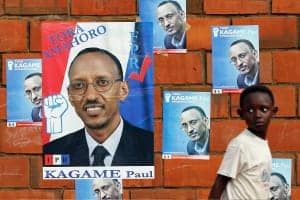 [22]
[22]A boy in Rwanda passes election posters a few days before the presidential election on Aug. 9, 2010. "Rwandan President Paul Kagame was reelected with 93 percent of the vote in the country's elections earlier this month, but there were widespread reports that journalists and opposition politicians had been imprisoned or killed. Now a leaked U.N. report suggests that Rwandan troops may have committed war crimes and massacred tens of thousands of people in the late 1990s," reported Newsweek on Aug. 27, the day the report was leaked. – Photo: Marc Hofer, AP
Let's hope that the time has come; let us hope that those who pull the strings realize that sustaining this sham, this disgraceful impunity, is untenable at this point. We firmly believe that those of us outside the U.N. should help enable those upright individuals within the organization to keep it from serving the interests of the Trilateral Commission10 [23] and of other powerful and elitist groups instead of serving the interests of peoples. In this respect, we share the views expressed by Adolfo Pérez Esquivel and Mallorquinian Sen. Pere Sampol, who was vice-president of the government of the Balearic Islands and knows well the mazes of political intrigue.
At any rate, what I stated in the preface of my book might begin to prove true: "When this monumental tragedy gets the coverage it deserves in the big media, it will become one of the most embarrassing chapters in the annals of the United Nations, of the entire Western world, in general, and in particular, of José Luís Rodríguez Zapatero's Socialist government."
Spain's prime minister, however, may still be able to change fate. He just needs to continue on the path he started by not meeting with Paul Kagame in Madrid; he just needs to refuse to co-chair together with this criminal the Advocacy Group of the Millenium Development Goals. He just needs to cooperate with Spain's Audiencia Nacional on the legal proceedings against the 40 top officials of the RPF. He just needs to meet – at long last – with the families of the nine Spanish victims.
Juan Carrera of the International Forum for the Truth and Justice in the Great Lakes Region, a Nobel Prize nominee, has campaigned for years against impunity there. In 1996, he walked over 600 miles to Brussels and a year later went on a 42-day hunger strike in front of the European Union Council headquarters to persuade the EU to stop the atrocities in the DR Congo. With Spanish Sen. Sampol he successfully pushed for a lawsuit in Spain against members of the Rwandan government on behalf of Spanish victims who died in Rwanda after the genocide. The lawsuit resulted in the indictments of 40 of Rwanda's current top and former military officials for genocide crimes and other human rights abuses. He can be reached by emailing info@stopimpunityinrwanda.org [24].He is currently one of the 12 Spanish members of the Trilateral Commission. [↩ [26]]
- He is currently one of the 12 Spanish members of the Trilateral Commission. [↩ [26]]
- The media, however, were allowed the photo-op de rigueur of that meeting. See Chapter 2 ofwww.pangea.org/olivar [27]. [↩ [28]]
- In the article mentioned above, Jean-Philippe Rémy comments on the statements made by one of the initiators of the report: "[T]here have been too many cases of massacres which have been concealed to the eyes of outside witnesses … These 'concealed elements' as well as those 'things never said should have been brought to light a long time ago,' the same source said. 'It was well-known that this was a huge thing,' the person added." [↩ [29]]
- Black Agenda Report, translated for Rebelión by Mariola and Jesús María García Pedrajas. [↩ [30]]
- It can be found in "C:\Unearthed 'Gersony Report' the U.N. said it never existed [31]" at The Proxy Lake. – mht [↩ [32]]
- The RPF first carried out the ethnic cleansing in the areas they were seizing in the spring of 1994, the same spring when the Hutu extremists were carrying out their own genocide of the Tutsi in the areas under their control. Primarily, however, it was the cleansing carried out by the RPF after its full-fledged victory on July 18. [↩ [33]]
- Editorial La Pagaie, pages 134-141. [↩ [34]]
- As I pointed out in my book, Sadako Ogata is also a member of the Trilateral Commission. [↩ [35]]
- Pages 140-141. [↩ [36]]
- Almost everyone who has played a key political role in the Rwandan conflict has been or still is a member of the Trilateral Commission and/or has attended or attends the meetings of the Bilderberg Group: Bill Clinton, Tony Blair, Margaret Thatcher, Kofi Annan, Madeleine Albright, Bill Richardson, Sadako Ogata, Susan Rice, Raymond Chrétien, Jean Chrétien, Hillary Clinton or Bernard Kouchner. This list does not take into account the higher number of members of the Foreign Relations Council or of the Royal Institute of International Affairs. [↩ [37]]URLs in this post:[1] [Translate]: http://sfbayview.comjavascript:show_translate_popup[3] report by U.N. High Commissioner for Human Rights Navanethem Pillay:http://www.kambale.com/pdf/drc_un_report_final_june2010.pdf[4] cover article: http://www.lemonde.fr/afrique/article/2010/08/26/l-acte-d-accusation-de-dix-ans-de-crimes-au-congo-rdc_1402933_3212.html[7] 1: #footnote_0_14132[8] 2: #footnote_1_14132[9] 3: #footnote_2_14132[10] report of the U.N. team headed by the Chilean Roberto Garretón:http://www.unhchr.ch/Huridocda/Huridoca.nsf/0811fcbd0b9f6bd58025667300306dea/8e3dbacbae51ce60802567460034073d?OpenDocument#IIB[11] Rwandan Crisis Could Expose U.S. Role in Congo Genocide:http://www.blackagendareport.com/?q=content/rwanda-crisis-could-expose-us-role-congo-genocide[12] 4: #footnote_3_14132[14] Gersony report: http://friendsofthecongo.org/pdf/gersony_report.pdf[15] 5: #footnote_4_14132[16] 6: #footnote_5_14132[18] 7: #footnote_6_14132[19] Image: http://sfbayview.com/wp-content/uploads/2010/09/Rwandan-Hutu-refugees-in-Congo-camp2.jpg[20] 8: #footnote_7_14132[21] 9: #footnote_8_14132[22] Image: http://sfbayview.com/wp-content/uploads/2010/09/Kagame-elections-posters-0810-by-Marc-Hofer-AP.jpg[23] 10: #footnote_9_14132[26] ↩: #identifier_0_14132[28] ↩: #identifier_1_14132[29] ↩: #identifier_2_14132[30] ↩: #identifier_3_14132[31] C:\Unearthed 'Gersony Report' the U.N. said it never existed:http://www.theproxylake.com/2010/09/unearthed-gersony-report/[32] ↩: #identifier_4_14132[33] ↩: #identifier_5_14132[34] ↩: #identifier_6_14132[35] ↩: #identifier_7_14132[36] ↩: #identifier_8_14132[37] ↩: #identifier_9_14132[38] Merchants of death: Exposing the corporate-financed holocaust in Africa:http://sfbayview.com/2008/merchants-of-death-exposing-the-corporate-financed-holocaust-in-africa/[39] Africom's covert war in Sudan: http://sfbayview.com/2009/africom%e2%80%99s-covert-war-in-sudan/[40] The Rwandan Patriotic Front's bloody record and the history of U.N. cover-ups:http://sfbayview.com/2010/the-rwandan-patriotic-front%e2%80%99s-bloody-record-and-the-history-of-u-n-cover-ups/[41] Congo's quest for liberation continues: http://sfbayview.com/2010/congos-quest-for-liberation-continues/[42] Cynthia McKinney: Rwanda, release Professor Peter Erlinder:http://sfbayview.com/2010/cynthia-mckinney-rwanda-release-professor-peter-erlinder/

__._,_.___
Posted by: Samuel Desire <sam4des@yahoo.com>
| Reply via web post | • | Reply to sender | • | Reply to group | • | Start a New Topic | • | Messages in this topic (1) |
----------------------------------------------------------------------------------------------------------
The hate of men will pass, and dictators die, and the power they took from the people will return to the people. And so long as men die, liberty will never perish.
I have loved justice and hated iniquity: therefore I die in exile.
The price good men pay for indifference to public affairs is to be ruled by evil men.
When the white man came we had the land and they had the bibles; now they have the land and we have the bibles.
----------------------------------------------------------------------------------------------------------
The Voice of the Poor, the Weak and Powerless.
-----------------------------------------------------------
Post message: AfricaRealities@yahoogroups.com
Subscribe: AfricaRealities-subscribe@yahoogroups.com
Unsubscribe: AfricaRealities-unsubscribe@yahoogroups.com
List owner: AfricaRealities-owner@yahoogroups.com
__________________________________________________________________
Please consider the environment before printing this email or any attachments.
---------------------------------------------------------------------------------------------------------------------
-http://www.africarealities.com/
-https://www.facebook.com/africarealities
-----------------------------------------------------------------------------------------
-New International Scholarships opportunities: http://www.scholarshipsgate.com
http://www.primescholarships.com
-----------------------------------------------------------------------------------------------
Find Friends in Africa:
- www.africanaffection.com
- www.datinginafrica.com
https://www.facebook.com/onlinedatinginafrica
The hate of men will pass, and dictators die, and the power they took from the people will return to the people. And so long as men die, liberty will never perish.
I have loved justice and hated iniquity: therefore I die in exile.
The price good men pay for indifference to public affairs is to be ruled by evil men.
When the white man came we had the land and they had the bibles; now they have the land and we have the bibles.
----------------------------------------------------------------------------------------------------------
The Voice of the Poor, the Weak and Powerless.
-----------------------------------------------------------
Post message: AfricaRealities@yahoogroups.com
Subscribe: AfricaRealities-subscribe@yahoogroups.com
Unsubscribe: AfricaRealities-unsubscribe@yahoogroups.com
List owner: AfricaRealities-owner@yahoogroups.com
__________________________________________________________________
Please consider the environment before printing this email or any attachments.
---------------------------------------------------------------------------------------------------------------------
-http://www.africarealities.com/
-https://www.facebook.com/africarealities
-----------------------------------------------------------------------------------------
-New International Scholarships opportunities: http://www.scholarshipsgate.com
http://www.primescholarships.com
-----------------------------------------------------------------------------------------------
Find Friends in Africa:
- www.africanaffection.com
- www.datinginafrica.com
https://www.facebook.com/onlinedatinginafrica

.


__,_._,___

Comments
Post a Comment