
About Africa Realities Media

Rwanda: Cessation clause or ongoing genocide against Hutu
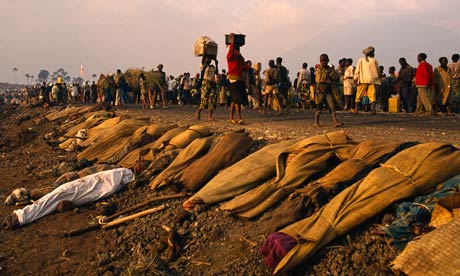

Cessation clause or ongoing genocide against Hutu

hutu-refugees-at-un-s-gom-006The terror I fled is still around. The deadline for the cessation clause of the refugee status for Rwandans who fled their country between 1959 and 1998 is getting closer: June 30th, 2013. If I cannot return yet, it is not my fault. 
ABC News writes that, "some [Rwandan] refugees are taking precautionary measures such as avoiding their beds at night." I don't really go to sleep these days," said Ephraim Rutabingwa, a Hutu refugee [living in the Nakivale camp in Uganda.]" 
In the Democratic Republic of Congo, their youth has been spent in the forests. They are between 100, 000 and 150,000 human beings that the world has continued and persists to ignore. They survive living in the two Kivu provinces. If it hadn't been by the protection provided by FDLR, they would've been completely exterminated as their existence is deliberately obscured. Genocide against their Hutu community in the Great Lakes region which started on October 1st, 1990 is ongoing.
In 1994, the majority of them were only 10 years old or even less. Others were born after in the bush. But they are today men, women, and children living in inhuman conditions; however despite that, what their experience has taught them is that Rwanda led by President Paul Kagame is not yet safe. For their survival against his direct and commissioned attacks by local militias, they have to be constantly alert to defend themselves. They are survivors of the genocide that the Rwandan President and his funded local forces in the Kivus have committed and continue to perpetuate against them.
As the deadline of the announced cessation clause looms, two important international conferences on the subject were held in Belgium and South Africa respectively from 19 to 20/4/13 and 18/4/13.
The first meeting brought together a range of Rwandan political organizations and those from the civil society particularly operating outside the country and interested in the protection of refugees.
The second meeting involved eleven African countries and UNHCR Africa Regional Office: Burundi, the Democratic Republic of the Congo, Kenya, Malawi, Mozambique, the Republic of the Congo, Rwanda, South Africa, Uganda, Zambia, and Zimbabwe, all concerned with the problem posed by Rwandan refugees.
In the address of the South African Home Affairs Minister, Naledi Pandor, during UNHCR meeting on the Implementation of the Comprehensive Durable Solutions Strategy, explained that,
"The position of the UNHCR in relation to Rwanda has created anguish and uncertainty among the refugee community in South Africa. As such it appears as though much work requires to be done on the part of the UNHCR to clearly articulate the reasons for the cessation declaration among the affected refugee community. Much work requires to be done and the looming date for cessation, 30 June 2013, merely serves to add to the general anxiety among the affected communities. One pertinent question that has arisen with my own interaction with representatives of the Rwandan Refugee community is the declaration of cessation is not to be applied to Rwandans who fled the country after 1998. This they point out is a tacit admission that there exist conditions in Rwanda that would force people to seek asylum."
With cessation of refugee status – the issue that attracted most debate – it became clear during the meeting that not all states were ready to invoke a general application of the cessation clauses by 30 June 2013 in line with the strategy recommendation. Others underscored that for various legal, access, logistical, practical or other considerations, they are not in a position to apply the cessation clauses by the end of June, or will in any case not do so. Others specified that for the time being they will concentrate on taking forward other components of the strategy, namely voluntary repatriation and local integration.
Whether in those cases in which one or more States move ahead with the invocation of the cessation clauses or continue to consider applying them, it is clear that this will be done on a "case by case" basis or by "differentiated" approach.
Professor Charles Kambanda considers the Rwandan refugee issue as being wrongly addressed.
"The whole move is misguided. Kagame knows so well the reasons why people go into exile. He knows that the factors that led his parents into exile are a reality in Rwanda under his leadership. … refugees, especially refugees in refugee camps are a "ready-made" source of man power for a military attack on his dictatorship – the same way he used Tutsi refugee camps for his military victory- his major concern is to demolish all Hutu refugee camps in different countries. Kagame counts on use of force and violence than institutionalizing values. …his approach is not sustainable."
The cessation clause appears to pursue genocide against Hutus. The latter is implemented by the Rwandan government of President Paul Kagame and translated through several national policies: dispossession of property, discriminating practices in education, judiciary, health, and farming and employment sectors, and denial of political space. After 23 years of a combination of brutal and gradual extermination practices of the Hutu community both in Rwanda and the region, the question arises of knowing how strong are its members' willingness and resilience to resist their extinction as a distinct and vibrant social and cultural entity for the good of future generations.

Comments

  1. I recently came across your blog and have been reading along. I thought I would leave my first
    comment. I dont know what to say except that I have enjoyed reading. Nice blog.
    I will keep visiting this blog very often.
    umrah jeddah flights

    ReplyDelete

Post a Comment

Support Our Work Now !

Africa Realities Media is independent. Your support helps us expose injustice, challenge silence and produce evidence-based analysis on Africa and the Great Lakes Region.
Africa Realities Media offre un espace aux écrivains, chercheurs, experts, activistes, voix communautaires, militants, analystes et personnes ayant une expérience vécue qui souhaitent contribuer à des contenus réfléchis, responsables et courageux sur les changements nécessaires dans la région des Grands Lacs, ainsi que sur les réalités politiques, économiques, culturelles et sociales africaines souvent ignorées, minimisées ou mal représentées. Nos articles et vidéos visent à ouvrir le débat, renforcer la sensibilisation, encourager la pensée critique et favoriser une réflexion plus profonde sur les réalités vécues par les populations africaines. Nous voulons aider les peuples de la région des Grands Lacs à mieux comprendre leurs droits, notamment leurs droits humains, leur droit au développement, leur droit à la dignité, à la sécurité, au bien-être et à une vie meilleure. À travers nos contenus, nous cherchons également à rappeler aux décideurs, aux institutions publiques, aux acteurs régionaux et internationaux, ainsi qu’aux responsables politiques, leur devoir de transparence, de responsabilité et de redevabilité envers les populations qu’ils prétendent servir. Notre objectif est de contribuer à une culture de vérité, de justice, de participation citoyenne et de protection égale pour tous les peuples africains.

Why We Exist

Many abuses facing African people are committed by African states, ruling elites, armed groups, military forces and security services. But these abuses are often sustained by international silence, Western lobbying, trade interests, migration deals, mineral access, diplomatic partnerships and unequal global accountability. Africa Realities Media exposes that system.

Lived Experience Matters

Survivors, displaced communities, refugees, families affected by repression, journalists, activists, women, young people and diaspora voices are not passive subjects. They are knowledge holders. Their experiences must shape policy, advocacy, journalism and public debate. The people closest to injustice are often closest to the solutions.

Our Principle

Africa Realities Media is rooted in one principle: African lives deserve equal truth, equal justice and equal protection.

Popular Posts

Pourquoi la politique africaine du Président Macron, centrée sur le Rwanda, n’a pas porté ses fruits

Le Président Emmanuel Macron a passé neuf ans à faire la paix avec Paul Kagame et, pendant ce temps, la France a perdu presque tout le reste de ce qu’elle avait en Afrique. Les vies africaines ne valent pas moins. Les morts africaines ne sont pas normales. Les intérêts occidentaux ne doivent jamais devenir un permis de tuer des Africains. Introduction : une réconciliation bâtie sur une seule relation Lorsqu’Emmanuel Macron arrive à l’Élysée en mai 2017, il promet de refonder la relation entre la France et l’Afrique. Six mois plus tard, devant les étudiants de Ouagadougou, il annonce à tout un continent la fin de la Françafrique. Neuf ans après, le bilan est sans appel. La France n’a plus aucune base militaire permanente en Afrique de l’Ouest ni en Afrique centrale, trois gouvernements du Sahel boycottent ses sommets, et les manifestations antifrançaises font désormais partie du paysage politique, de Bamako à Kinshasa. Au cœur de la diplomatie africaine d’Emmanuel Macro...

Disgusting Reports On How African & Indonesian Women Dry Their VAGINA With Sand & Bleach To Make Sex Pleasurable For Men

Share 64   3   Share 3   1   Tweet 64 Women mostly in South and Central Africa, and Indonesia are carrying out a horrific practice known as  ‘ Dry Sex’  which not only leaves them in pain but at increased risk of HIV.  Dailymail  Report Dry sex is a practice where women reduce moisture in their vaginas in order to make intercourse more pleasurable for men. This according to reports can lead to cuts, sores and inflammation in the vagina, and increases the chance of a condom breaking. These factors in turn increase the chance of the women contracting sexually transmitted diseases including HIV. It is borne out of a cultural belief that men find sex more pleasurable if a woman’s vagina is dry, and that men will reject women whose vaginas have been  ‘stretched out’  by sex. To achieve dryness, women insert, chalk, sand, pulverized rock, herbs, paper or sponges before sex, according to journalist Ms Syfret, who has reported o...

Why Kagame Defies US Sanctions: Minerals, Western Partners and the Roots of Rwanda’s Occupation of Eastern Congo

Why Kagame Defies US Sanctions: Minerals, Western Partners and the Roots of Rwanda’s Occupation of Eastern Congo Washington has now sanctioned the ministry that commands Rwanda’s army. Twenty months of escalating measures have not moved Rwandan troops out of eastern Congo, and the people of North and South Kivu are paying for every month of delay. African lives are not worth less. African deaths are not normal. Western interests must never become a licence to kill African people. Introduction: Sanctioned Again, Still in Congo On 28 October 2026 the US Treasury sanctioned Rwanda’s Ministry of Defence and Zigama Credit and Savings Society, the financial institution that serves Rwanda’s security services, for supporting the M23 rebellion in eastern Democratic Republic of Congo (DRC). Treasury Secretary Scott Bessent’s demand was direct: “Rwanda must halt its support for M23 and withdraw its troops from eastern DRC.” The measures are the most serious the United States has t...

Why President Macron's Rwanda-Based Africa Policy Failed to Deliver

President Emmanuel Macron spent nine years making peace with Paul Kagame, and in that time France lost almost everything else it had in Africa. African lives are not worth less. African deaths are not normal. Western interests must never become a licence to kill African people. Introduction: A Reset Built on One Relationship When Emmanuel Macron took office in May 2017, he promised to rebuild France's relationship with Africa. Six months later, in a speech to students in Ouagadougou, he told a continent that the age of Françafrique was over. Nine years on, the results are plain. France has no permanent military base left in West or Central Africa, three Sahel governments refuse to attend its summits, and anti-French protest has become a feature of politics from Bamako to Kinshasa. At the centre of Macron's Africa diplomacy stood one country: Rwanda. After decades of bitter accusations from Paul Kagame and his former foreign minister Louise Mushikiwabo over Fra...

Lettre ouverte à Emmanuel Macron après l’humiliation infligée par Kagame à Phnom Penh

Monsieur le Président, vous avez récolté ce que vous avez semé ! Résumé Le sommet de Phnom Penh restera marqué par l’humiliation, le manque de respect et le manque de considération que vous avez subis de la part d’un dirigeant que vous avez courtisé avec obsession et soutenu sans condition, pour des raisons jamais expliquées. Depuis près de dix ans, votre stratégie repose sur l’idée que traiter avec le Rwanda, c’était traiter avec l’Afrique, et vous avez négligé la RDC, le Burundi et le Sahel. Vous vous êtes rendu au Rwanda, mais pas au Burundi, son voisin, qui partage une composition ethnique, une histoire et des défis de développement comparables. Vous avez manqué de courage pour affronter le président Kagame sur les violations des droits humains et les crimes de guerre présumés au Rwanda, sur l’occupation de l’est du Congo et les tueries de civils congolais et de réfugiés hutu, ou sur l’arrogance et le mépris qu’il manifeste envers d’autres dirigeants, dont vous. Et vous avez...

Comment les relations diplomatiques entre le Rwanda et la France ont contribué au déclin de la France en Afrique

Cet article analyse la manière dont la relation diplomatique entre la France et le Rwanda a contribué au recul de l'influence française sur le continent africain. De protectrice, Paris est devenue pénitente face à Kigali. Cette posture de déférence se traduit aujourd'hui par le recours aux troupes rwandaises pour protéger des intérêts gaziers français, par l'approfondissement des liens militaires alors même que les États-Unis sanctionnent l'armée rwandaise, son ministère de la Défense et une raffinerie d'or de Kigali, et par un silence obstiné sur le bilan démocratique du Rwanda. Ce silence frappe d'autant plus que la France a imposé le multipartisme au Rwanda en 1990, soutenu des sanctions et une résolution du Conseil de sécurité contre le Burundi pour un troisième mandat présidentiel, et condamne aujourd'hui les régimes militaires du Sahel. Le symbole le plus dommageable de ce revirement reste le soutien de Paris à la Rwandaise Louise Mushikiwabo pou...

Can Kagame Outlast US Sanctions? Rwanda’s Five Bets on the DRC War

Can Kagame Outlast US Sanctions? Rwanda’s Five Bets on the DRC War Waiting for a New Policy: Are Kagame’s Hopes of Outlasting the Sanctions Realistic? Kigali’s strategy in eastern Congo now rests on a single assumption: that Washington, Brussels and the UN will tire before Rwanda does. The evidence suggests some of those hopes are sound, and others are already failing. African lives are not worth less. African deaths are not normal. Western interests must never become a licence to kill African people. Introduction: The Strategy of Waiting On 28 October 2026 the US Treasury sanctioned Rwanda’s Ministry of Defence and Zigama Credit and Savings Society, a financial institution serving Rwanda’s security services, under Executive Order 13413, as amended, citing their roles in facilitating the Rwanda Defence Force’s activities and support for M23 in eastern Congo. They are the latest in a series of measures that now cover the Rwanda Defence Force (RDF), four of its senior...

How Rwanda-France Diplomatic Relations Contributed to France's Decline in Africa

This article examines how France's diplomatic relationship with Rwanda has contributed to the decline of French influence across Africa. Paris has moved from patron to penitent with Kigali, adopting a deferential posture that now includes relying on Rwandan troops to protect French gas interests, deepening military ties while the United States sanctions Rwanda's army, defence ministry and a Kigali gold refinery, and staying silent on Rwanda's democratic record. This silence stands out because France pressed multiparty democracy on Rwanda in 1990, backed sanctions and a Security Council resolution against Burundi over a third presidential term, and condemns military rulers in the Sahel today. The most damaging symbol of this shift was France's decision to back Rwanda's Louise Mushikiwabo to lead the Francophonie, even though her country had moved away from French. In the view of many critics, these choices told French-speaking states that speaking French and st...

An Open Letter to Macron After Kagame's Humiliation in Phnom Penh

Mr President, You Reaped What You Sowed! Summary The Phnom Penh summit will be remembered for the humiliation, disrespect and lack of consideration you suffered at the hands of a leader you courted obsessively and supported unconditionally, for reasons that have never been explained. For almost ten years your strategy rested on the idea that dealing with Rwanda meant dealing with Africa, and you neglected the DRC, Burundi and the Sahel. You visited Rwanda but not Burundi, its neighbour, which shares a similar ethnic make-up, history and development challenges. You lacked the courage to confront President Kagame over human rights abuses and alleged war crimes in Rwanda, over the occupation of eastern Congo and the killing of Congolese civilians and Hutu refugees there, or over the arrogance and disrespect he shows towards other leaders, including you. And you let Mrs Mushikiwabo run the Francophonie like a private company in which she held all the shares. In 2018 Paris handed the...

Fw: [uRwanda_rwacu] US, UK Want Review of “1994 Genocide Against the Tutsi” Appellation – THE CHRONICLES | Rwanda

  https://www.chronicles.rw/2020/05/26/us-uk-want-review-of-1994-genocide-against-the-tutsi-appellation/ US, UK Want Review of "1994 Genocide Against the Tutsi" Appellation Chronicles Team UK Prime Minister Boris Johnson and US President Donald Trump during the latter's visit in London In a rare shift of policy, both the United States and the United Kingdom are fiercely opposed to referencing the genocide which took place in Rwanda in 1994 as "1994 genocide against the Tutsi", according to documents only emerging now. The US and UK also accuse government of Rwanda of attempting to "force" its desires on the international community. In response, Rwanda also accuses both countries of "distorting" facts about the genocide. The letters from all sides about the issue give a rare insight into a long political fight that seems to be getting underway. ...

Why Africa Realities Media Is Different

Africa Realities Media speaks to Africa and to the developed world. Many abuses facing African people are committed by African states and ruling elites, but they are often protected by international silence, lobbying, public relations, trade interests, migration deals and unequal global accountability. While governments pay lobbyists to present a good image abroad, ordinary African people continue to face violence, hunger, disease, poverty, repression and exclusion. We challenge the normalisation of African suffering and demand equal truth, equal justice and equal protection.

Pourquoi Africa Realities Media est différent?

Africa Realities Media s’adresse à l’Afrique et au monde développé. De nombreux abus subis par les peuples africains sont commis par des États africains et des élites dirigeantes, mais ils sont souvent protégés par le silence international, le lobbying, les relations publiques, les intérêts commerciaux, les accords migratoires et une responsabilité mondiale inégale. Tandis que des gouvernements paient des lobbyistes pour présenter une bonne image à l’étranger, des Africains ordinaires continuent de faire face à la violence, à la faim, aux maladies, à la pauvreté, à la répression et à l’exclusion. Nous contestons la normalisation de la souffrance africaine et exigeons une vérité égale, une justice égale et une protection égale.

BBC News

Policy and Systems Change

Our work is designed to trigger debate, discomfort and action. We do not only expose injustice; we work for policy and systems change. We want governments and institutions to address the root causes of inequality, disadvantage, discrimination, exclusion and barriers affecting African people. We believe lasting change must be shaped by people with lived experience.

Exposing Injustice in Africa

Africa Realities Media is an independent African accountability platform based in London. We report, analyse and challenge the systems that shape African suffering, silence African victims and protect abusive power. We are not here to repeat diplomatic language. We are here to ask the questions that are often avoided: why are African deaths treated as normal? Why are African victims given less urgency? Why are governments that imprison, exclude, displace or kill their own people protected when they serve powerful international interests?

Africanews

Africa Realities Media gives space to writers, researchers, experts, activists, community voices, campaigners, analysts and people with lived experience who want to contribute thoughtful, responsible and courageous content about the changes needed in the region, as well as the political, economic, cultural and social African realities that are often ignored, minimised or misrepresented. Our articles and videos aim to encourage debate, raise awareness, stimulate critical thinking and support reflection. We seek to help people in the Great Lakes Region understand their rights to human rights, development and wellbeing, while also encouraging decision-makers to be more transparent, responsive and accountable.

Recent Posts

Appel à contributions

Sensibilisez le public aux causes qui vous tiennent à cœur. Prenez part au changement que vous souhaitez voir émerger. Aidez à combattre l'injustice partout où elle se manifeste.

Africa Realities Media accueille des articles originaux, analyses, tribunes, réflexions communautaires et commentaires fondés sur des faits concernant la région des Grands Lacs africains, ainsi que les questions liées à la justice, aux droits humains, à la gouvernance, aux conflits, à la paix, aux réfugiés, aux ressources naturelles et à la responsabilité publique en Afrique.

Nous accueillons également les annonces concernant de nouvelles ou d'anciennes publications liées à nos domaines d'intérêt. Vous pouvez annoncer gratuitement votre publication, notamment un livre, un rapport, une étude, un article académique ou tout autre travail pertinent.

Les articles doivent être rédigés en anglais ou en français et ne doivent pas dépasser 1 500 mots.

Veuillez inclure le nom complet de l'auteur, qui sera publié avec l'article s'il est accepté.

Avant de soumettre votre article, veuillez d'abord lire nos pages du site web afin de vérifier si votre article correspond à nos priorités éditoriales, à nos thèmes et à nos domaines d'intérêt.

Si vous avez un article, un commentaire ou une annonce de publication à partager avec un public plus large, veuillez l'envoyer par email à :

africarealitiesmedia@gmail.com

Nous étudierons la possibilité de publier gratuitement les articles et annonces de publications appropriés s'ils répondent à nos critères éditoriaux, notamment la pertinence, la clarté, l'originalité, l'intérêt public, le respect des communautés concernées et l'utilisation responsable des informations et des preuves.

Les articles sont publiés tels qu'ils sont soumis s'ils répondent à nos critères et à notre politique éditoriale. Nous ne procédons pas à une modification supplémentaire de votre article avant sa publication.