
Rwandan Officials Should Immediately Halt All Support or Face Sanctions
 Email
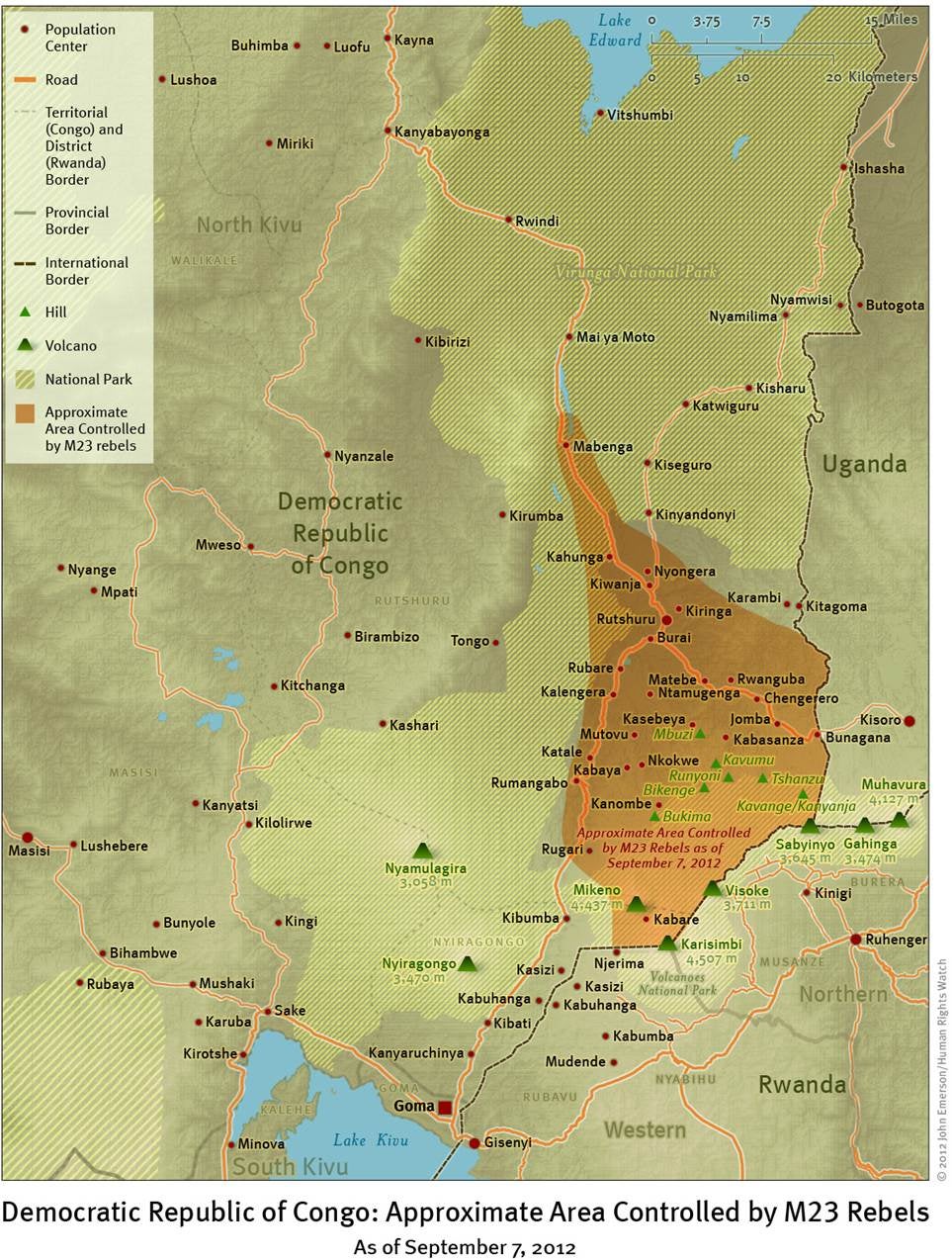
Email- © 2012 John Emerson/Human Rights Watch
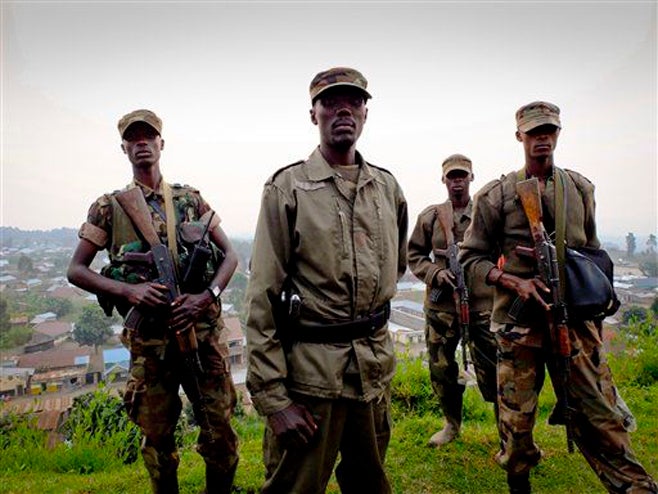
Colonel Sultani Makenga, center, a senior M23 leader, on a hill in eastern Congo, July 2012.
© 2012 AP Images
Families flee fighting between the Congolese army and M23 rebels in Rutshuru territory, eastern Congo in May 2012.
© 2012 Human Rights Watch


The M23 rebels are committing a horrific trail of new atrocities in eastern Congo. M23 commanders should be held accountable for these crimes, and the Rwandan officials supporting these abusive commanders could face justice for aiding and abetting the crimes.
(Goma) – M23 rebels in easternDemocratic Republic of Congoare responsible for widespread war crimes, including summary executions, rapes, and forced recruitment. Thirty-three of those executed were young men and boys who tried to escape the rebels' ranks.
Rwandan officials may be complicit in war crimes through their continued military assistance to M23 forces, Human Rights Watch said. The Rwandan army has deployed its troops to eastern Congo to directly support the M23 rebels in military operations.
Human Rights Watch based its findings on interviews with 190 Congolese and Rwandan victims, family members, witnesses, local authorities, and current or former M23 fighters between May and September.
"The M23 rebels are committing a horrific trail of new atrocities in eastern Congo," said Anneke Van Woudenberg, senior Africa researcher at Human Rights Watch. "M23 commanders should be held accountable for these crimes, and the Rwandan officials supporting these abusive commanders could face justice for aiding and abetting the crimes."
The M23 armed group consists of soldiers who participated in a mutiny from the Congolese national army in April and May 2012. The group's senior commanders have a well-known history of serious abuses against civilians. In June the United Nations high commissioner for human rights, Navi Pillay, identified five of the M23's leaders as "among the worst perpetrators of human rights violations in the DRC, or in the world." They include Gen. Bosco Ntaganda, who is wanted on two arrest warrants by theInternational Criminal Court (ICC) for war crimes and crimes against humanity in Ituri district, and Col. Sultani Makenga, who is implicated in the recruitment of children and several massacres in eastern Congo.
Based on its research, Human Rights Watch documented the forced recruitment of at least 137 young men and boys in Rutshuru territory, eastern Congo, by M23 rebels since July. Most were abducted from their homes, in the market, or while walking to their farms. At least seven were under age 15.
Witnesses told Human Rights Watch that at least 33 new recruits and other M23 fighters were summarily executed when they attempted to flee. Some were tied up and shot in front of other recruits as an example of the punishment they could receive.
One young recruit told Human Rights Watch, "When we were with the M23, they said [we had a choice] and could stay with them or we could die. Lots of people tried to escape. Some were found and then that was immediately their death."
Since June, M23 fighters have deliberately killed at least 15 civilians in areas under their control, some because they were perceived to be against the rebels, Human Rights Watch said. The fighters also raped at least 46 women and girls. The youngest rape victim was eight years old. M23 fighters shot dead a 25-year-old woman who was three months pregnant because she resisted being raped. Two other women died from the wounds inflicted on them when they were raped by M23 fighters.
M23 rebels have committed abuses against civilians with horrific brutality, Human Rights Watch said. Just after midnight on July 7, 2012, M23 fighters attacked a family in the village of Chengerero. A 32-year-old woman told Human Rights Watch that the M23 fighters broke down their door, beat her 15-year-old son to death, and abducted her husband. Before leaving, the M23 fighters gang-raped her, poured fuel between her legs, and set the fuel on fire. A neighbor came to the woman's aid after the M23 fighters left. The whereabouts of the woman's husband remain unknown.
Local leaders, customary chiefs, journalists, human rights activists and others who spoke out against the M23's abuses – or are known to have denounced the rebel commanders' previous abuses – have been targeted. Many received death threats and have fled to Congolese government-controlled areas.
M23 leaders deny that they or their forces have committed any crimes. In an interview with Human Rights Watch on August 8, Col. Makenga, one of the M23's leaders, denied allegations of forced recruitment and summary executions, claiming those who joined their ranks did so voluntarily. "We recruit our brothers, not by force, but because they want to help their big brothers…. That's their decision," he said. "They are our little brothers, so we can't kill them." He described the repeated reports of forced recruitment by his forces as Congolese government propaganda.
Rwandan military officials have also continued to recruit by force or under false pretenses young men and boys, including under the age of 15, in Rwanda to augment the M23's ranks. Recruitment of children under age 15 is a war crime and contravenes Rwandan law.
On June 4, Human Rights Watch reported that between 200 and 300 Rwandans were recruited in Rwanda in April and May and taken across the border to fight alongside M23 forces. Human Rights Watch has since gathered further evidence of forced recruitment in Rwanda in June, July, and August with several hundred more recruited. Based on interviews with witnesses and victims, Human Rights Watch estimates that at least 600 young men and boys have been forcibly or otherwise unlawfully recruited in Rwanda to join the M23, and possibly many more. These recruits outnumber those recruited for the M23 in Congo.
Congolese and Rwandans, including local authorities, who live near the Rwanda-Congo border told Human Rights Watch that they saw frequent troop movements of Rwandan soldiers in and out of Congo in June, July, and August in apparent support of M23 rebels. They said that Rwandan army soldiers frequently used the footpath near Njerima hill in Rwanda, close to Karisimbi volcano, to cross the border.
In addition to deploying reinforcements and recruits to support military operations, Rwandan military officials have been providing important military support to the M23 rebels, including weapons, ammunition, and training, Human Rights Watch said. This makes Rwanda a party to the conflict.
"The Rwandan government's repeated denials that its military officials provide support for the abusive M23 rebels beggars belief," Van Woudenberg said. "The United Nations Security Council should sanction M23 leaders, as well as Rwandan officials who are helping them, for serious rights abuses."
The armed conflict in eastern Congo is bound by international humanitarian law, or the laws of war, including Common Article 3 and Protocol II to the 1949 Geneva Conventions, which prohibit summary executions, rape, forced recruitment, and other abuses. Serious laws-of-war violations committed deliberately or recklessly are war crimes. Commanders may be criminally responsible for war crimes by their forces if they knew or should have known about such crimes and failed to prevent them or punish those responsible.
A United Nations Group of Experts that monitors the arms embargo and sanctions violations in Congo independently presented compelling evidence of Rwandan support to the M23 rebels. Its findings were published in a 48-page addendum to the Group's interim report in June 2012. The Rwandan government has denied these allegations. The UN sanctions committee should immediately seek additional information on M23 leaders and Rwandan military officers named by the Group of Experts with a view to adopting targeted sanctions against them, Human Rights Watch said.
In July and August, five donor governments – the United States, the United Kingdom, Germany, the Netherlands, and Sweden – announced the suspension or delay of assistance to Rwanda in light of the evidence presented by the Group of Experts. Although Rwandan military support for the M23, and M23 abuses have continued unabated, on September 4 the United Kingdom Department for International Development announced it would disburse around half the assistance it had withheld.
The renewed hostilities by the M23, the Congolese army, and various other armed groups have resulted in the displacement of over 220,000 civilians who have fled their homes to seek safety elsewhere in Congo or across the border in Uganda and Rwanda.
"Congolese civilians have endured the brunt of wartime abuses," Van Woudenberg said. "The UN and its member states should urgently step up their efforts to protect civilians, and donor governments providing aid or military assistance to Rwanda should urgently review their programs to ensure they are not fueling serious human rights abuses."
Background on the M23 and Its Leadership
The soldiers who took part in a mutiny from the Congolese army between late March and May and formed the M23 group were previously members of the National Congress for the Defense of the People (CNDP), a former Rwanda-backed rebel group that integrated into the Congolese army in January 2009.
General Ntaganda led the mutiny following Congolese government attempts to weaken his control and increased calls for his arrest and surrender to the ICC, in accordance with Congo's legal obligations to cooperate with the court. He was joined by an estimated 300 to 600 troops in Masisi territory, North Kivu province. Ntaganda's forces were defeated by the Congolese army, which pushed the rebels out of Masisi in early May. Around the same time, Col. Makenga, a former colleague of Ntaganda in the CNDP, announced he was beginning a separate mutiny in Rutshuru territory. In the days that followed, Ntaganda and his forces joined Makenga.
The new armed group called itself the M23. The soldiers claimed their mutiny was to protest the Congolese government's failure to fully implement the March 23, 2009, peace agreement (hence the name M23), which had integrated them into the Congolese army.
Some of the M23's senior commanders have well-known histories of serious abuses, committed over the past decade in eastern Congo as they moved from one armed group to another, including ethnic massacres, recruitment of children, mass rape,killings, abductions, and torture. Before the mutinies, at least five of the current M23 leaders were on a UN blacklist of people with whom they would not collaborate due to their human rights records.
Ntaganda has been wanted by the ICC since 2006 for recruiting and using child soldiers in Ituri district in northeastern Congo in 2002 and 2003. In July, the court issued a second warrant against him for war crimes and crimes against humanity, namely murder, persecution based on ethnic grounds, rape, sexual slavery, and pillaging, also in connection with his activities in Ituri. On September 4, the ICC renewed its request to the Congolese government to arrest Ntaganda immediately and transfer him to The Hague. Human Rights Watch has documented numerous war crimes and crimes against humanity by troops under Ntaganda's command since he moved from Ituri to North Kivu in 2006.
According to research by UN human rights investigators and Human Rights Watch, Col. Makenga is responsible for recruiting children and for several massacres in eastern Congo; Col. Innocent Zimurinda is responsible for ethnic massacres at Kiwanja, Shalio, and Buramba, as well as rape, torture, and child recruitment; Col. Baudouin Ngaruye is responsible for a massacre at Shalio, child recruitment, rape, and other attacks on civilians; and Col. Innocent Kayna is responsible for ethnic massacres in Ituri and child recruitment.
Ntaganda and Zimurinda are also both on a UN Security Council sanctions list. Under the UN sanctions, all UN member states, including Rwanda, are obligated to "take the necessary measures to prevent the entry into or transit through their territories of all persons" on the sanctions list. Both Ntaganda and Zimurinda have traveled to Rwanda since April, former M23 fighters who accompanied Ntaganda and people present during meetings Zimurinda attended in Rwanda told Human Rights Watch.
Publicly, the M23 maintains that Ntaganda is not part of its movement. However, several dozen former and current M23 fighters and others close to the M23's leadership told Human Rights Watch that Ntaganda has played a key command and leadership role among the M23 rebels, operating from the Runyoni area, and that he participated regularly in meetings with the M23's high command and Rwandan army officers.
The same people also told Human Rights Watch that there were tensions between Ntaganda and Makenga due to past differences over Ntaganda's 2009 putsch against the CNDP's then-leader Laurent Nkunda. But these differences, they said, have been put aside to focus on the rebellion against the Congolese army. As one M23 fighter explained to Human Rights Watch, "Many of us have bad memories of Ntaganda…but we need to prioritize the war against the FARDC [the Congolese army] first. The war against Ntaganda will come later."
Since July, Ntaganda appears to have been keeping a lower profile and, according to M23 defectors interviewed by Human Rights Watch, is closely protected by dozens of bodyguards.
Killings and Rape by M23 Forces
Human Rights Watch investigations found that M23 fighters deliberately killed at least 15 civilians, wounded 14 others, and raped at least 46 women and girls in areas under their control in June, July, and August. At least 13 of the rape victims were children. Some were attacked because they resisted forced recruitment or refused to contribute food rations to the M23. Others were targeted because they were perceived to be against the M23, or had fled to government-controlled areas and tried to return home in search of food.
In June, for example, M23 fighters killed a 50-year-old Hutu man, Nsabimana Rwabinumwe, who had fled when the M23 arrived in his village but came back to look for food at his farm. A friend who buried him told Human Rights Watch, "They [M23 fighters] used a hoe and beat him on the back of the head. …When you leave the areas controlled by the government and then come back, they punish you. …They killed [my friend] because he had been in the government area."
In early August, an elderly couple who lived near Runyoni left their home to flee to government-controlled areas when a group of M23 fighters stopped them. The M23 fighters grabbed the woman and tore off her clothes. Her husband tried to protect her, but some of the fighters started beating the 60-year-old man with their rifles, while others gang-raped his wife. The man lost consciousness when he saw his wife being raped. He was later taken to a hospital, where he told relatives, "I want to die. I have no desire to live after what I have seen. It is only animals who could have done this." Two weeks later he died of his wounds.
A 15-year-old girl from Muchanga told Human Rights Watch that she had gone to their farm with her mother and younger sister on July 10 when an M23 fighter approached them and demanded money. They gave him the money they had with them which they were saving to pay school fees, and then the fighter told them to get down on the ground. "He started by letting my mother and little sister go and telling them to run quickly. I was left alone with the fighter. He took me 500 meters from the farm and then he raped me."
On August 24, two M23 fighters raped a 12-year-old girl. They broke into her home, threatened her mother and aunt, and told the young girl to go outside. Some meters from the house, near the family's latrine, they gang-raped her. "[She] was in a lot of pain, she cried out loudly, but these criminals had no heart or pity for anyone," a witness told Human Rights Watch. "They continued to rape her until they were satisfied."
In addition to the 15 civilians deliberately killed by the M23, at least another 25 civilians were killed in July during combat between the M23 and their supporters against Congolese army soldiers and UN peacekeepers. At least 36 other civilians were wounded. In a number of cases neither the M23 nor the Congolese army made sufficient efforts to avoid civilian deaths or to permit civilians to flee the combat zone safely.
Rwandan Support to the M23
In July, several hundred Rwandan army soldiers, possibly more, were deployed to eastern Congo to assist the M23 take the strategic border post town of Bunagana, Rumangabo military base, the towns of Rutshuru, Kiwanja, and Rugari, and surrounding areas. Local residents and M23 defectors reported earlier Rwandan army deployments in which Rwandan soldiers came for short periods to support the M23 in key battles, withdrew, and then returned when needed. A UN peacekeeping officer in North Kivu corroborated regular surges of support for M23. He told Human Rights Watch, "Whenever [the M23] make a big push, they have additional strength."
Local residents and escaped M23 fighters told Human Rights Watch that on July 5 and 6, during an attack on Bunagana, several hundred Rwandan army soldiers from Gen. Emmanuel Ruvusha's division based in Gisenyi (northwestern Rwanda) were deployed to the area to reinforce the M23. Defectors told Human Rights Watch they recognized the division's officers. M23 rebels coordinated their offensive with the Rwandan forces against the Congolese army, who were supported by UN peacekeepers.
UN peacekeepers present during the attack told Human Rights Watch that the forces that attacked Bunagana were well-equipped and spoke English, and that their behavior was markedly different from that of Congolese soldiers, leading them to conclude that the attacking forces included Rwandan soldiers.
Many Rwandan army soldiers deployed to support the M23 passed directly from Rwanda into Congo, using various footpaths, including near Njerima and Kanyanje. Others reportedly passed through Ugandan territory to enter Congo, including via a path on the Ugandan side of Sabyinyo volcano. M23 defectors and local residents told Human Rights Watch that Rwandan soldiers used Ugandan territory and Ugandan vehicles to enter Congo.
Congolese and Rwandans, including local authorities who live near the Rwanda-Congo border, also told Human Rights Watch that they saw significant numbers of Rwandan soldiers crossing from Rwanda into Congo in June, July, and August. They had also seen Rwandan soldiers later returning to Rwanda from Congo.
In early July, just before the M23 rebels attacked Bunagana with support from Rwandan troops, a Congolese farmer from Hehu hill, near Kibumba, was visiting a friend in Kasizi, Rwanda, when he was taken by Rwandan soldiers and forced to carry boxes of ammunition.
He told Human Rights Watch that he had counted seven army trucks filled with Rwandan soldiers, weapons, and ammunition. "The soldiers took me, my friend, and other civilians… and forced us to carry boxes of ammunition to Njerima [near the Congo border]. I was forced to do three trips and then I managed to get away. The soldiers were well-armed and wearing military uniforms… I asked one of the soldiers walking next to me where we were going. He replied that they were going to fight in Congo."
In late July, people in Congo near Kasizi again reported seeing large numbers of Rwandan army soldiers passing into Congo from Rwanda. On August 3, two Rwandans, including a local village chief, told Human Rights Watch that they saw a large group of Rwandan army soldiers crossing from Rwanda into Congo, on a footpath near Karisimbi volcano.
Some people noticed Rwandan soldiers coming out of Congo. A journalist who traveled from Ruhengeri to Kinigi in early August told Human Rights Watch he saw two groups of at least 100 soldiers walking from the direction of the Congolese border toward the main road between Ruhengeri and Kinigi in Rwanda. He described the soldiers as "visibly tired and dirty" and said "some were limping, their boots were muddy, and they were clearly very tired."
Rwandan forces in Congo appear to have coordinated their actions with the M23, often playing commanding roles, local residents and M23 defectors told Human Rights Watch. One former M23 combatant told Human Rights Watch he saw a Rwandan General, Emmanuel Ruvusha, on Tshanzu hill, one of the M23's main bases, during the fighting in Bunagana, apparently commanding and overseeing military operations.
Another defector who commanded a unit of M23 fighters said he received his orders from Rwandan army officers during the attack on Bunagana. Other M23 defectors were also able to identify Rwandan officers by name that had been at M23 positions in Congo. They claimed that these officers had directed, or helped to direct, military operations, provided weapons, or supervised the training of new recruits.
Many of the M23 defectors and escaped recruits from both Congo and Rwanda interviewed by Human Rights Watch said that their training had been conducted by Rwandan army soldiers at training camps in Bukima, Tshanzu, and Rumangabo, in Rutshuru territory, Congo.
A Rwandan M23 defector who used to be an officer in the CNDP told Human Rights Watch he recognized the Rwandan army officers training the new M23 recruits because he himself had been trained by them in Rwanda while he was with the CNDP. "I knew them well because I had taken their courses in Rwanda," he said. "I recognized them."
Human Rights Watch tried to contact the Rwandan military spokesperson for a response to the above allegations without success.
In an interview with Belgian newspaper Le Soir on August 29, the Rwandan defense minister, James Kabarebe, denied that the Rwandan army supported the M23. "Everyone knows that Rwanda does not have a single soldier amongst the M23 and does not give it any support." When asked if uncontrolled Rwandan soldiers could be acting in support of the M23, he said that the Rwandan army was "solid, well-organized, well-commanded, well-disciplined" and that there could not be any "uncontrolled elements" within it.
Forced Recruitment in Congo by the M23
Since early July, M23 rebels have stepped up recruitment activities in Rutshuru territory, eastern Congo, after the group took control of the areas around Bunagana and later Rutshuru, Kiwanja, Rumangabo, and Rugari. M23 commanders held meetings in villages and towns under their military control to convince the population to support their activities by providing recruits and food rations. When few joined voluntarily, M23 combatants quickly began to take young men and boys by force.
Human Rights Watch research found that at least 137 young men and boys were forcibly recruited in Rutshuru territory between early July and late August, including at least 20 children under 18, seven of whom were under age 15.
These are in addition to the 149 young men and boys recruited in Masisi territory in April, as reported by Human Rights Watch on May 16. The total number of young men and boys forcibly recruited by the M23 in Congo, known to Human Rights Watch, stands at 286; of whom at least 68 were children under 18, 24 of them under 15.
New recruits were taken to military training centers set up by the M23 in Bukima, Tshanzu, Runyoni, and Rumangabo. Recruits who managed to escape told Human Rights Watch that they were given military uniforms and taught how to use a rifle and other basic military tactics. The recruits also told Human Rights Watch that Rwandan army officers frequently led the training.
The forced recruitment created a climate of fear, leading many young men and boys to flee to government-controlled areas or across the border to Uganda or Rwanda.
On July 16 and 17, M23 fighters forcibly recruited at least 60 young men and boys from the Rugari and Kisigari areas. They told the recruits that they needed help transporting their belongings, collecting firewood and drawing water, and said they would be released afterward. Instead the young men and boys were taken to military training centers at Bukima and Tshanzu and briefly given military training.
One 20-year-old man who was forcibly recruited in the Kisigari area along with three other young men on July 21 later managed to escape. He told Human Rights Watch that he and the others were taken to a training camp at Bukima. "There, we spent an entire night in a hole with water up to our hips, like a pool," he said. "The M23 soldiers told us that that was the start of the military training, to teach us how to get used to the cold."
A 19-year-old Congolese youth was abducted on July 23 in Bugina on his way home from his fields. Witnesses said three M23 fighters forced him to carry their belongings, then inducted him into their rebel group. His family saw him in Rutshuru on July 25 in military uniform with a rifle, fighting alongside the M23 against the Congolese army.
One man who had gone to visit a relative in Tshanzu who had joined the M23 told Human Rights Watch that during his visit he saw a group of 70 to 80 new recruits undergoing training. The man recognized four of the recruits as children from his home village who were still in primary school and were around 13 or 14. The man told Human Rights Watch that many others of roughly the same age were among the recruits.
Any recruitment by armed groups of children under 18 is prohibited by the Optional Protocol to the Convention on the Rights of the Child on the involvement of children in armed conflicts, ratified by Congo and Rwanda. Under the ICC treaty, the recruitment of children under 15 is a war crime.
Rwandan Recruitment for the M23
Rwandan military authorities continued recruiting for the M23 in Rwanda between June and August, as they had in previous months, either by force or under false pretenses. Information collected by Human Rights Watch indicates that an estimated 600 were recruited in these circumstances in Rwanda. These recruits outnumber those recruited by the M23 in Congo. They included young Rwandan men and boys with no previous military experience and Congolese Tutsi refugees living in refugee or transit camps in Rwanda. Others targeted for recruitment included demobilized soldiers from the Rwandan army, the CNDP, and demobilized fighters from the FDLR who had returned to Rwanda. The FDLR are a largely Rwandan Hutu militia group operating in Congo, some of whose members participated in the 1994 genocide in Rwanda.
According to recruits interviewed by Human Rights Watch who were able to escape and reports from other sources, Rwandan authorities recruited dozens of young men and boys from camps for Congolese refugees in Kibuye and Byumba, as well as the Nkamira Transit Center. Many were forcibly taken from the camps at night by men in civilian clothes who drove them to the Rwandan military camp at Kinigi. There they were given uniforms, weapons, ammunition, and other materials to transport, and were escorted by Rwandan army soldiers to Congo. Others joined voluntarily, after being told that supporting the M23 would help their families return to Congo.
A Tutsi student, 22, who studied near Kitchanga, in Congo, told Human Rights Watch that he had fled to the Nkamira Transit Center in Rwanda in May to escape forced recruitment in Congo. Two weeks later, he was taken by force from the transit camp along with 13 other young men. He said men in civilian clothes assembled them and forced them into a vehicle with tinted windows.They were taken to Ruhengeri, given salt to carry and forced to march to the Congolese border, escorted by Rwandan army soldiers.
At the border, the group was met by M23 fighters, who escorted them to Runyoni, where they were given military training within days of arriving. "They [the M23] would beat us," the student said. "They told us we had to eliminate our 'sense of being a civilian.' They said we were going to take North Kivu."
In another case at Nkamira Transit Center, an 18-year-old Rwandan youth went to visit his sister at the camp on June 6. He said that the same night, he was picked up by civilian-clothed men who rounded up 28 young men in the camp and brought them in three vehicles to the Rwandan military camp in Kinigi. The young men were each given fuel canisters to carry and were escorted on foot toward the M23 military position in Runyoni, Congo, accompanied by Rwandan army soldiers.
Rwandan military authorities also mobilized local authorities to help with the recruitment. In Rwerere, Rwanda, near the Kasizi village border crossing with Congo, Rwandan military authorities called local leaders to a meeting on June 27 and told them that each leader with responsibility for 10 houses (known as thenyumbakumi) should find five recruits to send to Congo to support the M23. Two people who were at the meeting and were later interviewed by Human Rights Watch said they were instructed to "give priority to young demobilized soldiers" and to tell the youth that they should go to Congo "to secure Rwanda because the Congolese government was supporting the FDLR."
According to the same local leaders, on July 4 over 300 new recruits mobilized by the local authorities were taken to Kabumba, close to the border with Congo. They were then escorted by Rwandan army soldiers across the Congolese border to Runyoni to join the M23.
Another nyumbakumi from the area in Rwanda bordering Congo near Kasizi told Human Rights Watch that in a meeting on August 24, Rwandan civilian and military authorities again called on local leaders to recruit youth to join the M23. They told them that "all of the Kivus should come back to Rwanda because it is ours" and that they should collect money from their populations to pay the youth and encourage them to join.
An M23 combatant who spoke to Human Rights Watch was candid about the recruitment in Rwanda. "We have a small number of soldiers, and Rwanda has many," he said. "We recruit everywhere in Rwanda. We look especially for those with families in Congo, former CNDP fighters, or demobilized soldiers. The street children are also very susceptible to recruitment."
Rwandan military and civilian officials who recruit children under the age of 15 for the M23 are responsible for war crimes. Recruitment of children under the age of 18 for military service is also prohibited under Rwandan law.
Summary Executions and Mistreatment of Recruits
The M23 has treated its new recruits harshly. Beatings and cruel or degrading treatment were regular occurrences. Human Rights Watch research found that at least 33 M23 rebels and recruits who attempted to escape and were captured were summarily executed.
A Rwandan man, 18, who escaped after being forcibly recruited in Rwanda told Human Rights Watch that he witnessed the execution of a 16-year-old boy from his M23 unit who had tried to flee in June. The boy was captured and beaten to death by M23 fighters in front of other recruits. An M23 commander who ordered his killing then allegedly told the other recruits, "He wanted to abandon us," as an explanation for why the boy had been killed.
A Congolese Hutu man, 28, who was forcibly recruited in Karuba, Masisi, in early May, told Human Rights Watch that because he resisted becoming a fighter, the M23 detained him in a makeshift prison in a hole in the ground at the M23 military camp in Runyoni, along with 25 other Hutu recruits who were being punished for disobedience. A Rwandan recruit told Human Rights Watch: "We were mistreated at the [Runyoni] camp. …They often beat people so badly that they couldn't recover and got sick. …I wanted to flee."
Within days of being recruited, many young men and boys were sent into battle. With little or no military training or experience, the new recruits are frequently among the first killed. A 17-year-old Rwandan boy who was recruited in June in Ruhengeri, Rwanda, told Human Rights Watch, "There are lots of children with [General] Ntaganda now, and they send us to the front lines so we're the first to die. It's as if they take us to kill us."
One man from Rugari, Congo, told Human Rights Watch that his 15-year-old nephew was forcibly recruited in mid-July by the M23 while walking to his fields. Days later, the boy was killed in a battle on a hill near Rugari. After the battle, the M23 rebels forced a group of civilians, including the boy's uncle, to bury the dead. "I saw my [nephew] there, dead, with a bullet in his chest," the uncle said. The uncle participated in the burial of at least 60 bodies that day. Many appeared to be children.
Intimidation and Threats Against Human Rights Activists, Journalists, Local Leaders
Local leaders, customary chiefs, journalists, human rights activists and others who spoke out against the M23's abuses or are known to have denounced the rebel commanders' previous abuses have been targeted. Many received death threats and have fled to government-controlled areas.
The M23 took over community radio stations in Rutshuru territory shortly after they took control of villages and towns in July, threatening radio operators and journalists and forcing them to hand over equipment. One radio operator interviewed by Human Rights Watch said he was threatened by a senior M23 official, who told him that if he refused to let the M23 use his radio, they would kill him.
In late July, the M23 established local security committees in Kiwanja, Rutshuru, and Rubare. M23 leaders assert the committees are to serve as liaisons with local communities about security matters. However, a member of one of the committees told a civil society activist from the area that the main aims of the committees include recruiting youth to join the M23 and reporting to the M23 hierarchy those who oppose the movement.
Local customary chiefs who have not shown their loyalty to the M23 have also been targeted and some have fled to government-controlled areas.
The Rumangabo locality chief, Manishimwe Rwahinage, was detained by the M23 on July 17. M23 leaders told Human Rights Watch he had been taken into custody for collaborating with the FDLR and they were "trying to change him." He was released on August 11, after civilians from his locality paid US$150. On September 5, Rwahinage was shot and killed in Rumangabo, not far from an M23 military post. M23 leaders said that the FDLR may have been responsible, while those close to Rwahinage believe he was killed by M23 fighters. Further investigation is required to determine responsibility for his death.
Human rights activists in Goma said they received threatening phone calls and text messages from people suspected of being M23 members. On July 26, one activist received the following message: "We are now at the gates of Goma. Speak one more time [and] we will cut your mouth. Spread this message to your other colleagues, sons of dogs. We will end your life."
Forced Labor, Looting, and Extortion by the M23
M23 combatants have forced civilians to work for them, in some cases under threat of death.
On July 26, M23 fighters forced a primary school teacher, 32, from Gisiza locality to transport boxes of ammunition from Kabaya to the Rumangabo military camp. When the teacher tried to return home, he was shot in the back and injured by M23 fighters.
A local chief from the village of Kigarama, near Rugari, who had fled to Kanyaruchinya, told Human Rights Watch that on August 3 he went back to his farm to look for food. The next day M23 forces arrived and forced him to bring his pig to their camp, where it was slaughtered to feed fighters. For the next six days, the chief was forced to dig trenches, milk cows, and collect beans. He was also forced to find young women to bring to the M23 camp; he brought three, ages 15, 20, and 25. Their fate is not known.
Numerous other civilians told Human Rights Watch that they were forced to hand over their harvests, money, and other goods to M23 fighters. A man from Rugari told Human Rights Watch that M23 commanders held a meeting in mid-July at which every family was ordered to provide the M23 five kilograms of beans within a week. The M23 also carried out door-to-door looting raids, attacking those who resisted. On August 24, M23 fighters went to the homes of five traders in Rugari, attacked them with machetes and knives, and forced them to hand over money.
As of early September, the M23 controlled three main supply routes through Rutshuru to Rwindi, Bunagana, and Goma, and was imposing heavy "taxes" on all vehicles passing through their territory.
Pressure on Former CNDP Members by Rwandan Military Officials
Senior Rwandan military officials have sought to influence former CNDP members and their families, in both Congo and Rwanda, to support or join the M23. Several former CNDP military officers and political leaders told Human Rights Watch that they were under intense pressure from Rwandan officials to join the M23. The tactics included death threats and intimidation.
Senator Edouard Mwangachuchu, the president of the CNDP political party, who had publicly denounced the M23 mutiny, told Human Rights Watch that in early May, he received a phone call from the Rwandan defense minister, Gen. James Kabarebe, instructing him to support the M23 and demanding that the CNDP political party withdraw from its political alliance with the Congolese ruling coalition of President Joseph Kabila. The senator said that when he refused, Kaberebe told him to "shut up," and said "a lightning bolt will strike you." A few days later, other CNDP political party members declared they had ousted Mwangachuchu as party president and pulled the CNDP out of Kabila's political coalition.
The Rwandan government, in its official response to the UN Group of Experts, said that the phone calls between Rwandan officials and Congolese individuals had "deliberately been taken out of context" and that those made by Kabarebe were "aimed at avoiding a return to violence and [to] promote political dialogue."
Congolese Tutsi civilians, including businessmen and civilian leaders, also said they were under intense pressure to support the M23. Some have done so voluntarily, but others have refused and faced threats or intimidation. "It's as if they [the Rwandans] have a knife to our throats," one Congolese Tutsi businessman said.
Abuses by Other Armed Groups in Eastern Congo
Since the start of the M23 rebellion, the FDLR and other Congolese armed groups, including the Raia Mutomboki militia, have also increased their military activities, expanding their areas of control and killing hundreds of civilians in other parts of North Kivu and South Kivu, according to the UN and local human rights activists. These militias appear to have taken advantage of rising ethnic tensions and the security vacuum created by the Congolese army's focus on the M23 rebels.
Some of the militias, such as the Mai Mai Sheka – whose leader, Ntabo Ntaberi Sheka, is sought on a Congolese arrest warrant for crimes against humanity for mass rape – have also received support from Rwandan military officials or M23 leaders to conduct military operations against the Congolese army or the FDLR, according to UN officials and the UN Group of Experts.
Some of the most intense fighting has been between the Congolese armed group Raia Mutomboki (meaning "outraged citizens" in Swahili) and the FDLR. Residents and local human rights activists in Masisi, Walikale, Kalehe, and Shabunda territories of North and South Kivu provinces say that hundreds of civilians have been attacked during the fighting this year as each side accused the local population of supporting its enemies.On August 29, Pillay, the UN high commissioner for human rights, condemned the killings and massacres perpetrated by both groups. "The sheer viciousness of these murders is beyond comprehension," she said in a statement. "In some cases, the attacks against civilians may constitute crimes against humanity."
The M23 has sought to ally with some of the armed groups active in eastern Congo, providing them with either periodic or sustained support, including weapons and ammunition, and on occasion organizing coordinated attacks.
For example, in early September, Mai Mai Sheka combatants attacked and took control of Pinga, a town bordering Masisi and Walikale territories, with the support of the M23, according to UN officials.
M23 leaders and Rwandan officials who provided weapons, ammunition, and other support to Congolese armed groups, either directly or indirectly, may be complicit in violations of the laws of war committed by these groups.
Abuses by Congolese Armed Forces
During operations against the M23 rebels, Congolese armed forces have also committed abuses against civilians in Rutshuru territory and Goma, including arbitrary arrests of ethnic Tutsi assumed to be M23 supporters, in addition to the mistreatment of detainees, at least one of whom was killed.
Some of those detained by Congolese soldiers had no apparent connections to the M23, but may have been targeted because they were Rwandan or were from the Tutsi ethnic group.
Between late May and early July, for example, Congolese soldiers detained five Rwandan children, ages 12 to 17, in separate incidents in Kibumba and Goma, at the border with Rwanda. The children were taken to the military prison at the headquarters of the 802nd Regiment at Camp Katindo, in Goma. The guards told the other prisoners, mostly army soldiers, to beat the children. One boy, 17, told Human Rights Watch that the other prisoners said, "Since you are Rwandan, we're going to beat you to death." At night, the children were beaten and hung from the ceiling for hours "like monkeys." They were deprived of food and were not told of any charges or questioned by magistrates.
By mid-July, one of the children, Daniel Masengesho, about 16, became very ill. "We told the prison guard that he was very sick and would die here," one of the boys told Human Rights Watch. "The guard responded, 'Shut up. He is a Rwandan. Let him die slowly.'" The boys repeatedly asked the guards to take him to the hospital, but they refused. On July 23, Masengesho died. The next day, the army took the four other boys by motorcycle to the Rwandan border. Congolese immigration authorities questioned them after seeing their weak state, gave them food, and brought them to the hospital in Goma for medical treatment.
Congolese authorities responded promptly, and within days arrested Maj. Tharcisse Banuesize Chiragaga, the Congolese army officer responsible for detaining the five children. On August 17, a military court convicted him and sentenced him to five years in prison for arbitrary arrest, torture, falsification of documents, and illegal detention leading to the death of one detainee.
Although Congolese officials tried to return the boys to Rwanda, Rwandan government officials have refused to accept them, saying they are unable to confirm that they were Rwandan citizens. This has also occurred with Rwandan defectors from the M23, who continue to be held in Congolese military prisons or in the custody of UN peacekeepers.
As the Congolese army soldiers retreated north from their positions in Kiwanja, Rutshuru territory, on July 25, following an M23 offensive, the soldiers took a number of detainees with them. Human Rights Watch received several reports that four people in their custody may have been killed by soldiers near the Congolese military position at "Pont Mabenga." Congolese judicial officials should urgently investigate this incident, Human Rights Watch said.
Congolese soldiers were also responsible for widespread looting. In Rutshuru and Kiwanja on July 8 and 25, Congolese army soldiers looted homes and forced dozens of civilians to transport their belongings as they retreated in the face of M23 rebel offensives.
 FACEBOOK
 LINKEDIN
 REDDIT
 STUMBLEUPON
 TWITTER
 GOOGLE +
 TUMBLR
Comments
Post a Comment