
Latest Analysis

Independent analysis, commentary and investigations on Africa, the Great Lakes Region and international accountability.

Rwanda: Cessation clause or ongoing genocide against Hutu
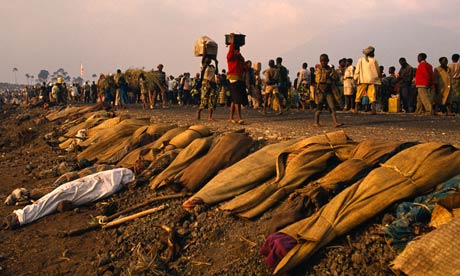

Cessation clause or ongoing genocide against Hutu

hutu-refugees-at-un-s-gom-006The terror I fled is still around. The deadline for the cessation clause of the refugee status for Rwandans who fled their country between 1959 and 1998 is getting closer: June 30th, 2013. If I cannot return yet, it is not my fault. 
ABC News writes that, "some [Rwandan] refugees are taking precautionary measures such as avoiding their beds at night." I don't really go to sleep these days," said Ephraim Rutabingwa, a Hutu refugee [living in the Nakivale camp in Uganda.]" 
In the Democratic Republic of Congo, their youth has been spent in the forests. They are between 100, 000 and 150,000 human beings that the world has continued and persists to ignore. They survive living in the two Kivu provinces. If it hadn't been by the protection provided by FDLR, they would've been completely exterminated as their existence is deliberately obscured. Genocide against their Hutu community in the Great Lakes region which started on October 1st, 1990 is ongoing.
In 1994, the majority of them were only 10 years old or even less. Others were born after in the bush. But they are today men, women, and children living in inhuman conditions; however despite that, what their experience has taught them is that Rwanda led by President Paul Kagame is not yet safe. For their survival against his direct and commissioned attacks by local militias, they have to be constantly alert to defend themselves. They are survivors of the genocide that the Rwandan President and his funded local forces in the Kivus have committed and continue to perpetuate against them.
As the deadline of the announced cessation clause looms, two important international conferences on the subject were held in Belgium and South Africa respectively from 19 to 20/4/13 and 18/4/13.
The first meeting brought together a range of Rwandan political organizations and those from the civil society particularly operating outside the country and interested in the protection of refugees.
The second meeting involved eleven African countries and UNHCR Africa Regional Office: Burundi, the Democratic Republic of the Congo, Kenya, Malawi, Mozambique, the Republic of the Congo, Rwanda, South Africa, Uganda, Zambia, and Zimbabwe, all concerned with the problem posed by Rwandan refugees.
In the address of the South African Home Affairs Minister, Naledi Pandor, during UNHCR meeting on the Implementation of the Comprehensive Durable Solutions Strategy, explained that,
"The position of the UNHCR in relation to Rwanda has created anguish and uncertainty among the refugee community in South Africa. As such it appears as though much work requires to be done on the part of the UNHCR to clearly articulate the reasons for the cessation declaration among the affected refugee community. Much work requires to be done and the looming date for cessation, 30 June 2013, merely serves to add to the general anxiety among the affected communities. One pertinent question that has arisen with my own interaction with representatives of the Rwandan Refugee community is the declaration of cessation is not to be applied to Rwandans who fled the country after 1998. This they point out is a tacit admission that there exist conditions in Rwanda that would force people to seek asylum."
With cessation of refugee status – the issue that attracted most debate – it became clear during the meeting that not all states were ready to invoke a general application of the cessation clauses by 30 June 2013 in line with the strategy recommendation. Others underscored that for various legal, access, logistical, practical or other considerations, they are not in a position to apply the cessation clauses by the end of June, or will in any case not do so. Others specified that for the time being they will concentrate on taking forward other components of the strategy, namely voluntary repatriation and local integration.
Whether in those cases in which one or more States move ahead with the invocation of the cessation clauses or continue to consider applying them, it is clear that this will be done on a "case by case" basis or by "differentiated" approach.
Professor Charles Kambanda considers the Rwandan refugee issue as being wrongly addressed.
"The whole move is misguided. Kagame knows so well the reasons why people go into exile. He knows that the factors that led his parents into exile are a reality in Rwanda under his leadership. … refugees, especially refugees in refugee camps are a "ready-made" source of man power for a military attack on his dictatorship – the same way he used Tutsi refugee camps for his military victory- his major concern is to demolish all Hutu refugee camps in different countries. Kagame counts on use of force and violence than institutionalizing values. …his approach is not sustainable."
The cessation clause appears to pursue genocide against Hutus. The latter is implemented by the Rwandan government of President Paul Kagame and translated through several national policies: dispossession of property, discriminating practices in education, judiciary, health, and farming and employment sectors, and denial of political space. After 23 years of a combination of brutal and gradual extermination practices of the Hutu community both in Rwanda and the region, the question arises of knowing how strong are its members' willingness and resilience to resist their extinction as a distinct and vibrant social and cultural entity for the good of future generations.

Comments

Support Our Work Now !

Africa Realities Media is independent. Your support helps us expose injustice, challenge silence and produce evidence-based analysis on Africa and the Great Lakes Region.

Recent Posts

Show more
Africa Realities Media offre un espace aux écrivains, chercheurs, experts, activistes, voix communautaires, militants, analystes et personnes ayant une expérience vécue qui souhaitent contribuer à des contenus réfléchis, responsables et courageux sur les changements nécessaires dans la région des Grands Lacs, ainsi que sur les réalités politiques, économiques, culturelles et sociales africaines souvent ignorées, minimisées ou mal représentées. Nos articles et vidéos visent à ouvrir le débat, renforcer la sensibilisation, encourager la pensée critique et favoriser une réflexion plus profonde sur les réalités vécues par les populations africaines. Nous voulons aider les peuples de la région des Grands Lacs à mieux comprendre leurs droits, notamment leurs droits humains, leur droit au développement, leur droit à la dignité, à la sécurité, au bien-être et à une vie meilleure. À travers nos contenus, nous cherchons également à rappeler aux décideurs, aux institutions publiques, aux acteurs régionaux et internationaux, ainsi qu’aux responsables politiques, leur devoir de transparence, de responsabilité et de redevabilité envers les populations qu’ils prétendent servir. Notre objectif est de contribuer à une culture de vérité, de justice, de participation citoyenne et de protection égale pour tous les peuples africains.

Why We Exist

Many abuses facing African people are committed by African states, ruling elites, armed groups, military forces and security services. But these abuses are often sustained by international silence, Western lobbying, trade interests, migration deals, mineral access, diplomatic partnerships and unequal global accountability. Africa Realities Media exposes that system.

Lived Experience Matters

Survivors, displaced communities, refugees, families affected by repression, journalists, activists, women, young people and diaspora voices are not passive subjects. They are knowledge holders. Their experiences must shape policy, advocacy, journalism and public debate. The people closest to injustice are often closest to the solutions.

Our Principle

Africa Realities Media is rooted in one principle: African lives deserve equal truth, equal justice and equal protection.

Popular Posts

THE BATTLE OF RUBAYA: Rwanda's War for Minerals Exposed

T he FDLR Pretext Collapses Under the Weight of Documented Plunder   Introduction: A Battle That Tells the Truth When Rwandan-backed RDF/M23 forces fought with extraordinary ferocity to seize and hold Rubaya — a remote mining town in North Kivu, eastern Democratic Republic of Congo — the stated justification was security. Kigali's consistent public line has been that its military presence in the DRC is a response to the threat posed by the Forces Democratiques de Liberation du Rwanda (FDLR), an armed group whose leaders include individuals linked to the 1994 genocide against the Tutsi. This narrative has been accepted, qualified, or left insufficiently challenged by Western governments and multilateral institutions for over a decade. The Battle of Rubaya strips that narrative bare. What unfolded in Rubaya was not a counter-insurgency operation against genocidal remnants. It was a sustained military campaign — reinforced by the Rwanda Defence Forces (RDF), prosecuted at sign...

LA BATAILLE DE RUBAYA : La guerre du Rwanda pour les minerais exposée

Le prétexte des FDLR s’effondre sous le poids du pillage documenté Introduction : une bataille qui dit la vérité Lorsque les forces RDF/M23 soutenues par le Rwanda ont combattu avec une férocité extraordinaire pour s’emparer de Rubaya et la conserver — une ville minière reculée du Nord-Kivu, dans l’est de la République démocratique du Congo — la justification officielle était la sécurité. La ligne publique constante de Kigali a été que sa présence militaire en RDC répond à la menace posée par les Forces démocratiques de libération du Rwanda (FDLR), un groupe armé dont les dirigeants comprennent des individus liés au génocide de 1994 contre les Tutsi. Ce récit a été accepté, nuancé, ou laissé insuffisamment contesté par les gouvernements occidentaux et les institutions multilatérales pendant plus d’une décennie. La bataille de Rubaya met ce récit à nu. Ce qui s’est déroulé à Rubaya n’était pas une opération de contre-insurrection contre des restes génocidaires. C’était une campagne mili...

Les remèdes cosmétiques de la France face à la guerre dans l’est de la RDC

Résolution 2773, Conférence de Paris, doctrine macronienne du dialogue et pari de la Francophonie La politique de la France à l’égard de l’est de la RDC a produit un schéma constant : un langage public fort, une faible application des décisions, aucune pression visible fondée sur les sanctions, et des appels répétés au dialogue qui laissent largement intact le levier militaire et politique du Rwanda. La France ne peut pas rédiger des résolutions, organiser des conférences, rejeter les sanctions, appeler au dialogue, puis revendiquer la neutralité pendant que les civils restent sous occupation, déplacement et violence. Dans une guerre de cette ampleur, le silence et l’inaction ne sont pas neutres. Ce sont des actes politiques. Introduction La France se présente comme l’une des puissances occidentales les plus engagées dans la recherche de la paix dans l’est de la République démocratique du Congo. Elle a parrainé la Résolution 2773 du Conseil de sécurité des Nations unies. Elle a organ...

President Macron Against US Sanctions on Rwanda

How France's Interests in Mozambique Obstruct Peace in the DRC A Critical Analysis of Emmanuel Macron's Interview with TV5 Monde, Africa Forward Summit, Nairobi, 12 May 2026 Published by The African Rights Campaign (ARC)   |   London, May 2026   1. Introduction This analysis is based on French President Emmanuel Macron's interview with TV5 Monde, conducted on 12 May 2026 during the Africa Forward Summit in Nairobi, Kenya. In that interview, Macron was asked a direct question: given that Rwanda's support for the M23 armed group has been documented by United Nations experts, and given that the United States has imposed sanctions on the Rwanda Defence Force and several of its senior officers, why have France and the European Union declined to do the same? Macron's response was unconvincing, dishonest and analytically incoherent. It revealed not a carefully calibrated position of principled neutrality, but the operational logic of a government that has c...

[AFRICAFORUM] Tr : [hinterland1] Tr : L'OCCUPATION RWANDAISE EN MARCHE

  ----- Mail transféré ----- De : Mpania Jean <drjeanmpania@yahoo.fr> À : Hinterland <hinterland1@yahoogroupes.fr> Envoyé le : Mercredi 26 février 2014 17h13 Objet : [hinterland1] Tr : L'OCCUPATION RWANDAISE EN MARCHE   Le Mercredi 26 février 2014 9h56, congokdp <congokdp@gmail.com> a écrit : L'OCCUPATION RWANDAISE EN MARCHE :   Voici comment les institutions et tout le système de sécurité de la RDC sont sous contrôle du Rwanda et les officiels congolais infiltrés par des «hirondelles» rwandaises! L'OCCUPATION RWANDAISE EN MARCHE :  Voici comment les institutions et tout le système de sécurité de la RDC sont sous contrôle du Rwanda et les officiels congolais infiltrés par des «hirondelles» rwandaises! Le processus d'occupation de la RDC par le lobby tutsi rwandais passe par le...

The Kagame Myth: Western Power, Private Jets and Rwanda’s Controlled Reality

  ANALYSIS AND INVESTIGATION Introduction: The Myth and the Man Behind the Myth There is a version of Paul Kagame that exists in the conference halls of Davos, in the pages of Western magazines, in private hotel meetings in London, Paris and Washington, and on the sleeves of European football shirts. In this version, Kagame is a visionary. A builder. A disciplined African moderniser. A leader who pulled a broken country from the ashes of genocide and turned it into what admirers often call the “Singapore of Africa”. In this version, Rwanda is clean, efficient, safe, investment-friendly and orderly. Kagame is presented as the African leader the West wants to believe in: controlled, polished, pro-market, security-focused and comfortable in elite Western spaces. Then there is the Rwanda that many Rwandans, exiles, journalists, opposition figures and human rights organisations describe. In this Rwanda, YouTubers and online commentators are jailed for what they say. Critics die in custo...

Dr Phil Clark ( SOAS University of London): A biased lecturer and researcher about African issues.

Dr Phil Clark   was born in Sudan and   is currently   working at SOAS University of London. He is known to be   biased lecturer and researcher about African issues, particularly the Rwandan genocide.     With his poor judgement and analytical thinking, this man only talk about   the results   of events and forget the     root causes. He is a staunch supporter of the criminal, dictator and killer Paul Kagame , the President of   Rwanda. He is singing the song of the winner of the Rwandan  war. He is in the same boat with Linda Melvern, a biased British   freelancer who received a medal from the dictator Paul     Kagame. "> "> Dr.Phil Clark "> Linda Melvern I am asking Dr Phil Clark   one question:   Dear   Dr Phil Clark, What     was the   role of   Paul Kagame and RPF in the Rwandan  massacres and genocide in and outside Rwanda?   Based...

Le Président Macron contre les sanctions américaines imposées au Rwanda

Comment les intérêts français au Mozambique font obstacle à la paix en RDC Analyse critique de l'entretien d'Emmanuel Macron avec TV5 Monde, Africa Forward Summit, Nairobi, 12 mai 2026 Publié par The African Rights Campaign (ARC)   |   Londres, mai 2026     1. Introduction La présente analyse est fondée sur l'entretien accordé par le président français Emmanuel Macron à TV5 Monde, le 12 mai 2026, lors de l'Africa Forward Summit à Nairobi, au Kenya. Au cours de cet entretien, Macron s'est vu poser une question directe : étant donné que le soutien du Rwanda au groupe armé M23 est aujourd'hui documenté par les experts des Nations Unies, et étant donné que les États-Unis ont imposé des sanctions aux Forces de défense du Rwanda (FDR) ainsi qu'à plusieurs de leurs hauts responsables, pourquoi la France et l'Union européenne n'ont-elles pas fait de même ? La réponse de Macron s'est révélée peu convaincante, malhonnête et analytique...

Kagame’s Image Machine: Who Profits While Rwanda Stays Poor

I nvestigation:  Paying to Stay Poor: How Western PR Firms, Lobbyists, Sports Clubs and Media Outlets Profit from Rwanda’s Image Economy Introduction: An Ecosystem of Paid Influence Rwanda is often presented internationally as a model of discipline, security, investment promotion and post-genocide recovery. That image has been carefully built, repeatedly amplified and professionally protected. Behind it sits a costly international network of sports sponsorships, lobbying contracts, public relations firms, legal consultancy, political access, favourable media relationships and diplomatic narrative management. The moral problem is clear. Rwanda remains heavily dependent on foreign aid and external financing. According to World Bank-linked data, foreign aid received by Rwanda reached approximately 1.39 billion US dollars in 2023. UNDP’s 2025 Human Development Report gives Rwanda a Human Development Index value of 0.578 for 2023, placing it 159th out of 193 countries and territories. U...

Justice ou théâtre politique ? Les procès français du génocide rwandais et le travail inachevé de la réconciliation entre Rwandais

Introduction Depuis 2014, les tribunaux français ont poursuivi une série de ressortissants rwandais hutu pour leur rôle présumé dans le génocide de 1994 contre les Tutsi. Le premier procès, celui de l’ancien chef du renseignement Pascal Simbikangwa, a été suivi par les condamnations des anciens bourgmestres Octavien Ngenzi et Tito Barahira en 2016, puis par la condamnation, en 2023, de l’ancien officier de gendarmerie Philippe Hategekimana. Aucun accusé jugé en France, au titre de la compétence universelle, pour le génocide rwandais n’a été acquitté. D’autres poursuites devraient suivre. Ces procédures ont été largement saluées comme la preuve que la France affronte enfin son passé d’État ayant protégé des auteurs présumés du génocide sur son territoire. Des organisations internationales de défense des droits humains, des spécialistes du génocide et une partie de la société civile française les ont présentées comme une contribution tardive, mais bienvenue, à la lutte mondiale contre l’...

Why Africa Realities Media Is Different

Africa Realities Media speaks to Africa and to the developed world. Many abuses facing African people are committed by African states and ruling elites, but they are often protected by international silence, lobbying, public relations, trade interests, migration deals and unequal global accountability. While governments pay lobbyists to present a good image abroad, ordinary African people continue to face violence, hunger, disease, poverty, repression and exclusion. We challenge the normalisation of African suffering and demand equal truth, equal justice and equal protection.

Pourquoi Africa Realities Media est différent?

Africa Realities Media s’adresse à l’Afrique et au monde développé. De nombreux abus subis par les peuples africains sont commis par des États africains et des élites dirigeantes, mais ils sont souvent protégés par le silence international, le lobbying, les relations publiques, les intérêts commerciaux, les accords migratoires et une responsabilité mondiale inégale. Tandis que des gouvernements paient des lobbyistes pour présenter une bonne image à l’étranger, des Africains ordinaires continuent de faire face à la violence, à la faim, aux maladies, à la pauvreté, à la répression et à l’exclusion. Nous contestons la normalisation de la souffrance africaine et exigeons une vérité égale, une justice égale et une protection égale.

BBC News

Policy and Systems Change

Our work is designed to trigger debate, discomfort and action. We do not only expose injustice; we work for policy and systems change. We want governments and institutions to address the root causes of inequality, disadvantage, discrimination, exclusion and barriers affecting African people. We believe lasting change must be shaped by people with lived experience.

Exposing Injustice in Africa

Africa Realities Media is an independent African accountability platform based in London. We report, analyse and challenge the systems that shape African suffering, silence African victims and protect abusive power. We are not here to repeat diplomatic language. We are here to ask the questions that are often avoided: why are African deaths treated as normal? Why are African victims given less urgency? Why are governments that imprison, exclude, displace or kill their own people protected when they serve powerful international interests?

Africanews

Africa Realities Media gives space to writers, researchers, experts, activists, community voices, campaigners, analysts and people with lived experience who want to contribute thoughtful, responsible and courageous content about the changes needed in the region, as well as the political, economic, cultural and social African realities that are often ignored, minimised or misrepresented. Our articles and videos aim to encourage debate, raise awareness, stimulate critical thinking and support reflection. We seek to help people in the Great Lakes Region understand their rights to human rights, development and wellbeing, while also encouraging decision-makers to be more transparent, responsive and accountable.

Appel à contributions

Sensibilisez le public aux causes qui vous tiennent à cœur. Prenez part au changement que vous souhaitez voir émerger. Aidez à combattre l’injustice partout où elle se manifeste.

Africa Realities Media accueille des articles originaux, analyses, tribunes, réflexions communautaires et commentaires fondés sur des faits concernant la région des Grands Lacs africains, ainsi que les questions liées à la justice, aux droits humains, à la gouvernance, aux conflits, à la paix, aux réfugiés, aux ressources naturelles et à la responsabilité publique en Afrique.

Nous accueillons également les annonces concernant de nouvelles ou d’anciennes publications liées à nos domaines d’intérêt. Vous pouvez annoncer gratuitement votre publication, notamment un livre, un rapport, une étude, un article académique ou tout autre travail pertinent.

Les articles doivent être rédigés en anglais ou en français et ne doivent pas dépasser 1 500 mots.

Veuillez inclure le nom complet de l’auteur, qui sera publié avec l’article s’il est accepté.

Avant de soumettre votre article, veuillez d’abord lire nos pages du site web afin de vérifier si votre article correspond à nos priorités éditoriales, à nos thèmes et à nos domaines d’intérêt.

Si vous avez un article, un commentaire ou une annonce de publication à partager avec un public plus large, veuillez l’envoyer par email à :

africarealitiesmedia@gmail.com

Nous étudierons la possibilité de publier gratuitement les articles et annonces de publications appropriés s’ils répondent à nos critères éditoriaux, notamment la pertinence, la clarté, l’originalité, l’intérêt public, le respect des communautés concernées et l’utilisation responsable des informations et des preuves.

Les articles sont publiés tels qu’ils sont soumis s’ils répondent à nos critères et à notre politique éditoriale. Nous ne procédons pas à une modification supplémentaire de votre article avant sa publication.