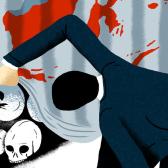
The director of "The Act of Killing" argues that the Indonesian government should end its silence over the purges that killed more than 500,000 people in 1965.
This week marks the 50th anniversary of the beginning of a mass slaughter in Indonesia. With American support, more than 500,000 people were murdered by the Indonesian Army and its civilian death squads. At least 750,000 more were tortured and sent to concentration camps, many for decades.
The victims were accused of being "communists," an umbrella that included not only members of the legally registered Communist Party, but all likely opponents of Suharto's new military regime — from union members and women's rights activists to teachers and the ethnic Chinese. Unlike in Germany, Rwanda or Cambodia, there have been no trials, no truth-and-reconciliation commissions, no memorials to the victims. Instead, many perpetrators still hold power throughout the country.
Indonesia is the world's fourth most populous nation, and if it is to become the democracy it claims to be, this impunity must end. The anniversary is a moment for the United States to support Indonesia's democratic transition by acknowledging the 1965 genocide, and encouraging a process of truth, reconciliation and justice.
Every weekday, get thought-provoking commentary from Op-Ed columnists, The Times editorial board and contributing writers from around the world.
On Oct. 1, 1965, six army generals in Jakarta were killed by a group of disaffected junior officers. Maj. Gen. Suharto assumed command of the armed forces, blamed the killings on the leftists, and set in motion a killing machine. Millions of people associated with left-leaning organizations were targeted, and the nation dissolved into terror — people even stopped eating fish for fear that fish were eating corpses. Suharto usurped President Sukarno's authority and established himself as de facto president by March 1966. From the very beginning, he enjoyed the full support of the United States.
I've spent 12 years investigating the terrible legacy of the genocide, creating two documentary films, "The Act of Killing" in 2013 and "The Look of Silence," released earlier this year. I began in 2003, working with a family of survivors. We wanted to show what it is like to live surrounded by still-powerful perpetrators who had murdered your loved ones.
The family gathered other survivors to tell their stories, but the army warned them not to participate. Many survivors urged me not to give up and suggested that I film perpetrators in hopes that they would reveal details of the massacres.
I did not know if it was safe to approach the killers, but when I did, I found them open. They offered boastful accounts of the killings, often with smiles on their faces and in front of their grandchildren. I felt I had wandered into Germany 40 years after the Holocaust, only to find the Nazis still in power.
Today, former political prisoners from this era still face discrimination and threats. Gatherings of elderly survivors are regularly attacked by military-backed thugs. Schoolchildren are still taught that the "extermination of the communists" was heroic, and that victims' families should be monitored for disloyalty. This official history, in effect, legitimizes violence against a whole segment of society.
The purpose of such intimidation is to create a climate of fear in which corruption and plunder go unchallenged. Inevitably in such an atmosphere, human rights violations have continued since 1965, including the 1975-1999 occupation of East Timor, where enforced starvation contributed to the killing of nearly a third of the population, as well as torture and extrajudicial killing that go on in West Papua today.
Military rule in Indonesia formally ended in 1998, but the army remains above the law. If a general orders an entire village massacred, he cannot be tried in civilian courts. The only way he could face justice is if the army itself convenes a military tribunal, or if Parliament establishes a special human rights court — something it has never done fairly and effectively.
With the military not subject to law, a shadow state of paramilitaries and intelligence agencies has formed around it. This shadow state continues to intimidate the public into silence while, together with its business partners, it loots the national wealth.
Indonesia can hold regular elections, but if the laws do not apply to the most powerful elements in society, then there is no rule of law, and no genuine democracy. The country will never become a true democracy until it takes serious steps to end impunity. An essential start is a process of truth, reconciliation and justice.
This may still be possible. The Indonesian media, which used to shy from discussing the genocide, now refers to the killings as crimes against humanity, and grassroots activism has taken hold. The current president, Joko Widodo, indicated he would address the 1965 massacre, but he has not established a truth commission, issued a national apology, or taken any other steps to end the military's impunity.
We need truth and accountability from the United States as well. U.S. involvement dates at least to an April 1962 meeting between American and British officials resulting in the decision to "liquidate" President Sukarno, the populist — but not communist — founding father of Indonesia. As a founder of the nonaligned movement, Sukarno favored socialist policies; Washington wanted to replace him with someone more deferential to Western strategic and commercial interests.
The United States conducted covert operations to destabilize Sukarno and strengthen the military. Then, when genocide broke out, America provided equipment, weapons and money. The United States compiled lists containing thousands of names of public figures likely to oppose the new military regime, and handed them over to the Indonesian military, presumably with the expectation that they would be killed. Western aid to Suharto's dictatorship, ultimately amounting to tens of billions of dollars, began flowing while corpses still clogged Indonesia's rivers. The American media celebrated Suharto's rise and his campaign of death. Time magazine said it was the "best news for years in Asia."
But the extent of America's role remains hidden behind a wall of secrecy: C.I.A. documents and U.S. defense attaché papers remain classified. Numerous Freedom of Information Act requests for these documents have been denied. Senator Tom Udall, Democrat of New Mexico, will soon reintroduce a resolution that, if passed, would acknowledge America's role in the atrocities, call for declassification of all relevant documents, and urge the Indonesian government to acknowledge the massacres and establish a truth commission. If the U.S. government recognizes the genocide publicly, acknowledges its role in the crimes, and releases all documents pertaining to the issue, it will encourage the Indonesian government to do the same.
This anniversary should be a reminder that although we want to move on, although nothing will wake the dead or make whole what has been broken, we must stop, honor the lives destroyed, acknowledge our role in the destruction, and allow the healing process to begin.
---------------------------------------------------------------------------------------------------------- The hate of men will pass, and dictators die, and the power they took from the people will return to the people. And so long as men die, liberty will never perish. I have loved justice and hated iniquity: therefore I die in exile. The price good men pay for indifference to public affairs is to be ruled by evil men. When the white man came we had the land and they had the bibles; now they have the land and we have the bibles. ---------------------------------------------------------------------------------------------------------- The Voice of the Poor, the Weak and Powerless.
----------------------------------------------------------- Post message: AfricaRealities@yahoogroups.com Subscribe: AfricaRealities-subscribe@yahoogroups.com Unsubscribe: AfricaRealities-unsubscribe@yahoogroups.com List owner: AfricaRealities-owner@yahoogroups.com __________________________________________________________________
Please consider the environment before printing this email or any attachments. --------------------------------------------------------------------------------------------------------------------- -http://www.africarealities.com/
Africa Realities Media is independent. Your support helps us expose injustice, challenge silence and produce evidence-based analysis on Africa and the Great Lakes Region.
Africa Realities Media offre un espace aux écrivains, chercheurs, experts, activistes, voix communautaires, militants, analystes et personnes ayant une expérience vécue qui souhaitent contribuer à des contenus réfléchis, responsables et courageux sur les changements nécessaires dans la région des Grands Lacs, ainsi que sur les réalités politiques, économiques, culturelles et sociales africaines souvent ignorées, minimisées ou mal représentées.
Nos articles et vidéos visent à ouvrir le débat, renforcer la sensibilisation, encourager la pensée critique et favoriser une réflexion plus profonde sur les réalités vécues par les populations africaines. Nous voulons aider les peuples de la région des Grands Lacs à mieux comprendre leurs droits, notamment leurs droits humains, leur droit au développement, leur droit à la dignité, à la sécurité, au bien-être et à une vie meilleure.
À travers nos contenus, nous cherchons également à rappeler aux décideurs, aux institutions publiques, aux acteurs régionaux et internationaux, ainsi qu’aux responsables politiques, leur devoir de transparence, de responsabilité et de redevabilité envers les populations qu’ils prétendent servir. Notre objectif est de contribuer à une culture de vérité, de justice, de participation citoyenne et de protection égale pour tous les peuples africains.
Why We Exist
Many abuses facing African people are committed by African states, ruling elites, armed groups, military forces and security services. But these abuses are often sustained by international silence, Western lobbying, trade interests, migration deals, mineral access, diplomatic partnerships and unequal global accountability.
Africa Realities Media exposes that system.
Lived Experience Matters
Survivors, displaced communities, refugees, families affected by repression, journalists, activists, women, young people and diaspora voices are not passive subjects. They are knowledge holders.
Their experiences must shape policy, advocacy, journalism and public debate. The people closest to injustice are often closest to the solutions.
http://www.veritasinfo.fr/m/article-122363461.html Itangazo ry'inama yahuje amashyaka i Buruseli kuwa 01/02/2014 Nk'uko byari biteganyijwe, kuri uyu wa gatandatu tariki ya 01/02/2014, i Buruseli mu Bubiligi hateraniye inama y'amashyaka atavuga rumwe n'ubutegetsi bwa Perezida Paul Kagame. Ku mashyaka icumi yari yatumiwe, ayabonetse mu nama ni atandatu (60%), ari yo : 1. Forces Démocratiques Unifiées (FDU-Inkingi) ; 2. Forces Démocratiques de Libération du Rwanda (FDLR) ; 3. Pacte Démocratique du Peuple (PDP-Imanzi) ; 4. Parti pour la Démocratie au Rwanda (PDR-Ihumure) ; 5. Parti Social (PS-Imberakuri) ; 6. Rwandan Dream Initiative (RDI-Rwanda Rwiza). Ihuriro FCLR - Ubumwe naryo ryari rihagarariwe muri iyo nama. Mu gutangira inama, abayijemo batoye umuyobozi wayo. Bamaze gusuzuma no kwemeza umurongo w'ibyigwa, bemeje ko muri iki gihe, ubufatanye bw'amashyaka ya opposition ari ngombwa cyane ...
The FDLR Myth: How Rwanda Weaponises a Diminished Threat to Justify Occupation Investigation Exposes Contradictions in Rwanda's Security Narrative For over a decade, Rwanda has justified its military presence in eastern Democratic Republic of Congo by citing threats from the FDLR, a Hutu militia group linked to the 1994 genocide. But an investigation into FDLR's actual capabilities, Rwanda's military operations, and patterns of violence reveals a narrative that does not match reality. The FDLR threat, whilst real, has been systematically exaggerated and manipulated to justify objectives that have nothing to do with the militia group. Introduction The Democratic Forces for the Liberation of Rwanda (FDLR) occupies a central position in Rwanda's justification for military intervention in eastern Democratic Republic of Congo. For more than two decades, Rwandan authorities have portrayed the militia group as an existential threat requiring sustaine...
Kigali wants Washington to punish Congo too. But a ceasefire that leaves the occupier in place is not peace; it is occupation without noise. African lives are not worth less. African deaths are not normal. Western interests must never become a licence to kill African people. Introduction: A Familiar Complaint On 29 June 2026, Rwanda’s Minister of Foreign Affairs, Olivier Nduhungirehe, sat before the cameras of France 24 and declared that his country was “disappointed by the increasingly biased US mediation” in the conflict with the Democratic Republic of Congo. He asked why sanctions had targeted only Rwanda. He called the measures unfair, one-sided and counterproductive. Weeks earlier, President Paul Kagame had told Jeune Afrique that sanctions and threats were insults thrown at Rwanda, and accused Washington of exerting heavy pressure on Rwanda while treating the DRC more delicately. The grievance sounds reasonable until you remember where you have heard it before. Since 2022, the Kr...
Political Bias — Archival Failures — Racial Framing — Neocolonialist Process — Historical Distortion June 2026 Note on citations: In-text references in blue italics indicate page numbers from the Duclert Report (vie-publique.fr/files/rapport/pdf/284672.pdf, 2021 English summary). Introduction The Duclert Report, formally titled France, Rwanda and the Tutsi Genocide (1990–1994) , was submitted to President Emmanuel Macron on 26 March 2021 by the Research Commission on French Archives Relating to Rwanda and the Tutsi Genocide, chaired by Professor Vincent Duclert. Produced after two years of archival work and running to nearly 1,000 pages, it was presented as a landmark in historical transparency: the first time France had opened its state archives to systematic scholarly examination of its role in one of the worst genocides of the twentieth century. The commission examined archives from the Presidency of the Republic, the Prime Minister’s office, the Ministry of Europe a...
B iais politique — Défaillances archivistiques — Cadrage racial — Processus néocolonial — Distorsion historique. Juin 2026 Note sur les citations : les références en italique bleu indiquent les numéros de pages du Rapport Duclert (vie-publique.fr/files/rapport/pdf/284672.pdf, résumé en anglais, 2021). Introduction Le Rapport Duclert, intitulé officiellement La France, le Rwanda et le génocide des Tutsi (1990–1994) , a été remis au président Emmanuel Macron le 26 mars 2021 par la Commission de recherche sur les archives françaises relatives au Rwanda et au génocide des Tutsi, présidée par le professeur Vincent Duclert. Produit après deux ans de travail archivistique et comptant près de mille pages, il a été présenté comme un moment fondateur de la transparence historique : la première fois que la France ouvrait ses archives d’État à un examen scientifique systématique de son rôle dans l’un des génocides les plus meurtriers du vingtième siècle. La comm...
http://www.victoire-ingabire.com/Eng/victoires-quotes/ Victoire Ingabire's Speech and Quotes I agree that there was a genocide by Hutu extremists against the Tutsis, that is the reality. The people who did this need to face justice. But there were also other crimes against humanity, including the killing of Hutus. I don't believe in violence and war is not the solution to the problems that face this country. People say there's stability in Rwanda but this stability is based on repression … We need stability based on freedom. I don't understand how democratic countries can remain friends with a government that doesn't allow democracy. The democratic UK is supporting a dictatorship. Shall I die or live, be detained or released what we have achieved will not go back. This movement is stronger than me. Remanding me in captivity or silencing my voice can only postpone the revolution. It cannot stop the movement. Unity and Reconciliation Speech at Gisozi Genocide Memori...
Le 30 juin 2026, pour la première fois en cinquante-six ans d'existence de l'Organisation internationale de la Francophonie, les candidats au poste de Secrétaire général ont été auditionnés publiquement devant les ministres des Affaires étrangères des 53 États membres de plein droit, réunis en Conférence ministérielle extraordinaire à Paris. Parmi les quatre prétendants au mandat 2027-2030, qui sera attribué par les chefs d'État au XXe Sommet de la Francophonie à Phnom Penh les 15 et 16 novembre 2026, figure un profil inédit : Dacian Cioloș, ancien Premier ministre de Roumanie, ancien commissaire européen à l'Agriculture et ancien président du groupe Renew au Parlement européen, seul candidat non africain de la course. Cet article, premier d'une série de cinq consacrée aux auditions, analyse la prestation de M. Cioloș sur huit axes : la vision, l'innovation, le développement des communautés locales, la promotion de la langue française, les conflits et la s...
La refondation proclamée, l'architecture manquante Fille de Patrice Lumumba et ancienne ministre congolaise, Juliana Lumumba porte la candidature de la République démocratique du Congo au poste de Secrétaire général de la Francophonie, dont le titulaire du mandat 2027-2030 sera désigné par les chefs d'État au XXe Sommet de la Francophonie, prévu à Phnom Penh les 15 et 16 novembre 2026. Son audition publique du 30 juin 2026 à Paris, devant les ministres des Affaires étrangères des 53 États membres de plein droit, était particulièrement attendue : sa candidature incarne à la fois le rééquilibrage africain de l'organisation et le face-à-face diplomatique entre Kinshasa et Kigali, dont l'élection est devenue l'un des théâtres. Cet article, deuxième d'une série de cinq consacrée aux auditions, analyse sa prestation sur huit axes : la vision, l'innovation, le développement des communautés locales, la promotion de la langue française, les conflits et la sécurité en...
ANALYSE ET INVESTIGATION Introduction : le mythe et l’homme derrière le mythe Il existe une version de Paul Kagame qui vit dans les salles de conférence de Davos, dans les pages des magazines occidentaux, dans les réunions privées d’hôtels à Londres, Paris et Washington, et sur les manches des maillots de football européens. Dans cette version, Kagame est un visionnaire. Un bâtisseur. Un modernisateur africain discipliné. Un dirigeant qui a sorti un pays brisé des cendres du génocide pour le transformer en ce que ses admirateurs appellent souvent le « Singapour de l’Afrique ». Dans cette version, le Rwanda est propre, efficace, sûr, favorable aux investissements et ordonné. Kagame est présenté comme le dirigeant africain auquel l’Occident veut croire : contrôlé, poli, favorable au marché, centré sur la sécurité et à l’aise dans les espaces d’élite occidentaux. Puis il y a le Rwanda que décrivent de nombreux Rwandais, exilés, journalistes, figures de l’opposition et organisations de déf...
Africa Realities Media speaks to Africa and to the developed world. Many abuses facing African people are committed by African states and ruling elites, but they are often protected by international silence, lobbying, public relations, trade interests, migration deals and unequal global accountability. While governments pay lobbyists to present a good image abroad, ordinary African people continue to face violence, hunger, disease, poverty, repression and exclusion. We challenge the normalisation of African suffering and demand equal truth, equal justice and equal protection.
Pourquoi Africa Realities Media est différent?
Africa Realities Media s’adresse à l’Afrique et au monde développé. De nombreux abus subis par les peuples africains sont commis par des États africains et des élites dirigeantes, mais ils sont souvent protégés par le silence international, le lobbying, les relations publiques, les intérêts commerciaux, les accords migratoires et une responsabilité mondiale inégale. Tandis que des gouvernements paient des lobbyistes pour présenter une bonne image à l’étranger, des Africains ordinaires continuent de faire face à la violence, à la faim, aux maladies, à la pauvreté, à la répression et à l’exclusion. Nous contestons la normalisation de la souffrance africaine et exigeons une vérité égale, une justice égale et une protection égale.
Our work is designed to trigger debate, discomfort and action. We do not only expose injustice; we work for policy and systems change.
We want governments and institutions to address the root causes of inequality, disadvantage, discrimination, exclusion and barriers affecting African people. We believe lasting change must be shaped by people with lived experience.
Exposing Injustice in Africa
Africa Realities Media is an independent African accountability platform based in London. We report, analyse and challenge the systems that shape African suffering, silence African victims and protect abusive power.
We are not here to repeat diplomatic language. We are here to ask the questions that are often avoided: why are African deaths treated as normal? Why are African victims given less urgency? Why are governments that imprison, exclude, displace or kill their own people protected when they serve powerful international interests?
Africa Realities Media gives space to writers, researchers, experts, activists, community voices, campaigners, analysts and people with lived experience who want to contribute thoughtful, responsible and courageous content about the changes needed in the region, as well as the political, economic, cultural and social African realities that are often ignored, minimised or misrepresented.
Our articles and videos aim to encourage debate, raise awareness, stimulate critical thinking and support reflection. We seek to help people in the Great Lakes Region understand their rights to human rights, development and wellbeing, while also encouraging decision-makers to be more transparent, responsive and accountable.
Appel à contributions
Sensibilisez le public aux causes qui vous tiennent à cœur. Prenez part au changement que vous souhaitez voir émerger. Aidez à combattre l’injustice partout où elle se manifeste.
Africa Realities Media accueille des articles originaux, analyses, tribunes, réflexions communautaires et commentaires fondés sur des faits concernant la région des Grands Lacs africains, ainsi que les questions liées à la justice, aux droits humains, à la gouvernance, aux conflits, à la paix, aux réfugiés, aux ressources naturelles et à la responsabilité publique en Afrique.
Nous accueillons également les annonces concernant de nouvelles ou d’anciennes publications liées à nos domaines d’intérêt. Vous pouvez annoncer gratuitement votre publication, notamment un livre, un rapport, une étude, un article académique ou tout autre travail pertinent.
Les articles doivent être rédigés en anglais ou en français et ne doivent pas dépasser 1 500 mots.
Veuillez inclure le nom complet de l’auteur, qui sera publié avec l’article s’il est accepté.
Avant de soumettre votre article, veuillez d’abord lire nos pages du site web afin de vérifier si votre article correspond à nos priorités éditoriales, à nos thèmes et à nos domaines d’intérêt.
Si vous avez un article, un commentaire ou une annonce de publication à partager avec un public plus large, veuillez l’envoyer par email à :
africarealitiesmedia@gmail.com
Nous étudierons la possibilité de publier gratuitement les articles et annonces de publications appropriés s’ils répondent à nos critères éditoriaux, notamment la pertinence, la clarté, l’originalité, l’intérêt public, le respect des communautés concernées et l’utilisation responsable des informations et des preuves.
Les articles sont publiés tels qu’ils sont soumis s’ils répondent à nos critères et à notre politique éditoriale. Nous ne procédons pas à une modification supplémentaire de votre article avant sa publication.
Comments
Post a Comment