
On Monday, 2 November 2015, 13:00, "innocent_twagiramungu Innocent_twagiramungu@yahoo.fr [Democracy_Human_Rights]" <Democracy_Human_Rights@yahoogroupes.fr> wrote:
Kagame Started the Genocide in Rwanda, then Congo https://shar.es/15pDz9 via @grtvnews
Kagame Started the Genocide in Rwanda, then Congo
To the City of Atlanta, former Mayor Andrew Young and Bernice King:
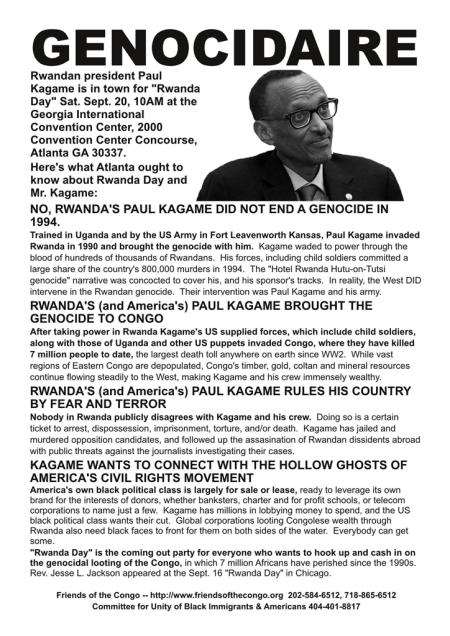
Individuals and organizations listed below have come to know that the President of Rwanda, Paul Kagame, is organizing what he calls Rwanda Day, a meeting with the Rwandan Diaspora and the American public in the city of Atlanta.
We, the Congolese and Rwandan Diaspora, indigenous of the Congo and Rwanda, together with friends of these two countries, denounce and strongly condemn the fact that the president of Rwanda is allowed to organize such a meeting on American soil with the blessing of the authorities of the City of Atlanta.
Our condemnation is based on the fact that the people of the African Great Lakes regions have suffered from the abuses committed by Paul Kagame and his government for 24 years now.
We would like to bring the following basic facts about Paul Kagame to the attention of all Americans who are committed to peace and social justice:
- In 1990, Gen. Paul Kagame invaded Rwanda heading a detachment of the Ugandan army dominated by Rwandan Tutsis like himself. He destabilized the country and committed numerous mass murders in the north of Rwanda.
- In 1994, when the city of Kigali was surrounded by camps filled with desperate refugees fleeing Kagame's army in the north, President Kagame pushed the country into a state of panic, terror and genocidal violence by ordering the assassination of the Rwandan and Burundian presidents as they returned from peace talks in Arusha, Tanzania, which were meant to end the conflict.

Image: Rwandans and Congolese joined forces to protest the first Rwanda Day, held in Chicago, Illinois, in 2011, and at each Rwanda Day since.
- In 1996 and 1998, Gen. Paul Kagame joined Gen. Yoweri Museveni in invading the Democratic Republic of the Congo, creating havoc in the country which resulted in deaths that the International Rescue Committee estimated to be as high as 5.4 million between January 1997 and January 2008. Since at least seven years of war and conflict were not counted in the IRC's epidemiological study, the death toll is no doubt much higher.
- Gen. Paul Kagame has never stopped plundering the Democratic Republic of the Congo since his first raids and today Rwanda is a major exporter of coltan (ore used in the manufacture of mobile phones, playstations and military electronics), although Rwanda itself has no coltan reserves.
- Gen. Paul Kagame has fueled wars in the Democratic Republic of the Congo by creating and supporting proxy militias such as the M23 that have helped him cover up his plundering of the country.
- Gen. Paul Kagame rules Rwanda with an iron fist. Political space is locked down favor of a minority. Nonviolent political challengers to Kagame, including Victoire Ingabire and Deo Mushayidi are incarcerated.

Image: A protester at Rwanda Day in Boston in 2012 held up a poster calling for the freedom of Rwandan political prisoner and opposition leader Victoire Ingabire Umuhoza.
- Gen. Paul Kagame does not hesitate to resort to political assassination inside and outside Rwanda's borders. In 2010, journalist Jean Leonard Rugambage was gunned down in the streets of Kigali, after letting the editor of the publication he wrote for know that he was about to release evidence of Kagame's complicity in the attempt to assassinate his former general, Kayumba Nyamwasa, in Johannesburg, South Africa. Kagame's former intelligence chief, Patrick Karegeya, was the last known to pay with his life for becoming a critic of the Kagame regime. Karegeya was found hanging in a Johannesburg hotel on New Year's Day this year. This case is still under investigation, but Kagame's response to the murder was to warn Rwandans, in a public speech, that "you can't betray Rwanda without paying the price."
All statements mentioned above have been duly documented by various U.N. reports, documented news reports including video footage, and legal judgments:
- In July 16, 1997, the U.S. House of Representatives hearings before the Committee on International Relations about the Democratic Republic of the Congo revealed that Paul Kagame's RPF (Rwandan Patriotic Front) had invaded Congo-Zaïre and that it was assassinating Hutu refugees in Eastern Congo-Zaïre. In 2006, President Obama, who was then a senator from Illinois, authored the Congo Relief Security and Democracy Promotion Act. Section 101(5) and (6) of Obama's 2006 Congo legislation reads:"(5) The most recent war in the Democratic Republic of the Congo, which erupted in 1998, spawned some of the world's worst human rights atrocities and drew in six neighboring countries."(6) Despite the conclusion of a peace agreement and subsequent withdrawal of foreign forces in 2003, both the real and perceived presence of armed groups hostile to the Governments of Uganda, Rwanda, and Burundi continue to serve as a major source of regional instability and an apparent pretext for continued interference in the Democratic Republic of the Congo by its neighbors [Uganda, Rwanda and Burundi]."

Image: Rwanda Day protest, London 2012
- In 2008, The Spanish National Court indicted 40 Rwandan officers on charges of mass murder, crimes against humanity, terrorism, genocide against Rwandans, Congolese and Spanish citizens in the aftermath of the 1994 Rwanda genocide. Judge Fernando Andreu of Spain's National Court also declared that he had sufficient evidence to implicate current Rwandan President Paul Kagame, but he also added that he could not indict him because of his presidential immunity.
- The U.N. Office of the High Commissioner for Human Rights (UNOHCHR) issued a report on the Congo called "The United Nations Mapping Exercise Report." This report affirms that the Rwandan government is responsible for the most serious violations of human rights and international humanitarian law in the Congo. Moreover, the observation of some of the crimes committed in the Democratic Republic of the Congo has led investigators to say that some elements "if proven before a competent court, could be characterized as crimes of genocide."
- On April 15, 2013, the Report of Foreign & Commonwealth Office (FCO) expresses concerns about the political space in Rwanda. It observes that there are many political constraints and that freedom of association and expression is not guaranteed. It also raises the question of the imprisonment of opposition leader Madame Victoire Ingabire.
- In a letter dated Dec. 12, 2013, from the Group of Experts on the Democratic Republic of the Congo addressed to the chair of the Security Council Committee established pursuant to Resolution 1533 (2004) concerning the Democratic Republic of the Congo, the U.N. experts argue that Rwandan Defense Minister James Kabarebe was commanding the M23 militia then terrorizing DR Congo and that Rwanda provided continuous support to M23 from Rwandan territory. The most consistent forms of support were through recruitment and provision of arms and ammunition, particularly during periods of combat. M23 also received troop reinforcements directly from the Rwandan army in August. During the October fighting, Rwandan tanks fired into DRC in support of M23.
- On Sept. 10, 2014, Magistrate Stanley Mkhari sentenced four men each to eight years in prison in a South African court, saying that they had been proven guilty of a ''politically motivated'' attempt to assassinate Kayumba Nyamwasa, Paul Kagame's former defense chief, in June 2010. The plot, the judge wrote, originated in Kigali, the capital of Rwanda.

Image: Kagame Day protest, Toronto 2013
The United States, which takes pride in its democratic history, and the City of Atlanta, which played such a proud role in the American Civil Rights Movement led by Dr. Martin Luther King, cannot want to appear to the world as supporters of dictatorship and mass murder, but allowing Paul Kagame to organize "Rwanda Day" in Atlanta tells the world that they are.
The violation of human rights is no more acceptable in Africa than in the United States or anywhere else in the world. We like to believe that human beings, wherever they are, are entitled to justice and that it is a denial of justice to host an event created to let a regime with bloody hands promote itself, while the millions it killed remain compelled to silence in death because we do not have the courage to speak for them and say enough is enough.
A message from a Congolese citizen, Philippe Lomboto Liondjo: "Please do not insult Martin Luther King's memory and the spirit of the honorable struggle for Civil Rights by allowing a killer such as Gen. Kagame to organize his Rwanda Day in Atlanta."
Coalition
BK Kumbi, spokesperson, Don't Be Blind This Time (Switzerland-DRC)
Don't Be Blind This Time, Swiss citizen movement
Bruce Dixon, Managing Editor, Black Agenda Report(USA)
Glen Ford, Executive Editor, Black Agenda Report
Milton Allimadi, Editor-in-Chief, Black Star News (USA)
Frank LeFever, retired neuroscientist, PacificaWBAI Local Station Board member (USA)
Ann Garrison, Journalist and Victoire Ingabire Umuhoza Democracy and Peace Prize Winner (USA)
Maurice Carney, Executive Director, Friends of the Congo (USA)
Kambale Musavuli, Student Coordinator and Mining Researcher, Friends of the Congo (USA-DRC)
Kweku Lumumba, Secretary General, World African Diaspora Union, Georgia (USA)
Christopher Black, ICTR Defense Counsel (Canada)
David Peterson, co-author of the upcoming book, "Enduring Lies: The Rwandan Genocide in the Propaganda System, 20 Years Later" (USA)
Claude Gatebuke, Rwandan Genocide survivor, Executive Director, African Great Lakes Action Network
Theophile Murayi, Foundation for Freedom and Democracy in Rwanda
June Terpstra (USA)
Lisanga, Congolese political association (France)
La LUCHA, mouvement citoyen RD Congo
Soledad Mora, Comités Umoya-Madrid (Spain)
Magloire Mpembi, doctor and novelist (Canada-DRC)
Jean-Mobert N'Senga-la, LUCHA, (DRC)
Momi M'Buze Noogwani Ataye Mieko, Congolese writer and activist
Monique Mbeka, Congolese film maker (Belgium-DRC)
Philippe Lomboto Liondjo, Congolese performer, actor and activist (Switzerland-RDC)
Olivier Mukuna, Journalist (Belgium)
Lopango Ya ba Nka, Congolese music band (Germany-RDC)
Willie Ratcliff, Publisher, San Francisco Bay View National Black Newspaper
Mary Ratcliff, Editor, San Francisco Bay View National Black Newspaper
JR Valrey, Producer, Block Report Radio, Associate Editor, SF Bay View (USA)
Anne Onidi, Journalist (Switzerland)
Nicolas-Patience Basabose (RSA)
Elengo (Switzerland-DRC
Victoria Dimandja (GB-DRC)
Youyou Muntu-Mosi (France-DRC)
Nadine Bena (France-DRC)
Jean-Jacques Tadoum (USA)
Leopold Mbala (USA-DRC)
Ekutsu Mambulu (DRC)
N'siala Kiese Patrick (Belgique-Drc)
Meta Nabou Cisse (Belgique)
Derrick Onyeri (Denmark-Uganda)
Nadia Nsayi (Belgiques-DRC)
Jean-Baptiste Paul (France-Haïti)
Rosa Moro, Journalist (Spain)
Flavia Garrigos Cabanero (Spain)
Dina Martinez (Spain)
Damiàn Socías Picornell (Spain)
Pedro Espinosa Bote (Spain)
Ana María Martínez Rodamilans (Spain)
Fuencisla de Andrés (Spain)
Ana Espinosa González (Spain)
Pedro Espinosa (Spain)
Maite Cobas (Spain)
Jaime Lara (Spain)
José Hernández (Spain)
Mingu Haro (Spain),
Marlene Ibarra (Ecuador)
Nella Azana (GB-DRC)
Vincent Conrad Ball (GB)
Kibsoo Diallo (Egypt)
Djallil Saada (Switzerland)
Benjamin Itzkovich (Switzerland)
Dieudonne Aoche (USA-DRC)
Lucie N'goma (France)
Paul Alain (France)
Judith Bass (Switzerland)
Juan Carlos Hernandez (Switzerland)
Mang Holenn Christian (RSA)
Leslie Luboloko Lusinda (RSA)
Patrick Kegbia (RSA)
Billy Lukinu (Angola)
Stacey Koyenyi (GB)
Kitondua Diasivi (France)
Ive Mass (GB-RDC)
Matondo Kapella (RDC)
Gloria Omoyi (France-RDC)
Gugu Ngwenya (RSA-RDC)
Owandji Olenga Lokolo Lopaka (RDC)
Sosthene Banda Badou (Poland-Tchad)
Bebelle Dembo (North Irland)
Anthea Harris (GB)
Claudine Mamona-Cullin (Austria)
Sala Naambwe (Canada)
Demunga Hassani (Canada)
S. Mathieu Gnonhossou (USA-Rwanda)
Philippe Faradja Byaombe , Congolese Student Organisation-Pretoria (RSA)
Aimant Lutonadio (Germany-RDC)
Sophie Teuwen (Senegal)
Ibrahim Touré (Algeria-Mali)
Dadao Mupulu (RDC)
Kalengula Wha Kalengula (USA-RDC)
J.L. Bondoko Ekolonga (RDC)
Motaouakkil Abdellatif (Morocco)
Paul Otshudi Loma (GB)
Dolly Kimpiatu Fofo Lukata (USA-DRC)
Raphaël Berland (France)
Beatrice Léonard Lomami (USA-DRC)
Freddy Aigle (DRC)
Ambrose Nzeyimana (GB-Rwanda)
Dady Dalla (USA-DRC)
Dalila Choukri (France)
Kakiese Nicole (Belgium-DRC)
Dominique Diomi (USA-DRC)
Joachim Mbala (GB-DRC)
Patience Ngoba-Mushidi (Germany-DRC)
Joyce Mbaya (USA-DRC)
Yiokito Ilangwa (RSA-DRC)
Patricia Athena (Sweden
Yaa-Lengi Ngemi, President, Congo Coalition
Nii Akuetteh, Founder, The Democracy & Conflict Research Institute (DCRI)
Ed Herman, co-author of the upcoming book, "Enduring Lies: The Rwandan Genocide in the Propaganda System, 20 Years Later"
Keith Harmon Snow, human rights investigator and war correspondent, Conscious Being Alliance
Robin Philpot, Baraka Books Publisher, author of "Rwanda and the New Scramble for Africa"
Kevin Alexander Gray, author of "The Decline of Black Politics: From Malcolm X to Barack Obama," contributor to Counterpunch and The Progressive
Nita Evele, Congo Coalition – Stop the Genocide in Congo-Zaire
Phil Taylor, Taylor Report Producer and Host, CIUT 89.5 FM, University of Toronto, former defense investigator for the ICTR
Kumbi Bénédicte Ndjoko, historian and activist, Don't Be Blind This Time
Jean Nepomuscene Manirarora, Secretary-General,Foundation for Freedom and Democracy in Rwanda
Jennifer Fierberg, Contributor, African Global Village
Don't Be Blind This Time, Swiss citizen movement
Bruce Dixon, Managing Editor, Black Agenda Report(USA)
Glen Ford, Executive Editor, Black Agenda Report
Milton Allimadi, Editor-in-Chief, Black Star News (USA)
Frank LeFever, retired neuroscientist, PacificaWBAI Local Station Board member (USA)
Ann Garrison, Journalist and Victoire Ingabire Umuhoza Democracy and Peace Prize Winner (USA)
Maurice Carney, Executive Director, Friends of the Congo (USA)
Kambale Musavuli, Student Coordinator and Mining Researcher, Friends of the Congo (USA-DRC)
Kweku Lumumba, Secretary General, World African Diaspora Union, Georgia (USA)
Christopher Black, ICTR Defense Counsel (Canada)
David Peterson, co-author of the upcoming book, "Enduring Lies: The Rwandan Genocide in the Propaganda System, 20 Years Later" (USA)
Claude Gatebuke, Rwandan Genocide survivor, Executive Director, African Great Lakes Action Network
Theophile Murayi, Foundation for Freedom and Democracy in Rwanda
June Terpstra (USA)
Lisanga, Congolese political association (France)
La LUCHA, mouvement citoyen RD Congo
Soledad Mora, Comités Umoya-Madrid (Spain)
Magloire Mpembi, doctor and novelist (Canada-DRC)
Jean-Mobert N'Senga-la, LUCHA, (DRC)
Momi M'Buze Noogwani Ataye Mieko, Congolese writer and activist
Monique Mbeka, Congolese film maker (Belgium-DRC)
Philippe Lomboto Liondjo, Congolese performer, actor and activist (Switzerland-RDC)
Olivier Mukuna, Journalist (Belgium)
Lopango Ya ba Nka, Congolese music band (Germany-RDC)
Willie Ratcliff, Publisher, San Francisco Bay View National Black Newspaper
Mary Ratcliff, Editor, San Francisco Bay View National Black Newspaper
JR Valrey, Producer, Block Report Radio, Associate Editor, SF Bay View (USA)
Anne Onidi, Journalist (Switzerland)
Nicolas-Patience Basabose (RSA)
Elengo (Switzerland-DRC
Victoria Dimandja (GB-DRC)
Youyou Muntu-Mosi (France-DRC)
Nadine Bena (France-DRC)
Jean-Jacques Tadoum (USA)
Leopold Mbala (USA-DRC)
Ekutsu Mambulu (DRC)
N'siala Kiese Patrick (Belgique-Drc)
Meta Nabou Cisse (Belgique)
Derrick Onyeri (Denmark-Uganda)
Nadia Nsayi (Belgiques-DRC)
Jean-Baptiste Paul (France-Haïti)
Rosa Moro, Journalist (Spain)
Flavia Garrigos Cabanero (Spain)
Dina Martinez (Spain)
Damiàn Socías Picornell (Spain)
Pedro Espinosa Bote (Spain)
Ana María Martínez Rodamilans (Spain)
Fuencisla de Andrés (Spain)
Ana Espinosa González (Spain)
Pedro Espinosa (Spain)
Maite Cobas (Spain)
Jaime Lara (Spain)
José Hernández (Spain)
Mingu Haro (Spain),
Marlene Ibarra (Ecuador)
Nella Azana (GB-DRC)
Vincent Conrad Ball (GB)
Kibsoo Diallo (Egypt)
Djallil Saada (Switzerland)
Benjamin Itzkovich (Switzerland)
Dieudonne Aoche (USA-DRC)
Lucie N'goma (France)
Paul Alain (France)
Judith Bass (Switzerland)
Juan Carlos Hernandez (Switzerland)
Mang Holenn Christian (RSA)
Leslie Luboloko Lusinda (RSA)
Patrick Kegbia (RSA)
Billy Lukinu (Angola)
Stacey Koyenyi (GB)
Kitondua Diasivi (France)
Ive Mass (GB-RDC)
Matondo Kapella (RDC)
Gloria Omoyi (France-RDC)
Gugu Ngwenya (RSA-RDC)
Owandji Olenga Lokolo Lopaka (RDC)
Sosthene Banda Badou (Poland-Tchad)
Bebelle Dembo (North Irland)
Anthea Harris (GB)
Claudine Mamona-Cullin (Austria)
Sala Naambwe (Canada)
Demunga Hassani (Canada)
S. Mathieu Gnonhossou (USA-Rwanda)
Philippe Faradja Byaombe , Congolese Student Organisation-Pretoria (RSA)
Aimant Lutonadio (Germany-RDC)
Sophie Teuwen (Senegal)
Ibrahim Touré (Algeria-Mali)
Dadao Mupulu (RDC)
Kalengula Wha Kalengula (USA-RDC)
J.L. Bondoko Ekolonga (RDC)
Motaouakkil Abdellatif (Morocco)
Paul Otshudi Loma (GB)
Dolly Kimpiatu Fofo Lukata (USA-DRC)
Raphaël Berland (France)
Beatrice Léonard Lomami (USA-DRC)
Freddy Aigle (DRC)
Ambrose Nzeyimana (GB-Rwanda)
Dady Dalla (USA-DRC)
Dalila Choukri (France)
Kakiese Nicole (Belgium-DRC)
Dominique Diomi (USA-DRC)
Joachim Mbala (GB-DRC)
Patience Ngoba-Mushidi (Germany-DRC)
Joyce Mbaya (USA-DRC)
Yiokito Ilangwa (RSA-DRC)
Patricia Athena (Sweden
Yaa-Lengi Ngemi, President, Congo Coalition
Nii Akuetteh, Founder, The Democracy & Conflict Research Institute (DCRI)
Ed Herman, co-author of the upcoming book, "Enduring Lies: The Rwandan Genocide in the Propaganda System, 20 Years Later"
Keith Harmon Snow, human rights investigator and war correspondent, Conscious Being Alliance
Robin Philpot, Baraka Books Publisher, author of "Rwanda and the New Scramble for Africa"
Kevin Alexander Gray, author of "The Decline of Black Politics: From Malcolm X to Barack Obama," contributor to Counterpunch and The Progressive
Nita Evele, Congo Coalition – Stop the Genocide in Congo-Zaire
Phil Taylor, Taylor Report Producer and Host, CIUT 89.5 FM, University of Toronto, former defense investigator for the ICTR
Kumbi Bénédicte Ndjoko, historian and activist, Don't Be Blind This Time
Jean Nepomuscene Manirarora, Secretary-General,Foundation for Freedom and Democracy in Rwanda
Jennifer Fierberg, Contributor, African Global Village
For more information, contact Friends of the Congo, 202-584-6512 or 718-865-6512 and Committee for Unity of Black Immigrants and Americans, 404-401-8817.
The original source of this article is San Francisco Bay View
Copyright © Global Research News, San Francisco Bay View, 2014
Envoyé depuis mon appareil Samsung
__._,_.___
Posted by: Alfred Nganzo <alfrednganzo@yahoo.com>
| Reply via web post | • | Reply to sender | • | Reply to group | • | Start a New Topic | • | Messages in this topic (1) |
----------------------------------------------------------------------------------------------------------
The hate of men will pass, and dictators die, and the power they took from the people will return to the people. And so long as men die, liberty will never perish.
I have loved justice and hated iniquity: therefore I die in exile.
The price good men pay for indifference to public affairs is to be ruled by evil men.
When the white man came we had the land and they had the bibles; now they have the land and we have the bibles.
----------------------------------------------------------------------------------------------------------
The Voice of the Poor, the Weak and Powerless.
-----------------------------------------------------------
Post message: AfricaRealities@yahoogroups.com
Subscribe: AfricaRealities-subscribe@yahoogroups.com
Unsubscribe: AfricaRealities-unsubscribe@yahoogroups.com
List owner: AfricaRealities-owner@yahoogroups.com
__________________________________________________________________
Please consider the environment before printing this email or any attachments.
---------------------------------------------------------------------------------------------------------------------
-http://www.africarealities.com/
-https://www.facebook.com/africarealities
-----------------------------------------------------------------------------------------
-New International Scholarships opportunities: http://www.scholarshipsgate.com
-----------------------------------------------------------------------------------------------
Find Friends in Africa:
http://www.africanaffection.com
http://www.datinginafrica.com/
http://www.foraha.net
https://www.facebook.com/onlinedatinginafrica
The hate of men will pass, and dictators die, and the power they took from the people will return to the people. And so long as men die, liberty will never perish.
I have loved justice and hated iniquity: therefore I die in exile.
The price good men pay for indifference to public affairs is to be ruled by evil men.
When the white man came we had the land and they had the bibles; now they have the land and we have the bibles.
----------------------------------------------------------------------------------------------------------
The Voice of the Poor, the Weak and Powerless.
-----------------------------------------------------------
Post message: AfricaRealities@yahoogroups.com
Subscribe: AfricaRealities-subscribe@yahoogroups.com
Unsubscribe: AfricaRealities-unsubscribe@yahoogroups.com
List owner: AfricaRealities-owner@yahoogroups.com
__________________________________________________________________
Please consider the environment before printing this email or any attachments.
---------------------------------------------------------------------------------------------------------------------
-http://www.africarealities.com/
-https://www.facebook.com/africarealities
-----------------------------------------------------------------------------------------
-New International Scholarships opportunities: http://www.scholarshipsgate.com
-----------------------------------------------------------------------------------------------
Find Friends in Africa:
http://www.africanaffection.com
http://www.datinginafrica.com/
http://www.foraha.net
https://www.facebook.com/onlinedatinginafrica

.


__,_._,___

Comments
Post a Comment