
 Email
EmailM23 rebels take position near the town of Mutaho, in eastern Democratic Republic of Congo on May 27, 2013.
© 2013 Reuters
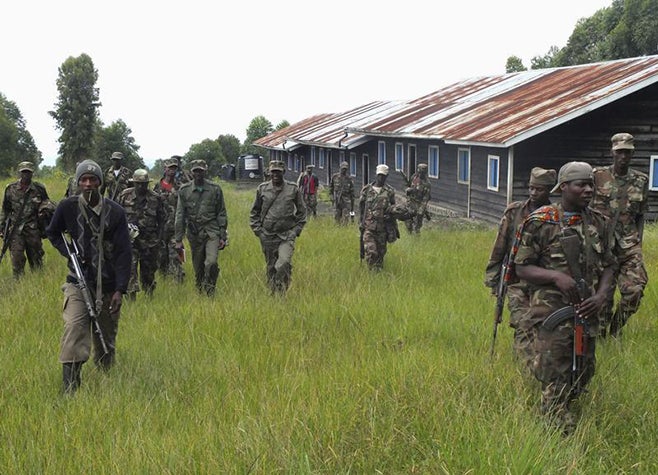
(Goma) – M23 rebels have summarily executed at least 44 people and raped at least 61 women and girls since March 2013 in eastern Democratic Republic of Congo. Local residents and rebel deserters reported recent forced recruitment of men and boys by the M23 in both Rwanda and Congo.
After a nearly two-month-long ceasefire, fighting resumed on July 14 between the Congolese armed forces and M23 rebels near the eastern city of Goma.
Residents and rebel deserters described recent support from within Rwanda to the abusive M23 forces. This includes regular movements from Rwanda into Congo of men in Rwandan army uniforms, and the provision of ammunition, food, and other supplies from Rwanda to the M23. The M23 has been recruiting inside Rwanda. Rwandan military officers have trained new M23 recruits, and have communicated and met with M23 leaders on several occasions.
"Not only is Rwanda allowing its territory to be used by the abusive M23 to get recruits and equipment, but the Rwandan military is still directly supporting the M23," said Daniel Bekele, Africa director at Human Rights Watch. "This support is sustaining an armed group responsible for numerous killings, rapes and other serious abuses."
The latest Human Rights Watch findings are based on more than 100 interviews since March, including with former M23 fighters who left the movement between late March and July and civilians living near the Congo-Rwanda border, some of whom were victims of abuses.
In addition to M23 abuses, Human Rights Watch documented several cases of killings and rapes by Congolese Hutu militia groups operating in and around M23-controlled territory. Some Congolese army officers have allegedly supported factions of these groups, as well as factions of the allied Democratic Forces for the Liberation of Rwanda (FDLR) – a largely Rwandan Hutu armed group, some of whose members participated in the 1994 genocide in Rwanda.
Since its inception in April 2012, the M23 has committed widespread violations of the laws of war. Despite numerous war crimes by M23 fighters, the armed group has received significantsupport from Rwandan military officials. After briefly occupying Goma in November, then withdrawing on December 1, the M23 controls much of Congo's Rutshuru and Nyiragongo territories, bordering Rwanda.
On April 25 and 26, M23 fighters killed 15 ethnic Hutu civilians in several villages in Busanza groupement in Rutshuru territory, and at least another 6 in mid-June, in an apparent attempt to "punish" villagers for alleged collaboration with Congolese Hutu militias.
Other civilians killed by M23 fighters since March include a 62-year-old man who was shot dead because he refused to hand his sons over to the M23, a motorcycle driver who refused to give money to the M23, M23 recruits who were caught after trying to escape, and others accused of collaborating with Hutu militia.
On July 5, four M23 fighters gang-raped a 12-year-old girl as she went to fetch water in her village in Rutshuru. An M23 fighter who accosted an 18-year-old woman near Bunagana shot her in the leg on April 15 when she refused to have sex with him.
Since June, M23 leaders have forced local chiefs in areas under their control to undergo military and ideological training and obtain recruits for the M23. The M23 considers these chiefs to be part of their "reserve force" that can be called upon to provide support during military operations.
M23 fighters have arrested or abducted dozens of civilians in recent weeks in Rutshuru, most of them Hutu. The M23 accused many of them of collaborating with the FDLR or allied Congolese Hutu militias. M23 fighters beat them severely, tied them up, and detained them. The M23 then forced many of them to undergo military training and become M23 fighters.
A former M23 police officer, who deserted in April, told Human Rights Watch that he participated in investigations of killings of civilians. He said that before each investigation, a high-ranking M23 commander, Innocent Kayna, told him: "You will do the investigation. You will say it's bandits in the neighborhood who killed, not M23."
Human Rights Watch contacted the M23's military leader, Sultani Makenga, but he was unavailable to speak about the recent alleged abuses.
Those recruited in Rwanda into the M23 include demobilized Rwandan army soldiers and former FDLR fighters, most of whom had become part of the Rwandan army's Reserve Force, as well as Rwandan civilians. A 15-year-old Rwandan boy told Human Rights Watch that he and three other young men and boys were promised jobs as cow herders in Congo, but when they got to Congo were forced to join the M23. They were given military training by Rwandan officers in Congo and told they would be killed if they tried to escape. Other M23 deserters also said Rwandan officers were training new M23 recruits.
Former M23 officers who had been part of previous Rwanda-backed rebellions said they recognized officers serving with the M23 who they knew were members of the Rwandan army. Congolese deserters told Human Rights Watch that a number of M23 fighters admitted freely that they were Rwandan. Some said they had served in the Rwandan army's peacekeeping contingent in Somalia or Darfur.
Recent M23 deserters interviewed by Human Rights Watch described frequent – in some cases weekly – arrivals of soldiers and recruits from Rwanda. Sometimes these were rotations, with new soldiers replacing others who had returned to Rwanda. Weapons, ammunition, large containers of milk, truckloads of rice, and other supplies were brought to the M23 from Rwanda. M23 deserters also described phone conversations and meetings in both Rwanda and Congo between senior M23 leaders and people the deserters were told or knew to be Rwandan officials.
All of the recent M23 deserters interviewed by Human Rights Watch said that Rwandan soldiers, officers, and trainers were present throughout their time with the M23, and that there had been new arrivals from Rwanda in recent months.
"For the past 17 years, the Rwandan army has repeatedly deployed troops to eastern Congo and backed abusive proxy forces responsible for war crimes," Bekele said. "As in the past, Rwanda denies it's supporting the M23, but the facts on the ground speak for themselves."
Rwandan government and military officials did not respond to Human Rights Watch's requests for a meeting. Rwandan officials in the past have repeatedly denied allegations that the government is providing support to the M23.
The Rwandan government should immediately halt all support to the M23 because of its broadly abusive behavior, Human Rights Watch said. The United Nations and United States special envoys for the Great Lakes region and donor governments should publicly denounce continuing Rwandan support to the M23 and call for sanctions against senior Rwandan officials responsible for backing the armed group.
The Congolese government should immediately suspend, investigate, and prosecute as appropriate Congolese military officers and government officials who have provided support to the FDLR or allied groups. The government should make clear that abusive militia commanders will not be integrated into Congo's army as part of any political settlement.
According to international journalists present near the front line and photographs seen by Human Rights Watch, Congolese army soldiers treated the corpses of M23 fighters killed in combat on July 16 in a degrading manner, stripping them, making ethnic slurs, and prodding their genitals with weapons. International law prohibits "committing outrages upon personal dignity," including against the dead. Human Rights Watch also documented cases in which the Congolese army detained former M23 fighters and alleged collaborators for several weeks without bringing them before a court, and often incommunicado and in harsh conditions.
Congolese military officials should appropriately discipline officers and soldiers responsible for mistreating corpses, and ensure that such acts cease immediately. Military and judicial officials should ensure that captured combatants and civilians are treated in accordance with due process standards, including being promptly brought before a judge and charged, or released. Detainees should not be mistreated or held in inhumane conditions.
Summary Executions and Other Attacks by the M23
Human Rights Watch has documented 44 summary executions committed by the M23 since March. M23 fighters have also killed and wounded an unknown number of civilians, including some caught in the crossfire during fighting.
M23 fighters killed 15 Hutu civilians in several villages in Busanza groupement in Rutshuru territory on April 25 and 26, and at least another 6 in mid-June, in an apparent attempt to "punish" villagers for alleged collaboration with Congolese Hutu militias.During the attack on the night of April 25, a group of M23 fighters moved through the villages of Ruvumbura, Kirambo, Nyamagana, and Shinda, killing and looting as they went. A 43-year-old mother of three told Human Rights Watch: "When they started killing people, we scattered into the bush. My husband went back to try to get our belongings, and they killed him. They shot him in the head."
In late May, M23 fighters shot dead a 62-year-old man in Ntamugenga because he refused to hand his sons over to the M23. On May 15, M23 fighters stopped a motorcycle driver outside Kiwanja and killed him because he did not give them money. In mid-June, M23 fighters shot a moneychanger several times in the chest, killing him. They then told his wife, "Give us money or we'll do to you what we did to your husband." She handed over their money, and the fighters left.
In Kibumba in mid-May, an M23 officer, Col. Yusuf Mboneza, ordered the execution of a 24-year-old man whom he accused of being a thief. After the execution, Mboneza called the villagers to a meeting and displayed the young man's corpse, saying it should serve as a warning to anyone else who might steal.
Others summarily executed by the M23 since March were new recruits and prisoners who unsuccessfully tried to escape.
On June 21, the M23 caught a Congolese M23 fighter known as "Tupac" as he tried to flee near Kabuhanga. They took him back to the military camp at Kamahoro, where the commander ordered the troops into formation and told soldiers to shoot him to discourage other deserters. They shot Tupac twice in the chest at close range. An M23 deserter told Human Rights Watch that he and other recruits were forced to bury Tupac.
After a clash between the M23 and a Congolese Hutu militia group on June 18, M23 fighters looted several villages in Busanza. The fighters demanded money from a 33-year-old woman. When she said she had no money, the fighters cut her on the shoulder with a machete and struck her 11-year-old son on the head. On April 15, an 18-year-old woman was shot in the leg when she refused to have sex with an M23 fighter who approached her at her farm near Bunagana. The victims of these attacks survived with serious injuries.
Rape by the M23
Human Rights Watch has documented 61 cases of rape of women and girls by M23 fighters between March and early July. Because of the stigma surrounding rape and fear of reprisals, the actual number of victims may be much higher. Many of those raped were in their fields or collecting firewood. M23 fighters accused some of them of being the "wives" of FDLR fighters. Most of the rapes occurred close to M23 positions, and some victims recognized the attackers as M23 fighters they had seen before. The rapists frequently told their victims that they would be killed if they spoke about the rape or sought medical treatment.
A 12-year-old girl told Human Rights Watch that an M23 fighter caught and raped her in June as she and her friends were buying sugar cane in a field near an M23 position in Rutshuru:
I saw a [M23] soldier. I started running, but I tripped on a piece of sugar cane and fell. The soldier caught up with me and said he would kill me because I tried to flee. I stopped then because I was very scared. Then he raped me. I cried out, but he closed my mouth.
A 17-year-old girl said M23 fighters had raped her twice. The second time, in June, occurred when she was alone in her house after M23 police abducted her husband and forced him to join a night patrol:
The M23 fighter came into my house and asked me where my husband was. He then put a knife to my chest and said he was going to kill me, and that I should give him money. I told him I didn't have any money, that my husband took it with him on patrol. I was sitting on the bed with my child. The soldier fought with me on the bed. He was stronger than me and he had a gun. Then he raped me.
A 35-year-old Hutu woman who was raped by an M23 fighter near Bunagana in June told Human Rights Watch:
When he finished, he left me in the forest. I was shaking and turned toward the ground, crying.… The one who raped me was an M23 fighter whom I know. I recognized him, but what can I do to him?
Forced Recruitment, Including of Children, and Abductions by the M23
Human Rights Watch has documented dozens of cases of forced recruitment by M23 forces since March, including of children. Recruitment appears to have increased in recent months as the M23 has struggled to keep its forces' numbers up. Over 700 M23 fighters and political cadres fled to Rwanda when Bosco Ntaganda's faction of the M23 was defeated by an M23 faction led by Makenga in March, an estimated 200 M23 fighters were killed during the infighting, and scores of fighters have deserted.
Since June, the M23 leadership has held several meetings with local chiefs and other community leaders and demanded their help in recruiting new fighters. In early June, the M23 forced local leaders and chiefs to attend a week-long military training conducted by Rwandan officers. They also received "ideological training," which included the M23's vision for taking over Congo.
The chiefs were released but are supposed to form part of a "reserve force" that can be called upon when necessary. The M23 ordered them to find recruits in their villages and send them to the M23. One local leader who participated in the training told Human Rights Watch that they had been told to give M23 officials the names of demobilized youth in their villages, so that the M23 "could then go themselves, find the demobilized youth, and make sure they joined up."
The M23 have arrested Hutu civilians whom they accused of collaborating with or supporting the FDLR or Congolese Hutu militia groups. The fighters detained, beat and whipped these civilians, and took many of them to an M23 military camp, where they were trained and forced to become M23 fighters.
A 19-year-old secondary school student told Human Rights Watch that he was recruited by the M23 in March while he was farming near Kalengera, in Rutshuru:
I saw the M23 come and surround me. They asked me if I was an FDLR, and I said no. After that, they started whipping and beating me. They tied me up and took me to Rumangabo, where they locked me in a cell. After two days, they untied me, but left me in the cell for a week. After, they told me I would become a soldier. They then started the military training. There were 80 of us being trained. There were 10 officers from Rwanda who led the training. They told us we had to become soldiers so we could fight to liberate Goma and then continue on to South Kivu.
On June 3, the M23 went from house to house in Kiwanja's Kachemu neighborhood, apprehending about 40 young men and boys whom they accused of collaborating with a local militia group. The fighters beat the civilians and detained them in a cell at the M23's base in Nyongera. Many had difficulty walking the next day as a result of the ill-treatment. About half of the youth were released after their families paid the M23 guards; 20 were taken to Rumangabo to be trained as fighters.
In other cases, families do not know what happened to abducted relatives. In March and April, for example, M23 fighters in Busanza abducted four young men whom they accused of collaborating with a Congolese Hutu militia. Their families have not heard from them since.
Congolese army soldiers captured by M23 fighters described torture and other ill-treatment in detention. One soldier, who was taken by the M23 in December and escaped in early July, said that two other soldiers held prisoner with him were beaten to death. For three days, the rebels hit the prisoners with sticks and stomped on their chests, while their legs and arms were tied together. While beating them, the M23 demanded information about where the Congolese army was hiding its weapons. The two men were not given medical treatment and died in detention.
M23 Recruitment in Rwanda and Other Rwandan Support
Based on interviews with 31 former M23 fighters who deserted since late March and numerous civilians living on both sides of the border, Human Rights Watch has documented military support from Rwanda to the M23. The support includes the provision of weapons and ammunition. Armed men in military uniform have moved regularly from Rwanda into Congo to support the M23; these could be new recruits and demobilized soldiers who were given uniforms before crossing into Congo, or serving Rwandan soldiers.Rwandan army officers have been seen at M23 bases, leading training for new recruits, and recruiting for the M23 in Rwanda.
Those recruited in Rwanda and taken across the border to fight with the M23 include demobilized Rwandan soldiers and former FDLR fighters who are part of the Rwandan army's Reserve Force, as well as civilians, including boys. Between January and June, UN peacekeepers demobilized and repatriated 56 former M23 fighters who said they were Rwandan nationals. But M23 deserters interviewed by Human Rights Watch, as well as the UN Group of Experts on the Democratic Republic of Congo, said that Rwandan army officers forcibly brought back Rwandan nationals who escaped the M23 and tried to return to Rwanda.
Human Rights Watch has documented the cases of seven Rwandan children, ages 15, 16, and 17, who were forcibly recruited in Rwanda in March and April, forced to fight with the M23, and were later able to escape. Human Rights Watch has received reports of other children recruited in Rwanda in recent months who have not been able to escape.
A 15-year-old Rwandan boy told Human Rights Watch that he was forcibly recruited from his village in Nyabihu district in Rwanda with two other boys and a young man in late April. The four of them were making bricks when two men in civilian clothes offered them jobs as cow herders in Congo. The two men then took them by motorcycle to the Congolese border, and on to an M23 military camp. They were forced to become M23 fighters and were warned that they would be killed if they refused or tried to escape.
The 15-year-old said that Rwandan army officers gave them military training for 10 days and that many other Rwandans were in his group of 58 new recruits. He said some of the Rwandan recruits tried to escape, but they were caught and brought back to the camp.
A Congolese M23 officer who deserted in late May told Human Rights Watch that Rwandan recruits and soldiers arrived regularly throughout his time with the M23, from November through May. He said the soldiers would come and go, as they rotated in and out. The recruits were given military training and forced to stay in Congo. Many tried to flee back to Rwanda, he said, but some were caught once they crossed into Rwanda and were taken back to the M23.
One deserter told Human Rights Watch that a Rwandan soldier in his unit had told him in April that he was a demobilized soldier and had come to fight in Congo so he could have a higher rank in the Rwandan army when he went back. He said that two other Rwandans in his unit had escaped to Rwanda in March, but had been re-recruited and brought back to the M23. A former M23 officer said that two Rwandans in his unit escaped in mid-April. Soon after they arrived in Rwanda, the former officer said, neighborhood authorities informed military intelligence officials, who brought the young men back to the M23. They were detained by the M23 for a week, then redeployed.
M23 deserters and Rwandan villagers said that Rwandan soldiers and new recruits often crossed the border on foot at night, using remote trails through Virunga National Park.
Two former M23 officers told Human Rights Watch that some of the Rwandan fighters in their units told them they had served in Somalia or Darfur as part of the Rwandan army's peacekeeping contingent. Several M23 deserters interviewed by Human Rights Watch, who had served in previous Rwanda-backed rebellions, said they recognized Rwandan army officers from their past experiences with the Rwandan military.
A Congolese man from Ntamugenga was forcibly recruited in May and forced to start military training. "In our group, there were 107 in the training," he said. "Most of the others were Rwandans. They told me they had been tricked and were promised money if they came to Congo. Many of them were children. The army officers from Rwanda gave us the training, and they told us themselves that they lived in Rwanda. [After the training], there were demobilized soldiers from Rwanda and some ex-FDLR in my group."
Several M23 deserters who escaped since late May described to Human Rights Watch the difference in the way the M23 treated Rwandans and Congolese within the rebel movement. One said:
Rwandans are favored. They're given uniforms immediately, they're given blankets, and they get boots. They're spoiled. When they talk, they talk like they are the owners of the movement. I felt this threat. [They] called me a loser. They said, "You are worth nothing in your country." They insulted me with things that you can't say out loud. They said, "You Congolese, you may have studied a lot, but you've never been to the front."
M23 deserters described deliveries of weapons, ammunition, food, phone credit, and other supplies from Rwanda. One former officer said that the wives of Rwandan officers often came to the M23's positions in Congo to visit their husbands, bringing with them letters from family members in Rwanda.
All of the M23 deserters Human Rights Watch interviewed said the presence of Rwandan soldiers, officers, and trainers continued throughout their time with the M23, and that new arrivals – often bringing with them military and other supplies – continued coming from Rwanda in recent months.
Three former M23 officers close to the movement's leadership told Human Rights Watch that the M23's senior commanders spoke on the phone and met regularly with senior Rwandan army officers until at least late May or June, when the three deserted. Sometimes Rwandan officers came to Tshanzu or Rumangabo to meet with the M23 leaders, and sometimes the M23 leaders went to Rwanda for meetings.
Rwandan Support for M23 Military Operations
M23 deserters and civilians from near the Congo-Rwanda border reported an increase in support from Rwanda to the M23 at the time of three recent periods of heavy fighting – during infighting between two M23 factions in March; during fighting between the M23 and the Congolese army around Mutaho in late May; and before the fighting north of Goma in mid-July.
After the M23 split into two factions, Rwandan officials backed the faction led by Sultani Makenga against Bosco Ntaganda. A former M23 officer in Makenga's faction told Human Rights Watch: "We were saved by Rwanda, and it's thanks to their support that we were able to defeat Ntaganda's group. They sent us ammunition and well-armed troops."
Days before the fighting in Mutaho in late May, a young Congolese man told Human Rights Watch that M23 fighters abducted him in Kibumba groupement in mid-May. The fighters took him across the border into Rwanda, where they met a group of Rwandan soldiers. He and others with him were forced to carry containers of milk and boxes of ammunition and walk with the soldiers and rebel fighters back into Congo.
A 19-year-old Congolese student who was forcibly recruited by the M23 in March told Human Rights Watch that he and other M23 fighters were taken across the border into Rwanda in mid-May to pick up a delivery of weapons and ammunition and bring them back to the M23. They crossed into Rwanda at Gasizi and the following morning carried the weapons and ammunition to Kibumba in Congo. "The weapons were in two trucks," he said. "We unloaded small bombs, machine guns, cartridges, and rocket launchers. Other Rwandans met us [in Gasizi] to help us carry the weapons back to Kibumba."
Numerous local residents who were at or near the border between May 19 and 23 told Human Rights Watch that they saw groups of armed men in uniform crossing the border from Rwanda into Congo, including at Kasizi, Kabuhanga, and Hehu hill.
On May 20, for example, a teacher in Kasizi, who lives next to the border, saw three trucks arrive at the border at about 5 p.m. A large number of armed men in Rwandan military uniforms with Rwandan flags on their uniforms got out of the trucks and crossed the border into Congo on foot, through the forest, just to the side of the official border crossing.
On May 21, a local resident told Human Rights Watch, he saw at least several dozen soldiers with Rwandan flags on the shoulders of their uniforms by the Ruhunda market in Kibumba at about 11 a.m., walking in single file. They had weapons and some were carrying boxes. Some who appeared to be of a higher rank carried walkie-talkies.
Human Rights Watch also received reports of increased movements of armed men from Rwanda into Congo in the days leading up to the fighting that broke out on July 14.
A farmer told Human Rights Watch that on the evening of July 10 he was visiting a relative who lives next to the Rwanda border in Kibumba groupement when he heard the sound of vehicles, looked out the window, and saw armed men in uniform going from the border toward Kibumba. Some were on foot and others in vehicles.
A farmer who lives on the Rwandan side of the border said he saw similar movements of trucks between July 7 and 11, in the evenings, bringing soldiers to the Rwandan army military position at Njerima. The men got out of the trucks at the border and crossed into Congo on foot.
Another Rwandan civilian who lives near the border, in Rubavu sector, told Human Rights Watch that Rwandan army officers called him and other local residents to a meeting in early July. A Rwandan army captain leading the meeting told those present that the FDLR was close to the border. "Instead of letting the war come to Rwanda," he said. "We will go to the other side."
Four days later, the same Rwandan civilian saw hundreds of Rwandan soldiers cross the border into Congo, carrying heavy weaponry. "Some had heavy guns, the kind that break down and three men each take one section," he said. "Others were carrying mortars. Most of the men were on foot, but they also used two trucks covered with sheeting."
This man said he saw another large movement of Rwandan soldiers cross into Congo on July 8, a week before fighting broke out between the M23 and the Congolese army. During the following week, he saw smaller groups of soldiers cross into Congo.
A Rwandan farmer who lives near Kabuhanga village said he saw groups of several dozen Rwandan army soldiers cross into Congo between June 20 and June 30. He also saw a larger group cross on July 12, two days before fighting broke out.
Abuses by Hutu Militia with Support from Congolese Military Personnel
The M23's control of territory weakened following the infighting between two M23 factions in March. Since then, Congolese Hutu armed groups, including the Popular Movement for Self-Defense (Mouvement populaire d'autodéfense or MPA), have carried out attacks in and around M23-controlled territory, and killed and raped several civilians. UN officials and former Hutu militia fighters told Human Rights Watch that some factions of these groups have received support from Congolese military personnel.
A 16-year-old girl told Human Rights Watch that on June 17, she, two other girls and an older woman who were coming home from their farm in Rutshuru were gang-raped by several Hutu militia fighters. In June, MPA fighters killed the local chief in Buchuzi, in Busanza groupement, as well as two M23 policemen. The fighters accused the chief of recruiting members for the M23. The attack followed a clash on June 6, when M23 fighters attacked the MPA and looted 12 houses and took dozens of goats.
Some of these Congolese Hutu groups are allied with the FDLR, which has long carried out horrific abuses against civilians in eastern Congo, including killings and rapes. Sources interviewed by the UN Group of Experts, cited in the group's leaked interim report in June, said that Congolese army soldiers have supplied ammunition to the FDLR and that local Congolese army officers operating near M23-controlled territory and FDLR commanders "regularly meet and exchange operational information."
Background on the M23 and Recent Fighting
The M23 was formed in April 2012 after a mutiny by former members of a previous Rwanda-backed rebellion, the National Congress for the Defense of the People (CNDP), whose members had integrated into the Congolese armed forces in 2009. With significant support from the Rwandan military, the M23 gained control of much of Rutshuru and Nyiragongo territories in Congo's North Kivu province. In late November, the M23 seizedthe main eastern city of Goma, again with significant Rwandan military support. The M23 withdrew from Goma on December 1, when the Congolese government agreed to peace talks.
On February 24, 11 African countries signed the Peace, Security and Cooperation Framework for the Democratic Republic of Congo and the Region in Addis-Ababa, under the auspices of UN Secretary-General Ban Ki-moon. The signatories – including Congo and Rwanda – agreed not to interfere in the internal affairs of neighboring countries; not to tolerate or provide support of any kind to armed groups; neither to harbor nor provide protection of any kind to anyone accused of war crimes, crimes against humanity, acts of genocide or crimes of aggression, or anyone falling under the UN sanctions regime; and to cooperate with regional justice initiatives. The former president of Ireland, Mary Robinson, was appointed UN special envoy for the Great Lakes Region to support implementation of the Framework Agreement.
On March 18, Ntaganda, one of the M23's leaders, surrendered to the US embassy in the Rwandan capital, Kigali, following his defeat during infighting between two M23 factions. He wastransferred to The Hague, where he is to face charges of war crimes and crimes against humanity at the International Criminal Court. Over 700 M23 fighters and political leaders loyal to Ntaganda also fled to Rwanda, including four people on UN and US sanctions lists: Innocent Zimurinda, Baudouin Ngaruye, Eric Badege, and Jean-Marie Runiga.
Zimurinda and Ngaruye have been implicated in ethnic massacres, rape, torture, and child recruitment. They should not be shielded from justice but instead arrested and prosecuted without delay, Human Rights Watch said.
Makenga and Kayna (known as "India Queen"), who are still in Congo, are also on UN and US sanctions lists and are wanted on Congolese arrest warrants for war crimes and crimes against humanity.
Talks in Kampala, Uganda between the Congolese government and the M23 have made little progress. The Congolese government has insisted that it will not integrate into its forces or reward people implicated in serious human rights abuses, including those who are on UN sanctions lists. Providing official positions to human rights abusers can encourage future human rights violations and is an affront to victims of past abuses, Human Rights Watch said.
After the M23 withdrew from Goma in December, a ceasefire had largely held between the M23 and the Congolese army until heavy fighting broke out around Mutaho, eight kilometers northwest of Goma, on May 20 to 22.
Fighting between the M23 and the Congolese army resumed on July 14 north of Goma.
Since its internal split in March, the M23's control over some territory has weakened, allowing the FDLR and allied Congolese Hutu groups to carry out incursions there.
A new Force Intervention Brigade , an African-led, 3,000-member force made up of troops from South Africa, Tanzania, and Malawi, is being deployed to eastern Congo. The force is part of the UN peacekeeping mission in Congo, MONUSCO, and has a mandate to carry out offensive operations against armed groups operating in eastern Congo. The M23 has strongly opposed the deployment of this force.
Recommendations
To the Rwandan government:
- Immediately end all support for the M23;
- Cooperate with efforts to bring to justice M23 commanders allegedly responsible for war crimes, crimes against humanity and other serious abuses, and ensure that any such commanders who have fled to Rwanda are not shielded from justice;
- Investigate and prosecute as appropriate Rwandan civilian and military officials who may be responsible for aiding and abetting war crimes by the M23 and other rebel forces in Congo.
To the Congolese government:
- Suspend, investigate, and prosecute as appropriate Congolese civilian and military officials who may be responsible for aiding and abetting war crimes by the FDLR and allied armed groups;
- Reject any settlement that rewards M23 leaders allegedly responsible for serious abuses, including Sultani Makenga and Innocent Kayna;
- Appropriately discipline officers and soldiers responsible for mistreating corpses, and ensure that such acts cease immediately;
- Ensure that captured combatants and civilians are treated in accordance with due process standards, including being promptly brought before a judge and charged, or released; ensure that detainees are not mistreated or held in inhumane conditions.
To the UN and US special envoys to the Great Lakes and governments providing aid to Rwanda and Congo:
- Denounce continued support to the M23 from Rwanda, and support sanctions against senior Rwandan officials responsible for supporting the M23 since 2012;
- Seek to ensure that any settlement between the Congolese government and the M23 excludes integration into the Congolese army of M23 leaders, including those on UN and US sanctions lists, implicated in war crimes and other serious abuses;
- Press for the arrest and prosecution of military commanders, including members of the M23, implicated in war crimes and other serious abuses;
- Suspend donor assistance to the Rwandan military for as long as it supports abusive armed groups in Congo, and continue to seek independent information about the use of Rwandan territory to recruit M23 members and the involvement of the Rwandan military in supporting the M23; include strong human rights benchmarks as part of other assistance programs to Rwanda.
 FACEBOOK
 LINKEDIN
 REDDIT
 STUMBLEUPON
 TWITTER
 GOOGLE +
 TUMBLR
Comments
Post a Comment