
Latest Analysis

Independent analysis, commentary and investigations on Africa, the Great Lakes Region and international accountability.

Rwanda: Is President Kagame’s mask slipping?


Is President Kagame's mask slipping?
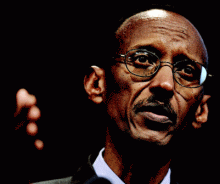
Paul Kagame - sparked Rwandan genocide
Paul Kagame
With the events which took place during Rwandan President Paul Kagame's visit to the UK on 18th May 2013 in aid of Rwanda Day, we take a look at some of his past exploits which might have contributed to his less-than-welcoming reception
A United Nations report known as the Mapping Report, which was published on 1st October 2010, documented clear evidence that President Kagame was responsible for large massacres of Hutu refugees in Congo and members of the Hutu civilian population between March 1993 and June 2003. In paragraph 512 of the report it states:
"The systematic attacks [...] resulted in a very large number of victims, probably tens of thousands of members of the Hutu ethnic group, all nationalities combined. In the vast majority of cases reported, it was not a question of people killed unintentionally in the course of combat, but people targeted primarily by AFDL/APR/FAB [Burundian army] forces and executed in their hundreds, often with edged weapons. The majority of the victims were children, women, elderly people and the sick, who posed no threat to the attacking forces. Numerous serious attacks on the physical or psychological integrity of members of the group were also committed, with a very high number of Hutus shot, raped, burnt or beaten. Very large numbers of victims were forced to flee and travel long distances to escape their pursuers, who were trying to kill them. The hunt lasted for months, resulting in the deaths of an unknown number of people subjected to cruel, inhuman and degrading living conditions, without access to food or medication. On several occasions, the humanitarian aid intended for them was deliberately blocked, in particular in Orientale Province, depriving them of assistance essential to their survival…"
Also, research made in Rwanda and later published in a report titledWhat Really Happened in Rwanda?, on October 6th 2009 by researchers Christian Davenport and Allan C. Stam, showed that Kagame's troops, the RPF, carried out the "large-scale killings" of mainly Hutus during the Rwandan genocide.
But despite this amount of evidence gathering against him, President Kagame continues to play the guilt card on the U.N., for having not responded to the cry for help during the Rwandan Genocide (although Kagame's RPF is the one who officially consistently rejected any offer of help to stop the killings), every time they call him out as a war criminal. This little trick so far has worked like a charm in keeping the U.N. firmly under Kagame's thumb, giving him control over them and silencing all those who try their luck at exposing him, leaving much to be desired in the move towards real justice being served for the criminal.
But the understandable shame of the U.N. should not by any means be reason for them to retreat back into their shells every time the finger is pointed at them. Neither should it be reason for them to be bullied into turning a blind eye to the shocking evidence that is coming forth from left, right and centre exposing the heinous crimes of President Paul Kagame.
Aside from this, Kagame has grown quite accustomed to hiding behind the media attention he gets for having supposedly developed Rwanda economically, this being an image which he actively strives to portray by employing lobbies to publish positive and glowing reports on what great change he has made to the country since the genocide, thus creating this 'perfect' image of himself. But behind this facade still lies a much more grave matter that is soiling this public image which he is working so hard to maintain.
Over the past few years, some of those who have experienced Kagame's cruelty first-hand have publically confessed about their involvement with him, such as the exiled ex-soldier who testified of the same crimes by the RPF as those set out in the U.N.'s Mapping Report - crimes of massacres of Hutu refugees and civilians in the DRC – at the commands of President Kagame, with the objective 'to liquidate any Hutu on Congolese soil'. The confessional interview concluded with the following statement from the Mapping Report:
" The massacres of Hutu refugees in the Democratic Republic of Congo between 1996 and 2002 led to an investigation report of the Office of the United Nations Human Rights known as the Mapping Report. According to the report, these massacres could, if proven before a competent court, be described as genocide."
But what has really been done about these accounts and how many like them must we hear before something can be done? How many men, women, children and elderly people must Kagame torment and kill before a standard can be raised up against him? How much blood must be shed before we can finally say "enough is enough"?
Take a look at the events which took place on 'Rwanda Day' when Kagame visited the UK to receive an award from Oxford University for his "development of Rwanda" on 18th May 2013. It has got to mean something when the President's own people throw eggs, stones and horse manure at him! And what does it mean? That he is not liked? Worse. He is hated. By those who know his deeds and want to see them put to an end. Killing many innocent lives for decades is not a thing to be taken lightly at all. It should carry with it a great punishment.
So it was no surprise that when he came to visit, instead of being welcomed like a good and admired leader, he was shown hatred and contempt by those who would rather see justice served.
In a video interview with the BBC published on 20th May 2013, Kagame unconvincingly attempted to pass off the growing amount of tension surrounding his name as people looking for somewhere "to put the blame". (1)
But no one conspired to make up these stories. And no, these negative reports about him aren't just plucked out of thin air. Everyone pointing the finger at him is doing so for a good reason.
If the saying 'a man is judged by his deeds' is true, then it is fair to say that Kagame has earned himself the title War Criminal of the Highest Degree.
Although I speak in past tense, these crimes by Kagame are far from being old news. Sadly, it is quite clear that such monstrosities carry on even to this day, with a storm of evidence gathering that shows that Kagame continues to hunt down opponents. Whether it be by pulling the strings of the M23  and other proxy rebellions from the comfort of his high chair through ordering the murder of Hutus in the DRC, or whether it be forcefully adorning the refugees who managed to flee to foreign lands with shackles of chains and imprisoning them for their supposed 'crimes', Kagame's crippling grip on his people has never been so strong. But then again, neither has this realisation from both Rwandans and foreigners alike that the face behind his mask is that of a mass murderer. And perhaps, with this realisation, we as a people, can start to determinedly pry his bloody fingers off our society.
—————————
(1) When asked "Why do you think Rwanda is consistently blamed?" Paul Kagame claimed, in his own words: "The same organisations – all those people who put on the blame – I think they have found some kind of industry that serves them and you want to just keep going. The blame is created on the basis of the situation itself, what is happening there, the kind of suffering of people there. And people are interested, simply interested in addressing the peripheral or superficially the problem, are not addressing the root cause of the problem. So in doing that they have created a self-serving industry so they want to keep going now for lack of a better explanation as to why this thing has been going on despite the efforts. They have to find where to put the blame."
Authour: Mireille Mutima

Comments

Support Our Work Now !

Africa Realities Media is independent. Your support helps us expose injustice, challenge silence and produce evidence-based analysis on Africa and the Great Lakes Region.

Recent Posts

Show more
Africa Realities Media offre un espace aux écrivains, chercheurs, experts, activistes, voix communautaires, militants, analystes et personnes ayant une expérience vécue qui souhaitent contribuer à des contenus réfléchis, responsables et courageux sur les changements nécessaires dans la région des Grands Lacs, ainsi que sur les réalités politiques, économiques, culturelles et sociales africaines souvent ignorées, minimisées ou mal représentées. Nos articles et vidéos visent à ouvrir le débat, renforcer la sensibilisation, encourager la pensée critique et favoriser une réflexion plus profonde sur les réalités vécues par les populations africaines. Nous voulons aider les peuples de la région des Grands Lacs à mieux comprendre leurs droits, notamment leurs droits humains, leur droit au développement, leur droit à la dignité, à la sécurité, au bien-être et à une vie meilleure. À travers nos contenus, nous cherchons également à rappeler aux décideurs, aux institutions publiques, aux acteurs régionaux et internationaux, ainsi qu’aux responsables politiques, leur devoir de transparence, de responsabilité et de redevabilité envers les populations qu’ils prétendent servir. Notre objectif est de contribuer à une culture de vérité, de justice, de participation citoyenne et de protection égale pour tous les peuples africains.

Why We Exist

Many abuses facing African people are committed by African states, ruling elites, armed groups, military forces and security services. But these abuses are often sustained by international silence, Western lobbying, trade interests, migration deals, mineral access, diplomatic partnerships and unequal global accountability. Africa Realities Media exposes that system.

Lived Experience Matters

Survivors, displaced communities, refugees, families affected by repression, journalists, activists, women, young people and diaspora voices are not passive subjects. They are knowledge holders. Their experiences must shape policy, advocacy, journalism and public debate. The people closest to injustice are often closest to the solutions.

Our Principle

Africa Realities Media is rooted in one principle: African lives deserve equal truth, equal justice and equal protection.

Popular Posts

[RwandaLibre] Re: Miss Rwanda 2014

  En l'espace de quelques heures, en moins de 24 heures, je viens de lire 3 postings différents, provenant d'autant de membres différents, qui pointent vers la défaillance du système d'éducation au Rwanda. Certains surnomment ironiquement les diplômes générés par ce système "Merci Kagame"! Rares sont les écoles, fussent-elles du tiers-monde, où les étudiants à la fin de leurs études seraient incapables de fonctionner dans d'autres écoles à l'étranger. Pourtant c'est la triste réalité actuelle au Rwanda. Pour ceux qui connaissent le fonctionnement des Nations-Unies, il est grand temps de dépêcher sur place un rapporteur spécial... L'UNESCO peut-être! Sibomana Jean Bosco. *DHR* BBC: Iyumvire uburyo Kagame na FPR bazambije uburezi mu Rwanda kuburyo ababyeyi bifite bahitamo kohereza abana babo hanze Libellés : Forums Peter Rwagasabo - 29 janv. à rwagasabo, (bcc:Democrac...

[RwandaLibre] Itangazo ry'inama yahuje amashyaka i Buruseli kuwa 01/02/2014 -

  http://www.veritasinfo.fr/m/article-122363461.html Itangazo ry'inama yahuje amashyaka i Buruseli kuwa 01/02/2014 Nk'uko byari biteganyijwe, kuri uyu wa gatandatu tariki ya 01/02/2014, i Buruseli mu Bubiligi hateraniye inama y'amashyaka atavuga rumwe n'ubutegetsi bwa Perezida Paul Kagame. Ku mashyaka icumi yari yatumiwe, ayabonetse mu nama ni atandatu (60%), ari yo : 1. Forces Démocratiques Unifiées (FDU-Inkingi) ; 2. Forces Démocratiques de Libération du Rwanda (FDLR) ; 3. Pacte Démocratique du Peuple (PDP-Imanzi) ; 4. Parti pour la Démocratie au Rwanda (PDR-Ihumure) ; 5. Parti Social (PS-Imberakuri) ; 6. Rwandan Dream Initiative (RDI-Rwanda Rwiza). Ihuriro FCLR - Ubumwe naryo ryari rihagarariwe muri iyo nama.   Mu gutangira inama, abayijemo batoye umuyobozi wayo. Bamaze gusuzuma no kwemeza umurongo w'ibyigwa, bemeje ko muri iki gihe, ubufatanye  bw'amashyaka ya opposition ari ngombwa cyane  ...

The FDLR Myth: How Rwanda Weaponises a Diminished Threat to Justify Occupation

The FDLR Myth: How Rwanda Weaponises a Diminished Threat to Justify Occupation Investigation Exposes Contradictions in Rwanda's Security Narrative For over a decade, Rwanda has justified its military presence in eastern Democratic Republic of Congo by citing threats from the FDLR, a Hutu militia group linked to the 1994 genocide. But an investigation into FDLR's actual capabilities, Rwanda's military operations, and patterns of violence reveals a narrative that does not match reality. The FDLR threat, whilst real, has been systematically exaggerated and manipulated to justify objectives that have nothing to do with the militia group. Introduction The Democratic Forces for the Liberation of Rwanda (FDLR) occupies a central position in Rwanda's justification for military intervention in eastern Democratic Republic of Congo. For more than two decades, Rwandan authorities have portrayed the militia group as an existential threat requiring sustaine...

[RwandaLibre] Re: Itangazo ry'inama yahuje amashyaka i Buruseli kuwa 01/02/2014 -

  @Mbera. Urakoze gutanga ibisobanuro birambuye kuri iyi ngingo. Ndagirango cyokora nkosore aho wafifitse nkana ugamije kujijisha rubanda.   Uragira uti: 1- [Hari ]urubuga rwa internet rw'umwimerere rwashyizweho muri 2007 http://www.fdu-rwanda.org/  n'urundi rubuga rwashinzwe n'abasigaye bakorera mu nzego bashyizeho bo nyuma y'aho Présidente agiriye mu Rwanda, arirwo http://www.fdu-rwanda.com/  rwashinzwe muri 2011. Nk'umuntu wamye uba Umunyamabanga mukuru wa FDU-Inkingi ukaba n'umuvugizi wayo kandi ukaba igikomeje kubyiyuta n'ubwo zahinduye imirishyo, wagombye kuba uzi ko Original website ya FDU-Inkingi yari  www.fdu-udf.org nk'uko bigararara muri iri tangazo ryo kuwa 23 Kamena 2010 umbere y'amakimbirane yatangiye muri january 2011: Nta kandida wigenga uzava muri FDU http://www.victoire2010.com/uploads/media/UMUKANDIDA_WA__FDU_01.pdf Kuba ruriya rubuga rundi rwaragiyeho nyuma byo ntawe utabizi kandi byar...

The Aggressor’s Complaint: Why Rwanda’s “Biased” US Sanctions Argument Echoes Russia

Kigali wants Washington to punish Congo too. But a ceasefire that leaves the occupier in place is not peace; it is occupation without noise. African lives are not worth less. African deaths are not normal. Western interests must never become a licence to kill African people. Introduction: A Familiar Complaint On 29 June 2026, Rwanda’s Minister of Foreign Affairs, Olivier Nduhungirehe, sat before the cameras of France 24 and declared that his country was “disappointed by the increasingly biased US mediation” in the conflict with the Democratic Republic of Congo. He asked why sanctions had targeted only Rwanda. He called the measures unfair, one-sided and counterproductive. Weeks earlier, President Paul Kagame had told Jeune Afrique that sanctions and threats were insults thrown at Rwanda, and accused Washington of exerting heavy pressure on Rwanda while treating the DRC more delicately. The grievance sounds reasonable until you remember where you have heard it before. Since 2022, the Kr...

THE GENOCIDE AGAINST THE HUTU. PART 2: DOCUMENTED MASS KILLINGS OF HUTU POPULATIONS

MASS KILLINGS OF HUTU BEFORE, DURING, AND AFTER 1994 IN RWANDA, DRC AND UGANDA INTRODUCTION TO PART 2 Part 1 established the assassination of President Habyarimana, the Bruguière and Spanish investigations, Kagame's responsibility for starting the war, the Kigali massacres, challenges to the "genocide against the Tutsi only" narrative, and the need for UN framework revision. Part 2 documents specific mass killings of Hutu populations that have been systematically erased from history: the Kibeho massacre of 1995, the Byumba Stadium massacre of 1994, the hunting and slaughter of Hutu refugees in the Democratic Republic of Congo from 1996 to 1997, killings in Uganda, and the pattern of political assassinations and property seizures. 2. THE KIBEHO MASSACRE (22 APRIL 1995) 2.1 The Camp and Its Population By April 1995, the Kibeho internally displaced persons camp in Gikongoro prefecture southwestern Rwanda held between 80,000 and 100,000...

Desperate Kagame: Where Does He Go From Here—and What Comes Next?

  How Paul Kagame Uses Diplomats' "Bury Your Head in the Sand" Strategy as a Green Light to Continue Rwanda's War in the DRC Africa Realities Media   |   17 July 2026 The purpose of this article is to expose a deliberate and systematic strategy: Paul Kagame's years-long practice of creating events — diplomatic dinners, RPF party meetings, genocide commemorations, international business forums and RPF Bureau Politique addresses — to which he invites foreign ambassadors and the world's business and political elite for one purpose: to explain, justify, and defend Rwanda's military invasion of the Democratic Republic of Congo. Everybody who follows this region knows the strategy now. The same narrative. The same arguments. The same defiance. At one event he tells the Trump Administration to go to hell. At the next he says those sanctioning him will leave power and he will remain. At the RPF Bureau Politique of 17 July 2026, he tells ambassadors that the on...

Analyse de l'audition de M Dacian Cioloș, candidat au poste de Secrétaire général de la Francophonie

  Le 30 juin 2026, pour la première fois en cinquante-six ans d'existence de l'Organisation internationale de la Francophonie, les candidats au poste de Secrétaire général ont été auditionnés publiquement devant les ministres des Affaires étrangères des 53 États membres de plein droit, réunis en Conférence ministérielle extraordinaire à Paris. Parmi les quatre prétendants au mandat 2027-2030, qui sera attribué par les chefs d'État au XXe Sommet de la Francophonie à Phnom Penh les 15 et 16 novembre 2026, figure un profil inédit : Dacian Cioloș, ancien Premier ministre de Roumanie, ancien commissaire européen à l'Agriculture et ancien président du groupe Renew au Parlement européen, seul candidat non africain de la course. Cet article, premier d'une série de cinq consacrée aux auditions, analyse la prestation de M. Cioloș sur huit axes : la vision, l'innovation, le développement des communautés locales, la promotion de la langue française, les conflits et la s...

Kagame désespéré : où va-t-il aller maintenant — et que va-t-il se passer ensuite ?

Comment Paul Kagame utilise la stratégie diplomatique de « l’autruche » comme feu vert pour poursuivre la guerre du Rwanda en RDC Le but de cet article est d’exposer une stratégie délibérée et systématique : la pratique, poursuivie depuis des années par Paul Kagame, consistant à créer des événements — dîners diplomatiques, réunions du parti FPR, commémorations du génocide, forums internationaux d’affaires et interventions devant le Bureau Politique du FPR — auxquels il invite des ambassadeurs étrangers ainsi que l’élite mondiale des affaires et de la politique dans un seul but : expliquer, justifier et défendre l’invasion militaire de la République démocratique du Congo par le Rwanda. Tous ceux qui suivent cette région connaissent désormais cette stratégie. Le même récit. Les mêmes arguments. La même défiance. Lors d’un événement, il dit à l’administration Trump d’aller au diable. Lors du suivant, il affirme que ceux qui le sanctionnent quitteront le pouvoir tandis que lui restera. Lor...

Analyse de l'audition de Mme Coumba Bâ, candidate au poste de Secrétaire général de la Francophonie

La francophonie utile à l'épreuve des projets concrets Conseillère à la présidence mauritanienne, forte d'une longue expérience auprès de cinq chefs d'État successifs de son pays, Coumba Bâ porte la candidature de la Mauritanie au poste de Secrétaire général de la Francophonie, dont le titulaire du mandat 2027-2030 sera désigné par les chefs d'État au XXe Sommet de la Francophonie, prévu à Phnom Penh les 15 et 16 novembre 2026. Son audition publique du 30 juin 2026 à Paris, devant les ministres des Affaires étrangères des 53 États membres de plein droit, reposait sur un positionnement singulier : celui d'un pays carrefour, à la fois africain, arabe et sahélien, présenté comme un pont possible vers les États qui ont quitté l'organisation. Cet article, quatrième d'une série de cinq consacrée aux auditions, analyse sa prestation sur huit axes : la vision, l'innovation, le développement des communautés locales, la promotion de la langue française, les confli...

Why Africa Realities Media Is Different

Africa Realities Media speaks to Africa and to the developed world. Many abuses facing African people are committed by African states and ruling elites, but they are often protected by international silence, lobbying, public relations, trade interests, migration deals and unequal global accountability. While governments pay lobbyists to present a good image abroad, ordinary African people continue to face violence, hunger, disease, poverty, repression and exclusion. We challenge the normalisation of African suffering and demand equal truth, equal justice and equal protection.

Pourquoi Africa Realities Media est différent?

Africa Realities Media s’adresse à l’Afrique et au monde développé. De nombreux abus subis par les peuples africains sont commis par des États africains et des élites dirigeantes, mais ils sont souvent protégés par le silence international, le lobbying, les relations publiques, les intérêts commerciaux, les accords migratoires et une responsabilité mondiale inégale. Tandis que des gouvernements paient des lobbyistes pour présenter une bonne image à l’étranger, des Africains ordinaires continuent de faire face à la violence, à la faim, aux maladies, à la pauvreté, à la répression et à l’exclusion. Nous contestons la normalisation de la souffrance africaine et exigeons une vérité égale, une justice égale et une protection égale.

BBC News

Policy and Systems Change

Our work is designed to trigger debate, discomfort and action. We do not only expose injustice; we work for policy and systems change. We want governments and institutions to address the root causes of inequality, disadvantage, discrimination, exclusion and barriers affecting African people. We believe lasting change must be shaped by people with lived experience.

Exposing Injustice in Africa

Africa Realities Media is an independent African accountability platform based in London. We report, analyse and challenge the systems that shape African suffering, silence African victims and protect abusive power. We are not here to repeat diplomatic language. We are here to ask the questions that are often avoided: why are African deaths treated as normal? Why are African victims given less urgency? Why are governments that imprison, exclude, displace or kill their own people protected when they serve powerful international interests?

Africanews

Africa Realities Media gives space to writers, researchers, experts, activists, community voices, campaigners, analysts and people with lived experience who want to contribute thoughtful, responsible and courageous content about the changes needed in the region, as well as the political, economic, cultural and social African realities that are often ignored, minimised or misrepresented. Our articles and videos aim to encourage debate, raise awareness, stimulate critical thinking and support reflection. We seek to help people in the Great Lakes Region understand their rights to human rights, development and wellbeing, while also encouraging decision-makers to be more transparent, responsive and accountable.

Appel à contributions

Sensibilisez le public aux causes qui vous tiennent à cœur. Prenez part au changement que vous souhaitez voir émerger. Aidez à combattre l’injustice partout où elle se manifeste.

Africa Realities Media accueille des articles originaux, analyses, tribunes, réflexions communautaires et commentaires fondés sur des faits concernant la région des Grands Lacs africains, ainsi que les questions liées à la justice, aux droits humains, à la gouvernance, aux conflits, à la paix, aux réfugiés, aux ressources naturelles et à la responsabilité publique en Afrique.

Nous accueillons également les annonces concernant de nouvelles ou d’anciennes publications liées à nos domaines d’intérêt. Vous pouvez annoncer gratuitement votre publication, notamment un livre, un rapport, une étude, un article académique ou tout autre travail pertinent.

Les articles doivent être rédigés en anglais ou en français et ne doivent pas dépasser 1 500 mots.

Veuillez inclure le nom complet de l’auteur, qui sera publié avec l’article s’il est accepté.

Avant de soumettre votre article, veuillez d’abord lire nos pages du site web afin de vérifier si votre article correspond à nos priorités éditoriales, à nos thèmes et à nos domaines d’intérêt.

Si vous avez un article, un commentaire ou une annonce de publication à partager avec un public plus large, veuillez l’envoyer par email à :

africarealitiesmedia@gmail.com

Nous étudierons la possibilité de publier gratuitement les articles et annonces de publications appropriés s’ils répondent à nos critères éditoriaux, notamment la pertinence, la clarté, l’originalité, l’intérêt public, le respect des communautés concernées et l’utilisation responsable des informations et des preuves.

Les articles sont publiés tels qu’ils sont soumis s’ils répondent à nos critères et à notre politique éditoriale. Nous ne procédons pas à une modification supplémentaire de votre article avant sa publication.