
Donate Today !

Africa Realities Media is independent. Your support helps us expose injustice, challenge silence and produce evidence-based analysis on Africa and the Great Lakes Region.

Latest Analysis

Independent analysis, commentary and investigations on Africa, the Great Lakes Region and international accountability.

Rwanda: Is President Kagame’s mask slipping?


Is President Kagame's mask slipping?
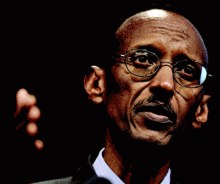
Paul Kagame - sparked Rwandan genocide
Paul Kagame
With the events which took place during Rwandan President Paul Kagame's visit to the UK on 18th May 2013 in aid of Rwanda Day, we take a look at some of his past exploits which might have contributed to his less-than-welcoming reception
A United Nations report known as the Mapping Report, which was published on 1st October 2010, documented clear evidence that President Kagame was responsible for large massacres of Hutu refugees in Congo and members of the Hutu civilian population between March 1993 and June 2003. In paragraph 512 of the report it states:
"The systematic attacks [...] resulted in a very large number of victims, probably tens of thousands of members of the Hutu ethnic group, all nationalities combined. In the vast majority of cases reported, it was not a question of people killed unintentionally in the course of combat, but people targeted primarily by AFDL/APR/FAB [Burundian army] forces and executed in their hundreds, often with edged weapons. The majority of the victims were children, women, elderly people and the sick, who posed no threat to the attacking forces. Numerous serious attacks on the physical or psychological integrity of members of the group were also committed, with a very high number of Hutus shot, raped, burnt or beaten. Very large numbers of victims were forced to flee and travel long distances to escape their pursuers, who were trying to kill them. The hunt lasted for months, resulting in the deaths of an unknown number of people subjected to cruel, inhuman and degrading living conditions, without access to food or medication. On several occasions, the humanitarian aid intended for them was deliberately blocked, in particular in Orientale Province, depriving them of assistance essential to their survival…"
Also, research made in Rwanda and later published in a report titledWhat Really Happened in Rwanda?, on October 6th 2009 by researchers Christian Davenport and Allan C. Stam, showed that Kagame's troops, the RPF, carried out the "large-scale killings" of mainly Hutus during the Rwandan genocide.
But despite this amount of evidence gathering against him, President Kagame continues to play the guilt card on the U.N., for having not responded to the cry for help during the Rwandan Genocide (although Kagame's RPF is the one who officially consistently rejected any offer of help to stop the killings), every time they call him out as a war criminal. This little trick so far has worked like a charm in keeping the U.N. firmly under Kagame's thumb, giving him control over them and silencing all those who try their luck at exposing him, leaving much to be desired in the move towards real justice being served for the criminal.
But the understandable shame of the U.N. should not by any means be reason for them to retreat back into their shells every time the finger is pointed at them. Neither should it be reason for them to be bullied into turning a blind eye to the shocking evidence that is coming forth from left, right and centre exposing the heinous crimes of President Paul Kagame.
Aside from this, Kagame has grown quite accustomed to hiding behind the media attention he gets for having supposedly developed Rwanda economically, this being an image which he actively strives to portray by employing lobbies to publish positive and glowing reports on what great change he has made to the country since the genocide, thus creating this 'perfect' image of himself. But behind this facade still lies a much more grave matter that is soiling this public image which he is working so hard to maintain.
Over the past few years, some of those who have experienced Kagame's cruelty first-hand have publically confessed about their involvement with him, such as the exiled ex-soldier who testified of the same crimes by the RPF as those set out in the U.N.'s Mapping Report - crimes of massacres of Hutu refugees and civilians in the DRC – at the commands of President Kagame, with the objective 'to liquidate any Hutu on Congolese soil'. The confessional interview concluded with the following statement from the Mapping Report:
" The massacres of Hutu refugees in the Democratic Republic of Congo between 1996 and 2002 led to an investigation report of the Office of the United Nations Human Rights known as the Mapping Report. According to the report, these massacres could, if proven before a competent court, be described as genocide."
But what has really been done about these accounts and how many like them must we hear before something can be done? How many men, women, children and elderly people must Kagame torment and kill before a standard can be raised up against him? How much blood must be shed before we can finally say "enough is enough"?
Take a look at the events which took place on 'Rwanda Day' when Kagame visited the UK to receive an award from Oxford University for his "development of Rwanda" on 18th May 2013. It has got to mean something when the President's own people throw eggs, stones and horse manure at him! And what does it mean? That he is not liked? Worse. He is hated. By those who know his deeds and want to see them put to an end. Killing many innocent lives for decades is not a thing to be taken lightly at all. It should carry with it a great punishment.
So it was no surprise that when he came to visit, instead of being welcomed like a good and admired leader, he was shown hatred and contempt by those who would rather see justice served.
In a video interview with the BBC published on 20th May 2013, Kagame unconvincingly attempted to pass off the growing amount of tension surrounding his name as people looking for somewhere "to put the blame". (1)
But no one conspired to make up these stories. And no, these negative reports about him aren't just plucked out of thin air. Everyone pointing the finger at him is doing so for a good reason.
If the saying 'a man is judged by his deeds' is true, then it is fair to say that Kagame has earned himself the title War Criminal of the Highest Degree.
Although I speak in past tense, these crimes by Kagame are far from being old news. Sadly, it is quite clear that such monstrosities carry on even to this day, with a storm of evidence gathering that shows that Kagame continues to hunt down opponents. Whether it be by pulling the strings of the M23  and other proxy rebellions from the comfort of his high chair through ordering the murder of Hutus in the DRC, or whether it be forcefully adorning the refugees who managed to flee to foreign lands with shackles of chains and imprisoning them for their supposed 'crimes', Kagame's crippling grip on his people has never been so strong. But then again, neither has this realisation from both Rwandans and foreigners alike that the face behind his mask is that of a mass murderer. And perhaps, with this realisation, we as a people, can start to determinedly pry his bloody fingers off our society.
—————————
(1) When asked "Why do you think Rwanda is consistently blamed?" Paul Kagame claimed, in his own words: "The same organisations – all those people who put on the blame – I think they have found some kind of industry that serves them and you want to just keep going. The blame is created on the basis of the situation itself, what is happening there, the kind of suffering of people there. And people are interested, simply interested in addressing the peripheral or superficially the problem, are not addressing the root cause of the problem. So in doing that they have created a self-serving industry so they want to keep going now for lack of a better explanation as to why this thing has been going on despite the efforts. They have to find where to put the blame."
Authour: Mireille Mutima

Comments

Recent Posts

Show more

Why We Exist

Many abuses facing African people are committed by African states, ruling elites, armed groups, military forces and security services. But these abuses are often sustained by international silence, Western lobbying, trade interests, migration deals, mineral access, diplomatic partnerships and unequal global accountability. Africa Realities Media exposes that system.

Lived Experience Matters

Survivors, displaced communities, refugees, families affected by repression, journalists, activists, women, young people and diaspora voices are not passive subjects. They are knowledge holders. Their experiences must shape policy, advocacy, journalism and public debate. The people closest to injustice are often closest to the solutions.

Our Principle

Africa Realities Media is rooted in one principle: African lives deserve equal truth, equal justice and equal protection.

Popular Posts

Le Président Macron contre les sanctions américaines imposées au Rwanda

Comment les intérêts français au Mozambique font obstacle à la paix en RDC Analyse critique de l'entretien d'Emmanuel Macron avec TV5 Monde, Africa Forward Summit, Nairobi, 12 mai 2026 Publié par The African Rights Campaign (ARC)   |   Londres, mai 2026     1. Introduction La présente analyse est fondée sur l'entretien accordé par le président français Emmanuel Macron à TV5 Monde, le 12 mai 2026, lors de l'Africa Forward Summit à Nairobi, au Kenya. Au cours de cet entretien, Macron s'est vu poser une question directe : étant donné que le soutien du Rwanda au groupe armé M23 est aujourd'hui documenté par les experts des Nations Unies, et étant donné que les États-Unis ont imposé des sanctions aux Forces de défense du Rwanda (FDR) ainsi qu'à plusieurs de leurs hauts responsables, pourquoi la France et l'Union européenne n'ont-elles pas fait de même ? La réponse de Macron s'est révélée peu convaincante, malhonnête et analytique...

President Macron Against US Sanctions on Rwanda

How France's Interests in Mozambique Obstruct Peace in the DRC A Critical Analysis of Emmanuel Macron's Interview with TV5 Monde, Africa Forward Summit, Nairobi, 12 May 2026 Published by The African Rights Campaign (ARC)   |   London, May 2026   1. Introduction This analysis is based on French President Emmanuel Macron's interview with TV5 Monde, conducted on 12 May 2026 during the Africa Forward Summit in Nairobi, Kenya. In that interview, Macron was asked a direct question: given that Rwanda's support for the M23 armed group has been documented by United Nations experts, and given that the United States has imposed sanctions on the Rwanda Defence Force and several of its senior officers, why have France and the European Union declined to do the same? Macron's response was unconvincing, dishonest and analytically incoherent. It revealed not a carefully calibrated position of principled neutrality, but the operational logic of a government that has c...

L’Encouragement de la France à Kagame pour Poursuivre l’Occupation Rwandaise de l’Est de la RDC

  L’Encouragement de la France à Kagame pour Poursuivre l’Occupation Rwandaise de l’Est de la RDC Comment l’intervention de Macron à Nairobi protège l’agresseur et sape la responsabilité internationale Publié par la Campagne Africaine pour les Droits (ARC) | Mai 2026   Introduction Le 12 mai 2026, à l’issue du Sommet Africa Forward de Nairobi, au Kenya, le président français Emmanuel Macron a accordé une interview de quarante minutes à France 24, RFI et TV5 Monde. L’interview a abordé une série de questions de politique africaine. Sur le sujet de la République Démocratique du Congo et du Rwanda, Macron a adopté une position qui n’était pas simplement diplomatiquement prudente — elle était analytiquement trompeuse, stratégiquement intéressée, et directement préjudiciable à l’architecture de responsabilité internationale que les États-Unis avaient commencé à construire. Macron s’est opposé à l’adoption de sanctions collectives contre Kigali sur le modèle a...

LA BATAILLE DE RUBAYA : La guerre du Rwanda pour les minerais exposée

Le prétexte des FDLR s’effondre sous le poids du pillage documenté Introduction : une bataille qui dit la vérité Lorsque les forces RDF/M23 soutenues par le Rwanda ont combattu avec une férocité extraordinaire pour s’emparer de Rubaya et la conserver — une ville minière reculée du Nord-Kivu, dans l’est de la République démocratique du Congo — la justification officielle était la sécurité. La ligne publique constante de Kigali a été que sa présence militaire en RDC répond à la menace posée par les Forces démocratiques de libération du Rwanda (FDLR), un groupe armé dont les dirigeants comprennent des individus liés au génocide de 1994 contre les Tutsi. Ce récit a été accepté, nuancé, ou laissé insuffisamment contesté par les gouvernements occidentaux et les institutions multilatérales pendant plus d’une décennie. La bataille de Rubaya met ce récit à nu. Ce qui s’est déroulé à Rubaya n’était pas une opération de contre-insurrection contre des restes génocidaires. C’était une campagne mili...

[AFRICAFORUM] Tr : [hinterland1] Tr : L'OCCUPATION RWANDAISE EN MARCHE

  ----- Mail transféré ----- De : Mpania Jean <drjeanmpania@yahoo.fr> À : Hinterland <hinterland1@yahoogroupes.fr> Envoyé le : Mercredi 26 février 2014 17h13 Objet : [hinterland1] Tr : L'OCCUPATION RWANDAISE EN MARCHE   Le Mercredi 26 février 2014 9h56, congokdp <congokdp@gmail.com> a écrit : L'OCCUPATION RWANDAISE EN MARCHE :   Voici comment les institutions et tout le système de sécurité de la RDC sont sous contrôle du Rwanda et les officiels congolais infiltrés par des «hirondelles» rwandaises! L'OCCUPATION RWANDAISE EN MARCHE :  Voici comment les institutions et tout le système de sécurité de la RDC sont sous contrôle du Rwanda et les officiels congolais infiltrés par des «hirondelles» rwandaises! Le processus d'occupation de la RDC par le lobby tutsi rwandais passe par le...

Dr Phil Clark ( SOAS University of London): A biased lecturer and researcher about African issues.

Dr Phil Clark   was born in Sudan and   is currently   working at SOAS University of London. He is known to be   biased lecturer and researcher about African issues, particularly the Rwandan genocide.     With his poor judgement and analytical thinking, this man only talk about   the results   of events and forget the     root causes. He is a staunch supporter of the criminal, dictator and killer Paul Kagame , the President of   Rwanda. He is singing the song of the winner of the Rwandan  war. He is in the same boat with Linda Melvern, a biased British   freelancer who received a medal from the dictator Paul     Kagame. "> "> Dr.Phil Clark "> Linda Melvern I am asking Dr Phil Clark   one question:   Dear   Dr Phil Clark, What     was the   role of   Paul Kagame and RPF in the Rwandan  massacres and genocide in and outside Rwanda?   Based...

La mafia du génocide rwandais en France

  ENQUÊTE  |  FRANCE  |  RWANDA La mafia du génocide rwandais en France : réseaux d'influence, instrumentalisation judiciaire et réécriture de l'histoire Comment Kigali a déployé et utilise en France un réseau d'ONG, de journalistes, de chercheurs, de magistrats et de commissions officielles pour imposer le récit du FPR, neutraliser ses adversaires et réécrire l'histoire du génocide à son profit.     Introduction Depuis la prise du pouvoir par le Front patriotique rwandais (FPR) en juillet 1994, la France occupe une position singulière dans la stratégie internationale de Kigali. D'abord désignée comme puissance co-responsable du génocide des Tutsi, accusée d'avoir armé le régime Habyarimana et protégé les auteurs des massacres, Paris a progressivement capitulé devant les exigences du Rwanda. Le sentiment de culpabilité que la France a développé envers elle-même hante durablement ses institutions et ses citoyens — et c'est précisément ce...

Les remèdes cosmétiques de la France face à la guerre dans l’est de la RDC

Résolution 2773, Conférence de Paris, doctrine macronienne du dialogue et pari de la Francophonie La politique de la France à l’égard de l’est de la RDC a produit un schéma constant : un langage public fort, une faible application des décisions, aucune pression visible fondée sur les sanctions, et des appels répétés au dialogue qui laissent largement intact le levier militaire et politique du Rwanda. La France ne peut pas rédiger des résolutions, organiser des conférences, rejeter les sanctions, appeler au dialogue, puis revendiquer la neutralité pendant que les civils restent sous occupation, déplacement et violence. Dans une guerre de cette ampleur, le silence et l’inaction ne sont pas neutres. Ce sont des actes politiques. Introduction La France se présente comme l’une des puissances occidentales les plus engagées dans la recherche de la paix dans l’est de la République démocratique du Congo. Elle a parrainé la Résolution 2773 du Conseil de sécurité des Nations unies. Elle a organ...

RE: [AfricaRealities.com] Fw: [uRwanda_rwacu] In Focus: Rwanda's problem is not about Hutu and Tutsi but lack of freedom and democracy.

  Lies Rwanda  problem is Tutsi  versus Hutu,  it covers  all  countries  of central Africa. thank you To: africarealities@yahoogroups.com From: AfricaRealities@yahoogroups.com Date: Mon, 29 Jun 2015 18:50:39 +0000 Subject: [AfricaRealities.com] Fw: [uRwanda_rwacu] In Focus: Rwanda's problem is not about Hutu and Tutsi but lack of freedom and democracy.   Subject: [uRwanda_rwacu] In Focus: Rwanda's problem is not about Hutu and Tutsi but lack of freedom and democracy.   In Focus: Rwanda's problem is not about Hutu and Tutsi but lack of freedom and democracy June 29, 2015 15:58 BST Embed   Feed The Rwandan government has condemned the arrest of its intelligence chief Karenzi Karake, who is accused of having committed war c...

[AfricaRealities.com] The arrogance of power

  The arrogance of power All over the world there are some leaders who are reluctant to give up power. The most striking current example is   Burundi's President Pierre Nkurunziza   who, amidst violent opposition, is campaigning for a third term in office despite the constitution saying he can only have two. He argues that he was appointed, not elected, to his first term so it doesn't count. Many believe President Paul Kagame in neighbouring Rwanda is also looking to breach his two-term limit. But that would be a mere dot in time for President Yahya Jammeh of The Gambia. "If I have to rule this country for one billion years I will,"   he told the BBC in 2011 . Hanging on does not always work. The President of Burkina Faso, Blaise Compaore, was   overthrown by popular protest last year   for trying to change the constitution so that he could seek re-election. 'Let him continue' While some presidents...

Why Africa Realities Media Is Different

Africa Realities Media speaks to Africa and to the developed world. Many abuses facing African people are committed by African states and ruling elites, but they are often protected by international silence, lobbying, public relations, trade interests, migration deals and unequal global accountability. While governments pay lobbyists to present a good image abroad, ordinary African people continue to face violence, hunger, disease, poverty, repression and exclusion. We challenge the normalisation of African suffering and demand equal truth, equal justice and equal protection.

Pourquoi Africa Realities Media est différent?

Africa Realities Media s’adresse à l’Afrique et au monde développé. De nombreux abus subis par les peuples africains sont commis par des États africains et des élites dirigeantes, mais ils sont souvent protégés par le silence international, le lobbying, les relations publiques, les intérêts commerciaux, les accords migratoires et une responsabilité mondiale inégale. Tandis que des gouvernements paient des lobbyistes pour présenter une bonne image à l’étranger, des Africains ordinaires continuent de faire face à la violence, à la faim, aux maladies, à la pauvreté, à la répression et à l’exclusion. Nous contestons la normalisation de la souffrance africaine et exigeons une vérité égale, une justice égale et une protection égale.

BBC News

Policy and Systems Change

Our work is designed to trigger debate, discomfort and action. We do not only expose injustice; we work for policy and systems change. We want governments and institutions to address the root causes of inequality, disadvantage, discrimination, exclusion and barriers affecting African people. We believe lasting change must be shaped by people with lived experience.

Exposing Injustice in Africa

Africa Realities Media is an independent African accountability platform based in London. We report, analyse and challenge the systems that shape African suffering, silence African victims and protect abusive power. We are not here to repeat diplomatic language. We are here to ask the questions that are often avoided: why are African deaths treated as normal? Why are African victims given less urgency? Why are governments that imprison, exclude, displace or kill their own people protected when they serve powerful international interests?

Africanews

Appel à contributions

Sensibilisez le public aux causes qui vous tiennent à cœur. Prenez part au changement que vous souhaitez voir émerger. Aidez à combattre l’injustice partout où elle se manifeste.

Africa Realities Media accueille des articles originaux, analyses, tribunes, réflexions communautaires et commentaires fondés sur des faits concernant la région des Grands Lacs africains, ainsi que les questions liées à la justice, aux droits humains, à la gouvernance, aux conflits, à la paix, aux réfugiés, aux ressources naturelles et à la responsabilité publique en Afrique.

Nous accueillons également les annonces concernant de nouvelles ou d’anciennes publications liées à nos domaines d’intérêt. Vous pouvez annoncer gratuitement votre publication, notamment un livre, un rapport, une étude, un article académique ou tout autre travail pertinent.

Les articles doivent être rédigés en anglais ou en français et ne doivent pas dépasser 1 500 mots.

Veuillez inclure le nom complet de l’auteur, qui sera publié avec l’article s’il est accepté.

Avant de soumettre votre article, veuillez d’abord lire nos pages du site web afin de vérifier si votre article correspond à nos priorités éditoriales, à nos thèmes et à nos domaines d’intérêt.

Si vous avez un article, un commentaire ou une annonce de publication à partager avec un public plus large, veuillez l’envoyer par email à :

africarealitiesmedia@gmail.com

Nous étudierons la possibilité de publier gratuitement les articles et annonces de publications appropriés s’ils répondent à nos critères éditoriaux, notamment la pertinence, la clarté, l’originalité, l’intérêt public, le respect des communautés concernées et l’utilisation responsable des informations et des preuves.

Les articles sont publiés tels qu’ils sont soumis s’ils répondent à nos critères et à notre politique éditoriale. Nous ne procédons pas à une modification supplémentaire de votre article avant sa publication.