
The Most Brutal Genocide Money Can Buy
The camp for Congolese refugees in Kisoro is overcrowded, and people keep flowing in. The border between Uganda and DR Congo is just a few kilometers away, and right behind the border the vicious fighting goes on; there is true bloodshed and carnage.
The border is called Bunagana. I drive there, I film, and I talk to a few people. There is tension, everybody is edgy – locals and refugees. One cannot tell who is who. Both Ugandans and Congolese know, but, the outsider cannot tell the difference; it is one region, one area. People were coming back and forth for years and decades, people were mixing, staying at both sides of the border legally and illegally.
But now, there is almost nothing left to go back to at the other side of the border. Murderous militia M23 recently went on the rampage – killing, raping and looting with no mercy, and with absolute impunity.
M23 is supported by Rwanda, by President Kagame and by his RPF (Rwandan Patriotic Front). Rwanda and Uganda are old allies. They are looting DR Congo and its natural riches, mostly in unison, and with deadly precision. Their forces are supported, armed and trained by the West (Europe and the United States). So in the lexicon of political indoctrination and disinformation that is being spread by mass media on both sides of the Atlantic, the governments and armed forces of Uganda and Rwanda are defined as the 'good guys', they are even encouraged to serve in the lucrative 'peacekeeping missions' in Somalia, South Sudan and elsewhere.
It is widely believed that around 6 to10 million Congolese people have lost their lives since the 90's – which makes it the deadliest genocide since the WWII. One of the richest countries on earth in terms of natural wealth, was reduced to the lowest ranking on HDI (Human Development Index of UNDP, 2011).
What is shocking is that almost nobody in Europe or North America seems to know about the situation. Some have heard about 'the civil war' in the Great Lakes region; some have heard about the refugees and the victims; some have even read about the pathetic bunch of stoned lunatics, running around the jungle with Kalashnikovs and hand grenades.
But of the genocide, committed on behalf of Western business and geo-political interests? There is not a clue.
Reports coming from several Western press agencies, depict the situation in Kisoro in gloomy and abstract terms, that are full of clichés. "Hospitals are overcrowded", reads one of them.
Kisoro hospital that I visited two days after the appearance of the reports, could hardly be described as overcrowded, but the 'crowds' were outside, consisting of dozens of people trying to make their way through the gate and the wire grid-protected perimeter, to the medical facility. The Hospital is staffed with confused international doctors and local nurses. After some negotiation, I am taken to several wounded Congolese soldiers, who are resting on cots. They are too frightened, and resolutely refuse to be interviewed.
"Nobody would say it openly, but no refugee would end up in this hospital", explains my driver who is from the capital city of Kampala. "Locals are instructed to report all Congolese people to the authorities. Those who escape DRC, end up in the camps. Unless they have some private arrangement with the authorities…"
"Yesterday I saw 20 Congolese soldiers walking down the road away from the border", explained an elementary school teacher, who speaks to me just a few minutes drive from Bunagana border. "They were not armed: they usually leave their weapons at the border crossing."
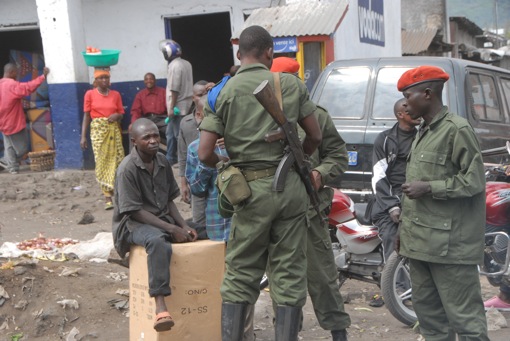
Soldiers in Goma, Congo. Photo: Andre Vltchek.
I am wondering what that means? The regular Congolese army is supposed to be fighting the Rwanda-backed M23. So what are they doing here? At least in theory, shouldn't they be immediately returned to DR Congo, or treated as deserters? After all, everybody now agrees that the ravishment of East Kivu, right across the border, could amount to genocide. And these well-nourished men in uniforms, are supposed to be defending their women, children and men, instead of getting sanatorium treatment in Uganda.
But it is obvious that Congolese soldiers in East Kivu are not encouraged to stay in their country, and fight pro-Rwandan and therefore pro-Western militias.
As I mentioned, the cyberspace is constantly fed by the reports from major Western press agencies, but I appear to be the only foreigner around, with professional still and video equipment. And I am here in order to put the final touches, to my documentary film, not for some mass media-related assignment. There are obviously no uncomfortable questions being asked. Authorities are alert but generally at ease, they show no fear. They don't shoot at me; they don't try to arrest me this time. They just shoe me away as if I was some annoying fly. But I am persistently making my rounds, shuttling between the border from which I now clearly hear fighting, to the camp, IRC post and the airstrip where a Russian piloted UN MI-8 helicopter parks, ready for immediate departure.
"The UN is shuttling one Ugandan minister between Kampala and Kisoro", I am told by an onlooker, in a whisper.
"Minister of what?", I ask cautiously, but nobody knows. And I have no way of verifying. Uganda is a country of rumors.
I park the car and enter Nyakabande refugee camp, the one at the outskirts of Kisoro. I immediately begin working, knowing the risk, and realizing that every second counts. It takes just a couple of minutes, and a security guard intercepts me.

Nyakabande Refugee Camp, Kisoro, Uganda. Photo: Andre Vltchek.
Soon I am facing the head of the camp, a thoroughly arrogant individual, with a spiteful way of talking. He refers to me as "darling", despite my beard. I confront him; demanding to be allowed to film and take photographs. Several of my official IDs are rejected without any closer scrutiny. He is demanding for some 'special permits' from Kampala, which is around 500 kilometers away. I demand that he backs up and let me film, photograph and talk to the refugees. He laughs at me. He feels so certain of himself, that he shouts in my face that he will not identify himself, and will not give his name. When I insist, he calls the armed forces and orders them to throw me out of the camp. In DR Congo I would be lucky to survive such a confrontation.
"He is Rwandese", somebody whispers in my ear as I am climbing into the vehicle.
"What?" I scream. I really do.
"His name and the way he speaks. Maybe he grew up here, in Uganda, but he speaks like Rwandese."
Rumors again?
I am trying to make the story simple. Not really simple, because there is no way to do it, but just a bit simpler.
The other day I was speaking to the co-producer and the editor of our huge 150-minute documentary film "Rwandan Gambit". We discussed the complexity of the Great Lakes story. I have made films and written books on the Indonesian genocide of 1965/66, on the entire system of neo-colonialism in Oceania, on Chile and many other places. But nowhere else is the story is so complex and so blurred; nowhere else, I feel that I have to begin from zero.
What does the West know? What do the people in New York, London, Paris or Sydney imagine when one utters the names Rwanda, Burundi, Uganda or DR Congo separately or in one single breathe? And I am talking about the educated people, not the crowd that gets the news from the network television stations.
Chances are they saw "Hotel Rwanda": a film about the 1994 genocide in Rwanda. About how Hutus suddenly went bananas, and began massacring innocent Tutsis. And how one good, heroic man – (in real life, his name is Paul Rusesabagina, and the hotel in Kigali is named Mille Collines) – saved hundreds of innocent lives.
A few months ago, I went back to Mille Collinesfor a cup of coffee, and had a chat with the headwaiter. Of course he had no clue that my editor spoke to Paul Rusesabagina and found out, that he was forced to leave Rwanda. "Do you know where Mr. Rusesabagina is?" I asked naively. "In South Africa", came the reply. "Why do you ask?" "Just being curious", I said.
So, how do I summarize what I found, during those three years of intensive work on the film on Rwanda and Congo?
First of all, all four countries involved: Rwanda, Burundi, DR Congo and Uganda have been suffering from the worst cases of colonialism and neo-colonialism. To begin with, Congo (then Zaire) had Patrice Lumumba, one of the greatest African leaders, assassinated by the West.
Emira Woods, Co-Director of Foreign Policy In Focus, explained in the film: "You had this liberation fighter Patrice Lumumba, who came to power as a leader of a unionist movement, a visionary who wanted to have the resources of the continent, as well as the country, serve the interest of the continent; to feed the children of the continent. And he was assassinated at the hands of the US and the UK – two key geopolitical actors, who wanted to deny the right of the Congo to truly seek its own destiny, to have a future determined by its own people."
When the President of Rwanda – Paul Kagame – was living in exile in Uganda, he became a close friend of the now Ugandan President, Yoweri Museveni. They even went to the same high school together – in Mbarara. Eventually Kagame became the head of Ugandan military intelligence, and his RPF had been funded by the Western sources through the Ugandan channels, as was confirmed to us by the former US Ambassador to Rwanda – Robert Flaten.
In that period of time, one prominent Ugandan businessman who wants to remain anonymous for now at least, told me: "In Uganda, Paul Kagame is known as Pilato(after Pontius Pilate). He was the most sadistic killer and torturer, when he was the head of the Military Intelligence of Uganda."
One of the many victims (in Uganda)who were under the supervision of Paul Kagame, declared to me in an interview, in Kampala on August 27, 2012: "I was electrocuted through my testicles as I was tied. Interrogators were using the so called kandoya. The kandoya involved tying forcefully, both of my hands behind my back, thus forcing my chest to widen, and in the process causing internal bleeding. After that I was again tied in a way that made me swing like a pendulum, and that is when electric torture was applied again. All this took place in Katabi Military Barracks in Entebbe, in 1987, when Paul Kagame was in charge. I spotted him on several occasions in the background. Most of the interrogators were Rwandese."
The dreadful human rights record of Paul Kagame naturally did not deter the US and its allies from supporting Kagame and the RPF, as it did not deter the West from supporting other sadistic murderers in Indonesia, the Arab world, El Salvador, Argentina, Chile, South Africa and elsewhere.
By the beginning of the 1990's, the RPF had been penetrating Rwandan territory from Uganda for years, killing civilians and forcing hundreds of thousands of refugees to flee their homes. There were already hundreds of thousands of refugees from Burundi – mainly Hutu – living in Rwanda, most of them arriving after the bloody and near-genocidal crackdown, of the Burundian Tutsi elites against Hutus.Two months ago, I ventured to Kirundo Province of Burundi, together with an interpreter, and the villagers recalled vividly and on the record (for my film) the horrors of 1979 exodus from their country. "The situation inside Burundi was so dreadful, that Hutus would not even want to bury their dead in their own country. They were carrying them across the border to Rwanda."
In their books, Andrew Wallis (Silent accomplice), Barbara F. Walter, and Jack L. Snyder (Civil Wars, Insecurity, and Intervention) argue:
In 1990, the Rwandan Patriotic Front, a rebel group composed mostly of Tutsi refugees, invaded northern Rwanda from Uganda in an attempt to defeat the Hutu-led government. They began the Rwandan Civil War, fought between the Hutu regime, with support from Francophone Africa and France… and the RPF, with support from Uganda. This exacerbated ethnic tensions in the country. In response, many Hutu gravitated toward the Hutu Power ideology, with the prompting of state-controlled and independent Rwandan media.
The racist rhetoric and agitation had been mounting across the country. The leitmotif was that, Tutsi were enslaving Hutu and had to be resisted at all cost.
The IMF was not idle either. It did its best to destabilize Rwanda, impoverished it and devalued its currency.
In his penetrating analysis of the economic and social causes behind the Rwandan holocaust, Michel Chossudovsky, a Canadian economist and a professor of economics (emeritus) at the University of Ottawa,focused his attention on how the structural adjustment policies of the IMF and the World Bank contributed to the disaster in the Great Lakes Region:
To lay the blame solely on deep-seated tribal hatred not only exonerates the great powers and the donors, it also distorts an exceedingly complex process of economic, social and political disintegration affecting an entire nation of more than seven million people… Rwanda, however, is but one among many countries in sub-Saharan Africa (not to mention recent developments in Burundi where famine and ethnic massacres are rampant) which are facing a similar predicament. And in many respects the Rwandan 1990 devaluation appears almost as a 'laboratory test case' as well as a threatening 'danger signal' for the devaluation of the CFA franc implemented on the instructions of the IMF and the French Treasury in January 1994 by the same amount, 50%.
And in the report prepared for the defense team at ICTR on June 2002, German analyst UweFrieseckewent even further byarguing that:
Western powers, most prominently the Anglo-American powers with the Francophone powers acting as competing junior partners, have caused the crises in the Great Lakes region of Africa during the 1980s and 1990s in a twofold manner and are therefore responsible for the human catastrophe that followed. First, they ruined the region like the rest of the continent through the International Monetary Fund's (IMF's) structural adjustment policy economically. Secondly, they intervened with cover operations to manipulate simmering conflicts for the purpose of political controle. The combination of both led to the disaster in Rwanda in 1994.
In 1994 the country was in total disarray, hit by misery, by RPF dashes across the border and by mounting refuges crises.
And then, on April 6, 1994, the airplane carrying the Rwandan President Juvénal Habyarimana and Cyprien Ntaryamira, the Hutu president of Burundi, was shot down on its final approachto Kigali airport, its debris scattering all over the backyard of Habyarimana's mansion, killing everyone on board, including the French crew.The country erupted.
The Hutu militia groups, including the notorious Interahamwe, began massacring members of Tutsi minority, including women and children. In just 100 days, between 500,000 and 1 million people died, although it is uncertain what the exact demographics of the victims were, as by then the RPF was already on Rwandan territory, and according to many experts, deeply involved in the slaughter as well, as it was marching towards the capital city of Kigali.
The 100 days of genocidal terror are very well documented, although some are arguing that it is partial and one-sided.
The essential question remains – "Who downed the plane with two Presidents"? – As this was clearly the trigger to the consequent events.
In my film, I worked closely with the Australian attorney Michael Hourigan, the former ICTR investigator, who clearly indicated that he was approached bymtrustworthy sources close to Kagame's regime. They were scared but determined to tell the truth. It was the RPF that downed the plane. Then, Hourigan was summoned to The Hague, and his testimony was disputed and eventually he was forced to resign, as he believes, because of the pressure from some of the Western powers.
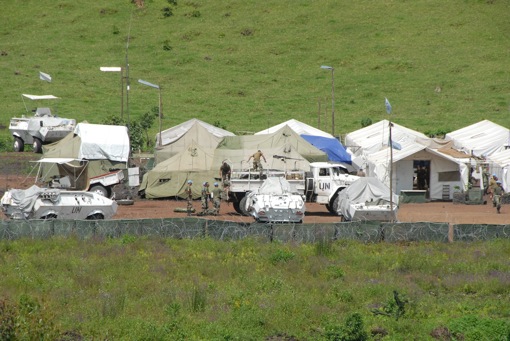
United Nations forces in Goma. Photo: Andre Vltchek.
Until now, not one RPF official or soldier has stood trial at the ICTR (International Criminal Tribunal for Rwanda) in Arusha, Tanzania. The tribunal is one-sided, dealing exclusively with the crimes committed by Hutu against Tutsi.
During the 1994 Rwandan Genocide, between 500,000 and 1 million people lost their lives, in the neighboring DR Congo the number of victims fluctuates between 6 and 10 million, between 1996 and now, depending on the sources.
People are literally murdered over Coltan, Uranium, Gold, Diamonds, and other strategic and precious minerals and gems.
Both Rwanda and Uganda – key Western allies – have been involved. After the Rwandan genocide, President Paul Kagame and the RPF found a very good excuse to penetrate neighboring DRCongo – there were Hutu genocide cadres hiding among the refugees, and the new Rwandan government, had the moral mandate, to pursue them across the border.
Althoughthe RPF was involved in some gruesome reprisal massacres, including the 1995 Kibeho Massacre of thousands, possibly tens of thousands of mainly Hutu refugees (in my film I use one powerful testimony of Terry Pickard – Australian military medic who in 1995 witnessed the carnage) –the real horror was reserved for Congo.
Both Rwandan and Ugandan forces have been plundering this enormous and rich (in terms of natural resources) part of Africa, staging military coups and supporting/aiding some of the most appalling militias in the world, including forces of former Congolese Tutsi army General – Laurent Nkunda – who later became one of the most brutal warlords in Africa, as well as the notorious militiaM23, led by General Bosco Ntaganda, former commander of the CNDP and the FARDC.
Pro-Rwandan and pro-Ugandan proxy militias have been periodically clashing, sometimes changing allegiances, or even going on their own. The mass slaughter of civilians, was regularly accompanied by mass rape, like that in the city of Bukavu.
The West and particularly the US and UK, have been firmly supportive of the regimes in both Rwanda and Uganda.
In my film, several personalities ranging from the former Congolese Presidential candidate Ben Kalala, to one of the leading African affairs analyst from Ghana, NiiAkuetteh, as well as Prof. Masako Yonekawa, former UNHCR Head of Field Office in Goma, confirmed that the Western governments and companies have great economic interests in DR Congo. And that both Rwanda and Uganda, have been utilized in plundering the neighboring country on their behalf.
While the Western mass media has on most occasions remained 'disciplined', and silent about the background of the conflict in DR Congo, the UN has managed to publish two damning reports. The first one was called "UN Mapping Report" published by HCHR in June 2010. Amongst other things it boldly states:
The intention to destroy a group in part is sufficient to constitute a crime of genocide and the international courts have confirmed that the destruction of a group can be limited to a particular geographical area.28 It is therefore possible to assert that, even if only a part of the Hutu population in Zaire was targeted and destroyed, it could nonetheless constitute a crime of genocide if this was the intention of the perpetrators. Several incidents listed in this report point to circumstances and facts from which a court could infer the intention to destroy the Hutu ethnic group in the DRC in part, if these were established beyond all reasonable doubt.
The scale of the crimes and the large number of victims, probably several tens of thousands, all nationalities combined, are illustrated by the numerous incidents listed in the report (104 in all). The extensive use of edged weapons (primarily hammers) and the systematic massacres of survivors after the camps had been taken show that the numerous deaths cannot be attributed to the hazards of war or seen as equating to collateral damage.30 The majority of the victims were children, women, elderly people and the sick, who were often undernourished and posed no threat to the attacking forces.31 Numerous serious attacks on the physical or mental integrity of members of the group were also committed, with a very high number of Hutus shot, raped, burnt or beaten.
The second, the most recent report released in June 2012, is called "Addendum to the interim report of the Group of Experts on the Democratic Republic of the Congo (S/2012/348)" concerning violations of the arms embargo and sanctions regime by the Government of Rwanda. It reads:
Since the outset of its current mandate, the Group has gathered evidence of arms embargo and sanctions regime violations committed by the Rwandan Government. These violations consist of the provision of material and financial support to armed groups operating in the eastern Democratic Republic of the Congo, including the recently established M23, in contravention of paragraph 1 of Security Council resolution 1807 (2008).
The arms embargo and sanctions regimes violations include the following:
• Direct assistance in the creation of M23 through the transport of weapons and soldiers through Rwandan territory
• Recruitment of Rwandan youth and demobilized ex-combatants as well as Congolese refugees for M23
• Provision of weapons and ammunition to M23
• Mobilization and lobbying of Congolese political and financial leaders for the benefit of M23
• Direct Rwandan Defence Forces (RDF) interventions into Congolese territory to reinforce M23
• Support to several other armed groups as well as Forces armées de la Républiquedémocratique du Congo (FARDC) mutinies in the eastern Congo
• Violation of the assets freeze and travel ban through supporting sanctioned individuals.
This latest report hit so hard, that even the closes allies of Rwanda – the US and UK – felt obliged to issue warnings and threats, that the military aid could be withdrawn from Kigali.
I took my last trip to Rwanda in July 2012. The atmosphere in the country did not feel good. All types of military groups were controlling Kigali, from the notorious Presidential Guards to the regular military, police and all sorts of paramilitary guards.
I had to collect the latest footage for my film, and I was once again ready to risk everything, and once again traveling to the extremes of the country. It helped that my driver (I used to drive my own car from Nairobi, Kenya, but such an approach was becoming increasingly dangerous) was Tutsi, but it helped only to some extent.
The fear could be felt everywhere. The street near my hotel was blocked by heavy barricades. It was one of the access roads to the Presidential mansion. There were metal detector checks, even into the Genocide Memorial in Kigali.
I saw potential recruits for the Congolese M23, near the Rwandan city of Musanze, in deep discussion with uniformed Rwandan soldiers.
I was arrested in Goma, right at the old border crossing. Of course I filmed and the Congolese guard spotted me – he emerged, enormous like a mountain – grabbing my hand and pulling me back to his country for interrogation. That prospect truly terrified me, having spent endless hours in the bunker, of Congolese intelligence two years earlier, when all my possessions gradually began to disappear into the deep pockets of my interrogators. Only my numerous ID's, most likely saved me from the worst.
I shouted to the Rwandese soldiers, who came – two of them – grabbed my other arm and began pulling me towards Rwanda, obviously eager to avoid an international scandal.
I immediately instructed my driver to approach the second border. We crossed, illegally, as I was filming, going back and forth.
The insanity of the last days of filming…
There was a refugee camp near Gisenyi, just a few months ago empty, now overflowing with the refugees. There were UNHCR insignias on the tents; there were UNHCR trucks, as well as countless aggressive guards. There were thousands of 'repatriated' Rwandan refugees and the refugees escaping from the fighting in Kivu.
What I had observed in Uganda, Rwanda and DR Congo, the population of this part of Africa was once again on the move.
Rwanda, the Prussian-style militaristic client state of the West was in a dismal condition – skyscrapers and clean streets in the center of the capital, but absolute misery off the main roads in the countryside, with the electrification in single digit –in a stark contrast to what the politicians like Tony Blair (one advisors to Paul Kagame), want the world to believe.
There was discontent, oppression and fear in all corners of the nation. Grenades were going off, the main opposition leader Victoire Ingabire had, had her head shaved and was in prison. Kagame was acting increasingly like some manic mass murder, striking at the dissent, and even at his former cohorts, with increasing desperation.
"Kagame believes that it is ok to kill anybody he dislikes. He kills Hutus, he kills Tutsis, and there are all those crimes that are piling upon him. He seems not to care. I think he has reached the point of no return…", Dr. Theogene Rudesingwa explained on my film , a former Chief of Staff of RPF and Ambassador to the US in 1995-1999, and in the past, one of the closest allies of Paul Kagame.
Another member of what used to be known as the "Gang of Four" in the RPF hierarchy, Dr. Gerald Gashima (former Prosecutor General in 1999-2003), talks on the film about disappearances and extra judicial killings, claiming, that now Kagame is "above the law; in Rwanda he is what is law…"
The accusations are mounting, but there seems to be no determined pressure from the West to call for free elections (RPF keeps winning elections by either liquidating or intimidating the opposition members), let alone to stop the genocide in DR Congo.
It took around 3 years to make the film – "Rwandan Gambit". I had to risk my life repeatedly, driving all over the country, filming despite clear restrictions and prohibitions.
I had to talk to hundreds of people on five continents. My editor and I could hardly count on any substantial financial support. The film proved to be a monster, and a financially ruinous one. It has exhausted me financially, emotionally and intellectually.
We were addressing, unveiling the roots of the worst genocide since the WWII; presenting it to the public all over the world that, had almost no knowledge about the occurrences in the Great Lake region.
We felt under pressure to finish the film and to finish it as soon as possible.
"6 million people! " shouted Congolese Presidential candidate, Ben Kalala, to our camera. "6 million innocent men, women and children. What is the world waiting for?"
Some now say 10 million. It is an unimaginable number. I covered Chile, and the horrors of the Pinochet era. There, 3-4 thousand people died. In Indonesia, during the US-sponsored military coup of 1965, between 800.000 and 3 million people vanished. The Great Lakes genocide was the worst topic I have ever had to cover, and the most complex, too.
One had to look at the colonialism and then move to the Cold War, one had to revisit the IMF practices and then the direct support of the West to potentially murderous but loyal regimes. One had to study the circumstances of the assassination of Lumumba and then to understand how, a few decades later, Paul Kagame was brought to power.
And now the film is finished. But the slaughter in Congo goes on. I only hope that our work of three years could trigger an outcry, and help to stop the genocide.
Andre Vltchek is a novelist, filmmaker and investigative journalist. He covered wars and conflicts in dozens of countries. His book on Western imperialism in the South Pacific – Oceania – is published by Lulu . His provocative book about post-Suharto Indonesia and market-fundamentalist model is called "Indonesia – The Archipelago of Fear" and will be released by Pluto Publishing House in August 2012. After living for many years in Latin America and Oceania, Vltchek presently resides and works in East Asia and Africa. He can be reached through his website.

Comments
Post a Comment