
Response to Crisis in East Should Emphasize Justice
 Email
Email- Congolese government soldiers patrol the streets of Minova under their control on November 25, 2012.© 2012 AP Images
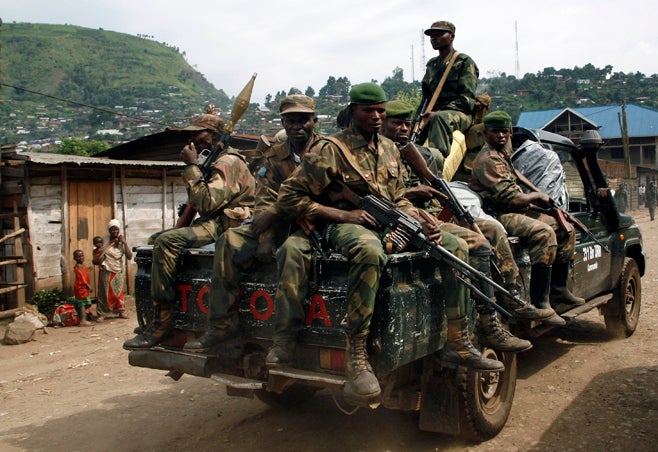
The killings and rape by M23 and government forces around Goma were fueled by an environment in which horrific abuses are rarely punished. The UN and others involved in talks should send a strong message to rebel leaders and Congolese army commanders that they will not be rewarded for their atrocities.
(Goma) – M23 rebels and Congolese army soldiers raped scores of women and committed other war crimes during the rebels' occupation of Goma in easternDemocratic Republic of Congo in late 2012.
Ongoing talks among parties to the conflict, countries in the region, and the United Nations should ensure that any agreements include holding those responsible for war crimes to account and that rebel commanders with abusive records do not serve in the Congolese army, Human Rights Watch said.
"The killings and rape by M23 and government forces around Goma were fueled by an environment in which horrific abuses are rarely punished," said Daniel Bekele, Africa director at Human Rights Watch. "The UN and others involved in talks should send a strong message to rebel leaders and Congolese army commanders that they will not be rewarded for their atrocities."
In the two months since the M23 occupied Goma in late November, Human Rights Watch interviewed more than 180 victims and witnesses of abuses, family members of victims, health workers, civil society leaders, and others who provided detailed information on alleged war crimes committed by M23 fighters and Congolese army soldiers.
The M23 rebel group, named after a March 23, 2009 peaceagreement, took control of Goma on November 20. After entering the city, their leaders publicly declared that their movement was disciplined. Yet beyond the center of town, the M23 spread terror through deliberate attacks on civilians and threats against those who spoke out against them.
After the M23 occupied Goma, soldiers from several Congolese army units based nearby retreated to Minova, a town 50 kilometers away. Over the next 10 days, they went on a raping and looting rampage in Minova and neighboring communities.
The M23 officially withdrew from Goma on December 1, after the Congolese government agreed to negotiate with them. Talks began in Kampala, Uganda, on December 9, but have made little progress.
African countries and the UN are holding parallel discussions about the conflict. These include a proposal to deploy an African-led "intervention brigade" to operate within the UN peacekeeping force in Congo, MONUSCO. The brigade's mandate would be to robustly enforce peace, prevent the expansion of armed groups, neutralize the threat posed by these groups, and disarm them.
Ongoing talks among parties to the conflict, countries in the region, and the United Nations should ensure that any agreements include holding those responsible for war crimes to account and that rebel commanders with abusive records do not serve in the Congolese army, Human Rights Watch said.
"The killings and rape by M23 and government forces around Goma were fueled by an environment in which horrific abuses are rarely punished," said Daniel Bekele, Africa director at Human Rights Watch. "The UN and others involved in talks should send a strong message to rebel leaders and Congolese army commanders that they will not be rewarded for their atrocities."
In the two months since the M23 occupied Goma in late November, Human Rights Watch interviewed more than 180 victims and witnesses of abuses, family members of victims, health workers, civil society leaders, and others who provided detailed information on alleged war crimes committed by M23 fighters and Congolese army soldiers.
The M23 rebel group, named after a March 23, 2009 peaceagreement, took control of Goma on November 20. After entering the city, their leaders publicly declared that their movement was disciplined. Yet beyond the center of town, the M23 spread terror through deliberate attacks on civilians and threats against those who spoke out against them.
After the M23 occupied Goma, soldiers from several Congolese army units based nearby retreated to Minova, a town 50 kilometers away. Over the next 10 days, they went on a raping and looting rampage in Minova and neighboring communities.
The M23 officially withdrew from Goma on December 1, after the Congolese government agreed to negotiate with them. Talks began in Kampala, Uganda, on December 9, but have made little progress.
African countries and the UN are holding parallel discussions about the conflict. These include a proposal to deploy an African-led "intervention brigade" to operate within the UN peacekeeping force in Congo, MONUSCO. The brigade's mandate would be to robustly enforce peace, prevent the expansion of armed groups, neutralize the threat posed by these groups, and disarm them.
The intervention brigade should have a clear mandate to arrest people wanted on international warrants for war crimes and crimes against humanity, and assist Congolese authorities in the enforcement of national arrest warrants, to bring them to justice, Human Rights Watch said.
M23 Abuses During the Occupation of Goma
Human Rights Watch has documented at least 24 cases of summary executions by M23 fighters during the M23's occupation of Goma and nearby areas, between November 19 and December 2. All but three of the victims were civilians. Human Rights Watch research found that M23 rebels raped at least 36 women and girls in and around Goma during the same period, including at least 18 wives of army soldiers and a 10-year-old girl, who died from her wounds a day later. The M23 forcibly recruited army soldiers and medical officers, police, and civilians into its ranks in violation of the laws of war, and took them to its military bases for "retraining." They also looted hundreds of homes, offices, and vehicles.
M23 Abuses During the Occupation of Goma
Human Rights Watch has documented at least 24 cases of summary executions by M23 fighters during the M23's occupation of Goma and nearby areas, between November 19 and December 2. All but three of the victims were civilians. Human Rights Watch research found that M23 rebels raped at least 36 women and girls in and around Goma during the same period, including at least 18 wives of army soldiers and a 10-year-old girl, who died from her wounds a day later. The M23 forcibly recruited army soldiers and medical officers, police, and civilians into its ranks in violation of the laws of war, and took them to its military bases for "retraining." They also looted hundreds of homes, offices, and vehicles.
The M23 fighters targeted government and judicial officials, Congolese army officers and their families, human rights activists and civil society leaders, people who resisted looting or forced recruitment into the M23, alleged common criminals, and suspected members of groups such as the Mai Mai militia that are perceived to oppose the M23.
For instance, on November 19, during the M23's advance toward Goma, M23 fighters in Nyiragongo, just outside of Goma, asked residents where they could find a local civil society leader who had made numerous declarations denouncing the M23's abuses. When they did not find him, they shot and killed his colleague instead. In a separate incident, they shot dead a 4-year-old girl when she asked M23 fighters where they were taking her father.
On November 20, M23 fighters abducted an ethnic Hunde mechanic, 23, in the Ndosho neighborhood of Goma. After checking his electoral card, used as identification in Congo, they accused him of being a Mai Mai combatant, which he denied. The M23 ignored his friends' pleas for his release and marched him to their position on a hilltop. The next day, his family found his body on the hill, along with four other corpses. They told Human Rights Watch the M23 had tried to put military pants on him, on top of the jeans he was wearing, apparently to make him look like a combatant. But the pants did not fit him so his jeans were still visible.
"They had stabbed him three times in the neck and sliced him across the stomach," one of his relatives told Human Rights Watch. "The M23 said they were going to free us, but instead they came to kill us. What kind of liberation is that?"
The night after they officially withdrew from Goma, on December 1 and 2, the M23 attacked a camp for displaced people just outside Goma. They raped at least 13 women living in the camp and looted dozens of huts, victims and other camp residents told Human Rights Watch. They also abducted over a dozen young men and forced them to transport looted goods out of the camp.
Under an agreement between regional leaders in late November, the M23 was supposed to withdraw to a distance of 20 kilometers from Goma. However, it has retained a position less than 5 kilometers away, and local residents reported as recently as January that they had seen known M23 members infiltrated in Goma wearing Congolese military or police uniforms, or civilian clothes.
Since the start of the M23 rebellion in April 2012, M23 fighters have been responsible for deliberate attackson civilians, summary executions, rapes, and forced recruitment of children. One of the M23's top leaders is Gen. Bosco Ntaganda, sought on arrest warrants from the International Criminal Court for war crimes and crimes against humanity in Ituri, northeastern Congo, 10 years ago. Ntaganda and other senior M23 commanders areresponsible for some of the worst atrocities in eastern Congo over the past two decades, as they moved from one armed group to another. The UN and the United States have imposed sanctions on six senior M23 military leaders, including Ntaganda. By eluding arrest and justice at The Hague, Ntaganda has remained free to be implicated in new crimes, Human Rights Watch said.
In a meeting with Human Rights Watch on February 4, 2013, Gen. Sultani Makenga, one of the M23's leaders, rejected allegations that M23 fighters committed abuses during their occupation of Goma. "You only want to find information against us," Makenga said. "We protected the population. … No one lodged a complaint against us."
Makenga said that two M23 fighters had been arrested and detained for having shot at a civilian in Rutshuru. He also said the M23 has not started investigating alleged abuses committed during its occupation of Goma or disciplined any of its fighters for such abuses.
The M23 has received significant support from the Rwandan military since the group's inception. Rwandan military officials have planned and commanded M23 military operations; supplied weapons, ammunition, uniforms, and other equipment; and recruited hundreds of young men and boys in Rwanda to join the rebellion, according to Human Rights Watch research.
Military support from Rwanda – as in earlier phases of the rebellion – was critical in enabling the rebels to seize control of Goma and to carry out abuses of civilians there. Civilians on both sides of the border described to Human Rights Watch the movement of at least several hundred Rwandan army troops from Rwanda into Congo in the days leading up to and during the M23's advance on Goma. Rwandan troops crossed the border at several locations, including Kasizi, Kabuhanga, and Kanyanja, as well as one of the official border posts between Goma and the Rwandan town of Gisenyi. Rwandan troops were present in Goma during the M23's occupation of the city.
Residents have reported additional troop movements from Rwanda into Congo since the M23 officially withdrew from Goma. For example, on December 11 and 12, Congolese residents in Kasizi and Kanyanja reported seeing 15 trucks carrying Rwandan soldiers crossing the border from Rwanda into Congo.
The UN Security Council has imposed sanctions on several M23 leaders, but it should also sanction Rwandan officials who have been backing them, Human Rights Watch said.
The Rwandan government has repeatedly denied providing support to the M23.
Congolese Army Abuses During Rebels' Advance
Human Rights Watch documented at least 76 cases of rape of women and girls by Congolese army soldiers from November 20 to 30 in the town of Minova and nearby Bwisha, Buganga, Mubimbi, Kishinji, Katolo, Ruchunda, and Kalungu. The victims included women as old as 60 and girls as young as 13. The total number of victims is probably much higher since many women were afraid to report being raped or seek medical assistance.
For instance, on November 19, during the M23's advance toward Goma, M23 fighters in Nyiragongo, just outside of Goma, asked residents where they could find a local civil society leader who had made numerous declarations denouncing the M23's abuses. When they did not find him, they shot and killed his colleague instead. In a separate incident, they shot dead a 4-year-old girl when she asked M23 fighters where they were taking her father.
On November 20, M23 fighters abducted an ethnic Hunde mechanic, 23, in the Ndosho neighborhood of Goma. After checking his electoral card, used as identification in Congo, they accused him of being a Mai Mai combatant, which he denied. The M23 ignored his friends' pleas for his release and marched him to their position on a hilltop. The next day, his family found his body on the hill, along with four other corpses. They told Human Rights Watch the M23 had tried to put military pants on him, on top of the jeans he was wearing, apparently to make him look like a combatant. But the pants did not fit him so his jeans were still visible.
"They had stabbed him three times in the neck and sliced him across the stomach," one of his relatives told Human Rights Watch. "The M23 said they were going to free us, but instead they came to kill us. What kind of liberation is that?"
The night after they officially withdrew from Goma, on December 1 and 2, the M23 attacked a camp for displaced people just outside Goma. They raped at least 13 women living in the camp and looted dozens of huts, victims and other camp residents told Human Rights Watch. They also abducted over a dozen young men and forced them to transport looted goods out of the camp.
Under an agreement between regional leaders in late November, the M23 was supposed to withdraw to a distance of 20 kilometers from Goma. However, it has retained a position less than 5 kilometers away, and local residents reported as recently as January that they had seen known M23 members infiltrated in Goma wearing Congolese military or police uniforms, or civilian clothes.
Since the start of the M23 rebellion in April 2012, M23 fighters have been responsible for deliberate attackson civilians, summary executions, rapes, and forced recruitment of children. One of the M23's top leaders is Gen. Bosco Ntaganda, sought on arrest warrants from the International Criminal Court for war crimes and crimes against humanity in Ituri, northeastern Congo, 10 years ago. Ntaganda and other senior M23 commanders areresponsible for some of the worst atrocities in eastern Congo over the past two decades, as they moved from one armed group to another. The UN and the United States have imposed sanctions on six senior M23 military leaders, including Ntaganda. By eluding arrest and justice at The Hague, Ntaganda has remained free to be implicated in new crimes, Human Rights Watch said.
In a meeting with Human Rights Watch on February 4, 2013, Gen. Sultani Makenga, one of the M23's leaders, rejected allegations that M23 fighters committed abuses during their occupation of Goma. "You only want to find information against us," Makenga said. "We protected the population. … No one lodged a complaint against us."
Makenga said that two M23 fighters had been arrested and detained for having shot at a civilian in Rutshuru. He also said the M23 has not started investigating alleged abuses committed during its occupation of Goma or disciplined any of its fighters for such abuses.
The M23 has received significant support from the Rwandan military since the group's inception. Rwandan military officials have planned and commanded M23 military operations; supplied weapons, ammunition, uniforms, and other equipment; and recruited hundreds of young men and boys in Rwanda to join the rebellion, according to Human Rights Watch research.
Military support from Rwanda – as in earlier phases of the rebellion – was critical in enabling the rebels to seize control of Goma and to carry out abuses of civilians there. Civilians on both sides of the border described to Human Rights Watch the movement of at least several hundred Rwandan army troops from Rwanda into Congo in the days leading up to and during the M23's advance on Goma. Rwandan troops crossed the border at several locations, including Kasizi, Kabuhanga, and Kanyanja, as well as one of the official border posts between Goma and the Rwandan town of Gisenyi. Rwandan troops were present in Goma during the M23's occupation of the city.
Residents have reported additional troop movements from Rwanda into Congo since the M23 officially withdrew from Goma. For example, on December 11 and 12, Congolese residents in Kasizi and Kanyanja reported seeing 15 trucks carrying Rwandan soldiers crossing the border from Rwanda into Congo.
The UN Security Council has imposed sanctions on several M23 leaders, but it should also sanction Rwandan officials who have been backing them, Human Rights Watch said.
The Rwandan government has repeatedly denied providing support to the M23.
Congolese Army Abuses During Rebels' Advance
Human Rights Watch documented at least 76 cases of rape of women and girls by Congolese army soldiers from November 20 to 30 in the town of Minova and nearby Bwisha, Buganga, Mubimbi, Kishinji, Katolo, Ruchunda, and Kalungu. The victims included women as old as 60 and girls as young as 13. The total number of victims is probably much higher since many women were afraid to report being raped or seek medical assistance.
Several women told Human Rights Watch that soldiers in official army uniform forced their way into the women's homes at night, pointed guns at them, and demanded money. The soldiers then threatened to kill the women if they refused to have sex with the soldiers or if they screamed for help. Some of the victims were gang raped in front of their husbands and children by several soldiers operating together.
Other women were raped while fleeing what they thought was the M23's advance from Goma toward Minova. A woman living in a displacement camp in Bweremana, 40 kilometers outside Goma, told Human Rights Watch that on November 22 she and many others in the camp started fleeing. When she got to the village of Ruchunda, she was stopped by Congolese soldiers who had also fled the M23's advance.
"They [the soldiers] took all my belongings and told me to lie on the ground," she said. "They said if I refused the rape, they would kill me. Then they tore off my pagne [dress] and started to rape me. Four of them raped me, one after another. When they finished, they abandoned me there. I was in a lot of pain and did not have the strength to keep walking."
An army soldier killed a 14-year-boy in the village of Bunyago on November 25. The boy was hiding in a friend's house when the soldier shot into the house through the closed front door. The boy was hit by two bullets and died in the hospital.
The military prosecutor in South Kivu province is investigating abuses by soldiers in and around Minova. Eleven soldiers have been arrested so far. Seven were accused of robbery, extortion, violations of military orders, collusion with the enemy, and other offenses. One is also being investigated for an alleged rape on December 24 in Minova. Two soldiers were arrested for the murder of the 14-year-old boy, and two others for the rape of a girl and a woman in Buganga on December 4 and 5. To Human Rights Watch's knowledge, the military prosecutor has not ordered the arrest of any military personnel believed to have been involved in the rapes between November 20 and 30near Minova.
Human Rights Watch called on Congolese authorities to promptly investigate, arrest, and prosecute those responsible for rapes and other serious abuses during this period.
The UN should also investigate which Congolese army units and commanders were responsible for the rapes, and ensure that its peacekeepers do not provide support to these units, in accordance with the UN's Human Rights Due Diligence policy, Human Rights Watch said.
Congolese army commanders responsible for troops committing rapes could face UN Security Council sanctions under Resolution 1807 (2008), which specifies that a travel ban and asset freeze can be applied to "individuals operating in the Democratic Republic of the Congo and committing serious violations of international law involving the targeting of children or women in situations of armed conflict, including killing and maiming, sexual violence, abduction and forced displacement."
Other women were raped while fleeing what they thought was the M23's advance from Goma toward Minova. A woman living in a displacement camp in Bweremana, 40 kilometers outside Goma, told Human Rights Watch that on November 22 she and many others in the camp started fleeing. When she got to the village of Ruchunda, she was stopped by Congolese soldiers who had also fled the M23's advance.
"They [the soldiers] took all my belongings and told me to lie on the ground," she said. "They said if I refused the rape, they would kill me. Then they tore off my pagne [dress] and started to rape me. Four of them raped me, one after another. When they finished, they abandoned me there. I was in a lot of pain and did not have the strength to keep walking."
An army soldier killed a 14-year-boy in the village of Bunyago on November 25. The boy was hiding in a friend's house when the soldier shot into the house through the closed front door. The boy was hit by two bullets and died in the hospital.
The military prosecutor in South Kivu province is investigating abuses by soldiers in and around Minova. Eleven soldiers have been arrested so far. Seven were accused of robbery, extortion, violations of military orders, collusion with the enemy, and other offenses. One is also being investigated for an alleged rape on December 24 in Minova. Two soldiers were arrested for the murder of the 14-year-old boy, and two others for the rape of a girl and a woman in Buganga on December 4 and 5. To Human Rights Watch's knowledge, the military prosecutor has not ordered the arrest of any military personnel believed to have been involved in the rapes between November 20 and 30near Minova.
Human Rights Watch called on Congolese authorities to promptly investigate, arrest, and prosecute those responsible for rapes and other serious abuses during this period.
The UN should also investigate which Congolese army units and commanders were responsible for the rapes, and ensure that its peacekeepers do not provide support to these units, in accordance with the UN's Human Rights Due Diligence policy, Human Rights Watch said.
Congolese army commanders responsible for troops committing rapes could face UN Security Council sanctions under Resolution 1807 (2008), which specifies that a travel ban and asset freeze can be applied to "individuals operating in the Democratic Republic of the Congo and committing serious violations of international law involving the targeting of children or women in situations of armed conflict, including killing and maiming, sexual violence, abduction and forced displacement."
ALSO AVAILABLE IN:
SHARE

Comments
Post a Comment